Wednesday, February 14, 2018

J.W. Bowker Locomotive at the California State Railroad Museum

Virginia & Truckee 2-4-0 #21 J.W. Bowker
Photo by Cliff West

Virginia & Truckee 2-4-0 locomotive #21, the J.W. Bowker, was built by Baldwin in 1875. Named for V&T master mechanic John William Bowker, it was built with a Knowles steam water pump for firefighting and was used as the switcher in Virginia City. It was renamed Mexico in 1876. It was sold in 1896 to the Sierra Nevada Wood & Lumber Company in Hobart Mills, California. It was donated to the Railway & Locomotive Historical Society in June 1937. It was used by Cecil B. DeMille in the 1939 film Union Pacific. Its last run was in June1953 in San Francisco. It has been displayed at the California State Railroad Museum in Sacramento, California, since 1976. It is the only surviving Baldwin 2-4-0 in the United States.

Empire Locomotive at the California State Railroad Museum

Virginia & Truckee 2-6-0 #13 Empire
Photo by Cliff West
Virginia & Truckee 2-6-0 locomotive #13, the Empire, was built by Baldwin in 1873. Ordered due to an upswing in freight traffic requiring a more powerful locomotive than the 4-4-0 American-type, the Empire was delivered in February 1873. By the late 1880s, the traffic surge had abated, and the Empire was held in reserve until it was overhauled and returned to regular freight service for another upswing in 1902. In 1910, it was converted from a wood-burner to an oil-burner, and was renumbered to #15, because superstitious crews thought the number 13 was unlucky. The Empire was retired and stored in 1918, and was sold to the Pacific Portland Cement Company of Gerlach, Nevada, where it became #501 and was used as a switcher until 1931, when it last operated. In 1938 it was donated to the Pacific Coast Chapter of the Locomotive and Railway Historical Society and moved to the San Francisco Bay Area for storage. It was cosmetically restored in 1966 at the Bethlehem Steel Corporation’s San Francisco shipyards. In 1976 it was moved to the new California State Railroad Museum’s Central Pacific Railroad Passenger Station in Sacramento, California, and two years later underwent a complete restoration. It was placed in the California State Railroad Museum’s Railroad History Museum in 1981.

Genoa Locomotive at the California State Railroad Museum

Virginia & Truckee 4-4-0 #12 Genoa
Photo by Cliff West
Virginia & Truckee 4-4-0 locomotive #12, the Genoa, was built by Baldwin in January 1873. The Virginia & Truckee Railroad Company was organized on March 5, 1868, and the 21-mile route between Carson City and Virginia City was completed on January 29, 1870, with an extension connecting Carson City to the Central Pacific Railroad in Reno completed in August 1872. The Genoa pulled passenger, freight and mixed trains on the V&T for nearly 30 years. On December 31, 1908, the Genoa was retired and stored in the Carson City engine house, where it remained until it was sold to the Eastern Railroads Presidents’ Conference in 1939. The Genoa was modified to resemble Central Pacific Railroad #60 Jupiter, one of the locomotives at the driving of the golden spike completing the transcontinental railroad in 1869. It was used in the Railroads on Parade pageant at the 1939-1940 World’s Fair in New York City, and operated at the 1948 Chicago Railroad Fair. It was donated to the Pacific Coast Chapter of the Railway & Locomotive Historical Society, which presented it to the state of California in 1969. For the 100th anniversary of the transcontinental railroad, Genoa It reprised its role as Jupiter for the golden spike reenactment at Promontory Summit in Utah, with Virginia & Truckee #11 Reno playing the part of Union Pacific #119. The Genoa’s last run was at the California State Railroad Museum in Sacramento, California, in May 1979. It was then restored to its 1902 appearance as seen here.

C.P. Huntington Locomotive at the California State Railroad Museum

Southern Pacific 4-2-4T #1 C.P. Huntington
Photo by Cliff West
Southern Pacific 4-2-4T locomotive #1, the C.P. Huntington, is displayed in front of a large window at the California State Railroad Museum in Sacramento, California. It was originally built by Danforth, Cooke & Company of Paterson, New Jersey, in 1863, as the Central Pacific Railroad’s third locomotive, #3, and it arrived in San Francisco on March 19, 1864. It was named for Collis P Huntington, Vice President of the Central Pacific. The locomotive is 29.5 feet long and weighs 21.75 tons. it could pull 4 times its weight. It had a top speed of 35 miles per hour and could maintain a speed of 15 mph on a grade of 26 feet per mile (0.49%). The Central Pacific would have preferred to purchase a larger locomotive, but none were available due to the importance of railroads in the Civil War. The C.P. Huntington was used in the construction of the transcontinental railroad. In 1879 it was transferred to the Southern Pacific Railroad, by then under the same control as the Central Pacific, and became SP #1. It was involved in a head-on collision in 1872 and was rebuilt in 1875 and received a new boiler in 1888. It was renumbered to #1001 in 1891. 

Photo by Cliff West
As Southern Pacific’s oldest locomotive, the C.P. Huntington was displayed at the 1892 California State Fair and the 1894 California Mid-Winter International Exposition before being retired in 1900. It was rebuilt as a weed burner in 1901 but was unsatisfactory. It was rebuilt again in 1910 and used as a shop switcher. It was nearly scrapped in 1914 but was instead restored for display and the 1915 Panama-Pacific International Exposition in San Francisco. It continued to make appearances at special events, and was last run in May 1939 at the opening of the Los Angeles Union Passenger Terminal. In September 1964, the Southern Pacific Railroad donated the locomotive to the state of California and it was placed on display at the old state fairgrounds in Sacramento. It was donated to the Pacific Coast Chapter of the Railway & Locomotive Historical Society in June 1969. In 1970 it was refurbished by Southern Pacific’s Sacramento Shops and in 1979 it was placed in the California State Railroad Museum’s reconstructed Central Pacific Railroad Passenger Station. In 1980 it was restored to its appearance at the 1915 Panama-Pacific International Exposition. It is the only surviving standard-gauge 4-2-4T in the United States.

Gov. Stanford Locomotive at the California State Railroad Museum

On our family’s California vacation, we spent March 15, 1992, exploring the California State Railroad Museum. 

The California State Railroad Museum first opened in 1976 with the reconstructed Central Pacific Railroad Passenger Station, and the Railroad History Museum opened in 1981. Sacramento is a fitting place for the state-operated museum; not only is Sacramento the state capitol, is was also the home of the state’s first railroad in 1856, and was the starting point for the Central Pacific Railroad’s eastward construction of the first transcontinental railroad in 1863.

As I recall, flash photography was not permitted inside the museum, and I don't think my dad brought a flash anyway, so the pictures he took inside the museum did not come out well.

Central Pacific 4-4-0 #1 Gov. Stanford
Photo by Cliff West

Central Pacific 4-4-0 locomotive #1, the Gov. Stanford, was the Central Pacific Railroad’s first locomotive. It is named for California Governor Leland Stanford, the first President of the Central Pacific Railroad. It was built in 1862 by R. Norris of Philadelphia. The 40-ton locomotive arrived in Sacramento on October 7, 1863, and made its first run on November 9, 1863.

Central Pacific 4-4-0 #1 Gov. Stanford
Photo by Cliff West
The locomotive was downgraded to a switcher in 1873, and was probably renumbered to #212 at the same time. It was renumbered to #1174 in 1891. It made its last run in January 1895 and was retired on July 20, 1895. It was refurbished in 1899 and presented to Stanford’s widow Jane Lathrop Stanford, who in turn donated the locomotive to Leland Stanford Junior University, where it was placed on display from March 1899 until 1963. In May 1963, it was loaned to the Pacific Coast Chapter of the Railway & Locomotive Historical Society, whose collection formed the basis for the California State Railroad Museum.

1992 California Trip, Part 2: Dunsmuir, California

After some car repairs, our next stop was the town of Dunsmuir, California. Dunsmuir was a division point on the Central Pacific and later Southern Pacific Railroad, where, in the days of steam, trains changed locomotives and crews at the base of the mountains. Though diesel locomotives reduced the town's importance to the railroad, Dunsmuir still celebrates its railroad history.

Southern Pacific M-6 2-6-0 1727
Photo by Cliff West

Southern Pacific steam locomotive #1727 is on static display at the city park in Dunsmuir.

Southern Pacific M-6 2-6-0 1727
Photo by Cliff West
Southern Pacific #1727 is an M-6 Class 2-6-0 Mogul built by the Baldwin Locomotive Works in September 1901. It was donated to the city of Dunsmuir in June 1957.

Dunsmuir Caboose
Photo by Cliff West
Near the city park is a steel caboose painted to commemorate the Southern Pacific Railroad in Dunsmuir. Despite the paint job, this caboose was never owned or operated by the Southern Pacific. It was built for the Northern Pacific Railway in 1954 as #1068. Later it was renumbered to #10068. After the Northern Pacific Railway was merged into the Burlington Northern Railroad, this caboose became Burlington Northern #11411 and operated into the 1980s.

Monday, February 12, 2018

1992 California Trip, Part 1: Salt Creek Trestle

In March 1992, our family took a vacation to Northern California. I was 11 years old. This vacation seems like a good place to start for a relaunch, even though I may repeat a thing or two that have posted before.

My dad took these pictures at Southern Pacific's Salt Creek Trestle in the Oregon Cascades on March 13, 1992. A forest service road off of Oregon Highway 58 provided access to one end of the Salt Creek Trestle. We didn't have to wait long for a Southern Pacific freight train to approach the trestle.
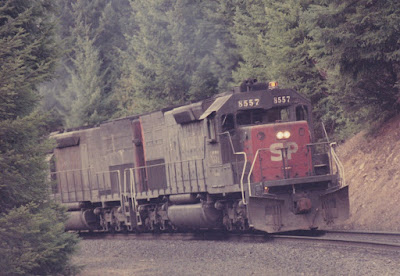
Southern Pacific Freight Train
Photo by Cliff West
The first railway to directly connect Oregon and California was Southern Pacific's line over Siskiyou Summit, which was completed on December 17, 1887, but mountainous route featured sharp curves and grades of up to 3.67%, the steepest on the entire railroad. In the early 1900s, construction started on a new route through the Cascade Range over Pengra Pass, but came to a halt in 1912. Progress on this new Cascade Line, or Natron Cutoff, didn't resume until 1923. The line was completed on September 1, 1926, and opened to through passenger service on April 17, 1927. The new Cascade Line was 25 miles shorter than Siskiyou Line and had a maximum grade of 2.2%, but it was still a demanding route, with 44-miles of continuous grade.

Southern Pacific's Salt Creek Trestle
Photo by Cliff West
Here are the three lead locomotives of the freight train starting across the Salt Creek Trestle. The Salt Creek Trestle carries the Southern Pacific's Cascade Line over Salt Creek and Oregon Highway 58 near Heather, Oregon. It was built in 1924 and was fabricated by the American Bridge Company of New York. The steel trestle is 1200 feet long with individual spans of up to 125 feet.
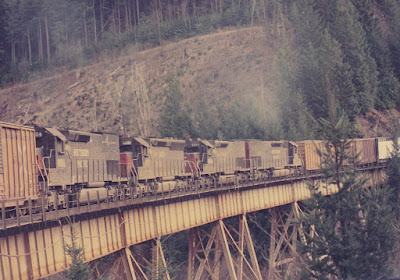
Southern Pacific's Salt Creek Trestle
Photo by Cliff West
In the middle of the freight train were four Southern Pacific helper locomotives. These locomotives are necessary for the train to climb the steep grades and negotiate the tight curves of this mountainous route.

There were no more helpers at the end of the train or even a caboose, just a Flashing Rear End Device, or FRED.

I took pictures myself but ended up misplacing the camera later in the trip. I also intended to keep a journal of the trip but gave up after the first entry. Here is what I wrote (including misspellings and errors):

Today we left on our trip. Hopefully we will make it to Kalamath Falls or Kalama de Flats (Dad's name for Kalamath Falls).

"Train" oh brother, its train time. We found a train and a photo stop. "We got signals, here she comes." Here came the train. I took a picture of the lead SD-40T-2 coming head on. Three SD-40T-2s on the head end. I was resetting my camera when "Oh my god, helpers." Three more SD-40T-2s and a SD-45. I wasn't ready for the lead helper so I got the trailing helper. I got ready for the caboose, but "Where's my bay window?" All that was there was FRED. I took my last picture which was of FRED. "Ok folks, that's a rap."

Later that day the car broke down so we had to spend the night in Oakridge while it was fixed. Also, upon reviewing the pictures, only two of the "SD-40T-2s" were in fact SD40T-2s (the first one and one of the helpers); the others were SD45T-2s.