Thursday, May 14, 2020

Storck Brewery

Storck Brewery on November 19, 2001

The Storck Brewery in Slinger traces its history back to the Benedict Kornburger Brewery of 1868. Lehman Rosenheimer acquired the brewery in 1870. In 1877 Charles Storck and William Hartig acquired it and it became the Storck & Hartig Brewery. Hartig’s name was dropped from the company name in 1884. One of the products produced by the Storck Brewery was Slinger Beer.

Storck Brewery on November 19, 2001

The brewery operated until 1958, surviving prohibition by making ice cream and bootleg beer, and supplied the Milwaukee Brewers stadium during the 1953 Milwaukee brewery strike. The former brewery property is now used by Blaine’s Auto & Truck Parts.

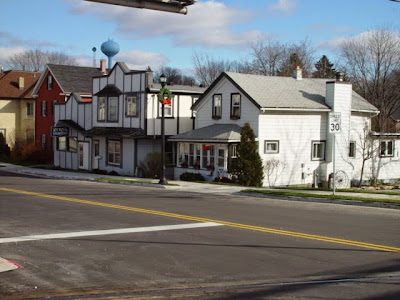
Dick's Ambulance Service

Dick's Ambulance Service in Slinger, Wisconsin, on November 19, 2001
Dick's Ambulance Service on November 19, 2001

Richard Burg established Dick’s Ambulance Service in Slinger, Wisconsin, in 1960, and built this commercial building at 411 Kettle Moraine Drive South in 1969.

Slinger Depot

Slinger Depot on November 19, 2001

The LaCrosse & Milwaukee Railroad was completed to Schleisingerville on August 23, 1855. It was merged into the Milwaukee & St. Paul in 1867, which subsequently merged with the Chicago & Pacific Railroad in 1874 to become the Chicago, Milwaukee & St. Paul Railway (also known as The Milwaukee Road). The Wisconsin Central Railroad reached Schleisingerville in 1882, crossing the Chicago, Milwaukee & St. Paul, but rather than a diamond crossing, the two railroads actually share the same track for a few hundred feet south of the Slinger depot, before separating again and running parallel to each other for several miles. 
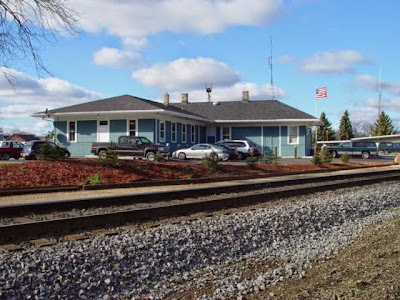

Slinger Depot on November 19, 2001

The Wisconsin Central Railroad was reorganized as the Wisconsin Central Railway in 1897 and was leased in 1909 by the Minneapolis, St. Paul & Sault Ste. Marie Railway, which itself was controlled by the Canadian Pacific Railway. This depot was built by the Chicago, Milwaukee & St. Paul around 1911 and it served both the Chicago, Milwaukee & St. Paul and the Minneapolis, St. Paul & Sault Ste. Marie. The previous depot was moved to become a residence at 121 Storck Street, where it remains today.
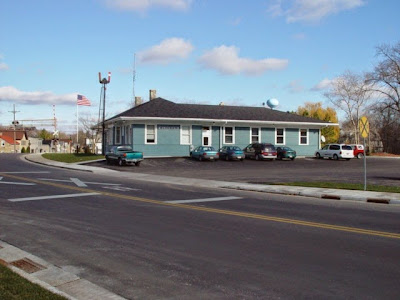
Slinger Depot on November 19, 2001

On September 1, 1944, the Minneapolis, St. Paul & Sault Ste. Marie Railway was reorganized as the Minneapolis, St. Paul & Sault Ste. Marie Railroad. The Wisconsin Central Railroad entered receivership in 1932, declared bankruptcy in 1944, and was reorganized as the Wisconsin Central Railroad Company in 1954. On January 1, 1961, the Minneapolis, St. Paul & Sault Ste. Marie Railroad and the Wisconsin Central Railroad Company were merged with the Duluth, South Shore & Atlantic Railroad to form the Soo Line Railroad. The Chicago, Milwaukee & St. Paul Railway was reorganized in 1928 as the Chicago, Milwaukee, St. Paul & Pacific Railroad, and after declaring bankruptcy in 1977, the line through Slinger was taken over by the new Wisconsin & Southern Railroad in 1980.
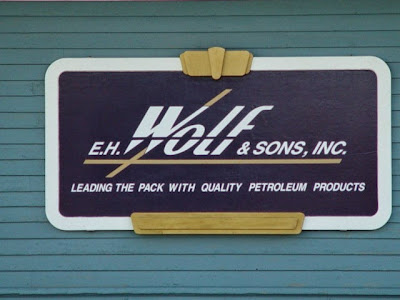
Sign on the Slinger Depot on November 19, 2001

In 1986, the depot was purchased by E.H. Wolf & Sons, Inc. and was restored for use as the company’s new headquarters as it moved from Ackerville to Slinger. It was also relocated slightly to 414 Kettle Moraine Drive South; though it is near its original location, it has been rotated about 90 degrees to face Kettle Moraine Drive South rather than the tracks. On October 11, 1987, the Soo Line spun off the former Wisconsin Central line to the new independent Wisconsin Central, Ltd. Since August 1992, the Wisconsin & Southern has had trackage rights over the Wisconsin Central from Slinger south to Waukesha. The Wisconsin Central was purchased by Canadian National Railway on October 9, 2001.

Slinger, Wisconsin

Slinger, Wisconsin, on November 19, 2001

The town now known as Slinger was founded in 1845 by Baruch Schleisinger Weil, an immigrant merchant who was born in Strasbourg, France on June 29, 1802, and settled here on November 1, 1845, buying two thousand acres of government land and platting the village of Schleisingerville, which was originally part of the town of Polk when the latter was organized on January 21, 1846. Schleisinger operated a general store and later a distillery before moving from the town around 1859-1860. The village of Schleisingerville was incorporated in 1869. Over time, people began to abbreviate the long name of Schleisingerville as Slinger, and on April 5, 1921, the residents of the town voted to officially change the name to Slinger and the name was officially change on May 3, 1921.

Slinger, Wisconsin, on November 19, 2001

Arthur Road Bridge

Arthur Road Bridge on November 19, 2001

This timber stringer bridge carries Arthur Road over the Wisconsin Central Railroad at Cedar Lake in Washington County, Wisconsin, just north of the town of Slinger. The bridge was built in 1936. Its deck is 19 feet wide and it has a total length of 129.9 feet, with its longest span measuring 20.3 feet.

Arthur Road Bridge on November 19, 2001

Tuesday, January 22, 2019

Milwaukee County Zoo

The Milwaukee County Zoo in Milwaukee, Wisconsin, was first established in 1892 as the West Park Zoo in Milwaukee's Washington Park. It was renamed the Washington Park Zoo in 1900 and was expanded to 23 acres in 1902, and was renamed the Milwaukee County Zoological Gardens in 1953. The zoo moved to its current location in 1958, and officially opened to the public on May 13, 1961.

I visited the Milwaukee County Zoo in early September of 2000. At that time, the 200-acre zoo was home to approximately 2,500 animals representing 300 species. Here are just a few of them.

Barren-Ground Caribou (Reindeer) at the Milwaukee County Zoo in Milwaukee, Wisconsin, in September 2000

This is the Caribou Yard with Barren-Ground Caribou, a subspecies of reindeer that are native to the arctic lands of Canada and Alaska. Reindeer are the only members of the deer family in which both males and females have antlers.

Grizzly Bear at the Milwaukee County Zoo in Milwaukee, Wisconsin, in September 2000

This is one of the three Grizzly Bears the zoo had at the time. Grizzly Bears are native to western North America and adults weight about 800 pounds. Their typical diet consists of nuts, berries, fruits, leaves, rodents and fish. The Grizzly Bear can run at speeds up to 30 miles per hour. Mother Grizzly Bears are extremely protective of their cubs.

Peacock at the Milwaukee County Zoo in Milwaukee, Wisconsin, in September 2000

Here is one of the many peacocks that roam freely in the zoo.

Elk at the Milwaukee County Zoo in Milwaukee, Wisconsin, in September 2000

Elk are the second largest member of the deer family in North America, behind the Moose, and are native to the northern United States, Canada, and Alaska.

Polar Bears at the Milwaukee County Zoo in Milwaukee, Wisconsin, in September 2000

The Polar Bears have their own exhibit at the Milwaukee County Zoo, which features an underwater window.

Alaskan Brown Bear at the Milwaukee County Zoo in Milwaukee, Wisconsin, in September 2000

Alaskan Brown Bears are closely related to the Grizzly Bear and to the somewhat-larger Kodiak Brown Bear, which is found only on Kodiak Island off the coast of Alaska.

Wednesday, December 26, 2018

Glacier Park Lodge

Glacier Park Lodge at East Glacier, Montana, on July 24, 1999

The Glacier Park Lodge at East Glacier, Montana, was built in 1913 by the Glacier Park Company, a subsidiary of the Great Northern Railway, and its design was based on the Forestry Building from the 1905 Lewis & Clark Centennial Exposition in Portland, Oregon. This picture was taken from Amtrak's eastbound Empire Builder passenger train on July 24, 1999.