Wednesday, May 20, 2020

Quad/Graphics

Quad/Graphics in Pewaukee, Wisconsin, on November 19, 2001

Quad/Graphics was founded July 13, 1971 by Harry V. Quadracci and his wife Elizabeth. This plant in the Duplainville neighborhood in Pewaukee, Wisconsin, is Quad/Graphics' original location. Originally a 20,171 square foot abandoned mill warehouse that Harry Quadracci purchased at auction, Quad/Graphics started here with 11 employees, a leased press and a loaned binder. Since then it has grown to a 291,097 square foot facility with over 700 employees, and includes an on-site medical clinic, fitness & rehabilitative center, and child care center for employee use.

Quad/Graphics in Sussex, Wisconsin, on November 19, 2001

The Quad/Graphics plant in Sussex, Wisconsin, opened in 1983. The 1.3 million square foot facility employs over 2,900 workers. This plant’s M-64 32-page offset web printing press set a world record in 1996, printing more than 350,000,000 impressions that year.

Quad/Graphics in Sussex, Wisconsin, on November 19, 2001

This facility features a 24-hour child care center, fitness center, sand volleyball courts, softball diamond, and fishing ponds for employee use.

Quad/Graphics in Sussex, Wisconsin, on November 19, 2001

Quad/Graphics became the largest privately-owned printing company in the world and the fifth largest printing company in the United States with 13,000 employees and 22 facilities on three continents.

Quad/Graphics Trailer in Sussex, Wisconsin, on November 19, 2001

The Sussex plant is also the headquarters for Duplainville Transport with over 350 trucks, the company’s distribution subsidiary originally founded in 1973.
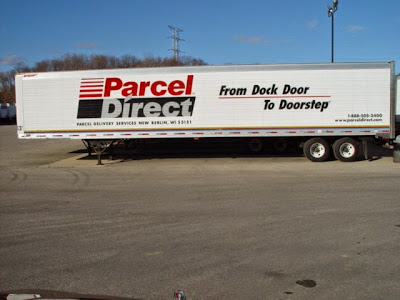
Parcel Direct Trailer in Sussex, Wisconsin, on November 19, 2001

Parcel Direct was founded by Quad/Graphics on September 16, 1998 as a package consolidator and expeditor for catalog and online retailers, picking up and sorting parcels and delivering them to post offices for final delivery. Parcel Direct’s headquarters and main facility was in New Berlin, Wisconsin. Parcel Direct was sold to Federal Express in 2004.

M. Davidson Lime Kiln

M. Davidson Lime Kiln in Sussex, Wisconsin, on November 19, 2001

As many as nine lime kilns were operating in the area of Sussex, Wisconsin, from as early as 1840. The abandoned M. Davidson lime kiln is the only one remaining in Sussex. It was built by the Wisconsin Lime & Stone Company prior to 1891, perhaps as early as 1873. The kiln is approximately 35 feet tall with exterior walls of heavily-mortared limestone. It has two rectangular burning shafts lined with refractory brick and granite with rounded corners for the uninterrupted movement of the hot, sticky pieces of limestone, which was fed from carts into the top of the kiln, accessed by an inclined wooden skid. Firing eyes originally covered by cast iron doors are on the east and west sides, and finished lime was drawn from arched opening at the base of the west side. This kiln operated continuously in all seasons until 1910, when the Chicago & North Western Railway was built on reclaimed quarry land to the north, and the kiln was abandoned.

Chicago & North Western Railway Bridge over the Wisconsin Central in Sussex, Wisconsin, on November 19, 2001

This through plate girder bridge adjacent to the kiln carries the Chicago & North Western Railway line through Sussex over the Wisconsin Central. It is probably not the original bridge from 1910, though it is unclear when it was built. The Chicago & North Western was merged into the Union Pacific on April 24, 1995.

Thursday, May 14, 2020

Storck Brewery

Storck Brewery on November 19, 2001

The Storck Brewery in Slinger traces its history back to the Benedict Kornburger Brewery of 1868. Lehman Rosenheimer acquired the brewery in 1870. In 1877 Charles Storck and William Hartig acquired it and it became the Storck & Hartig Brewery. Hartig’s name was dropped from the company name in 1884. One of the products produced by the Storck Brewery was Slinger Beer.

Storck Brewery on November 19, 2001

The brewery operated until 1958, surviving prohibition by making ice cream and bootleg beer, and supplied the Milwaukee Brewers stadium during the 1953 Milwaukee brewery strike. The former brewery property is now used by Blaine’s Auto & Truck Parts.

Dick's Ambulance Service

Dick's Ambulance Service in Slinger, Wisconsin, on November 19, 2001
Dick's Ambulance Service on November 19, 2001

Richard Burg established Dick’s Ambulance Service in Slinger, Wisconsin, in 1960, and built this commercial building at 411 Kettle Moraine Drive South in 1969.

Slinger Depot

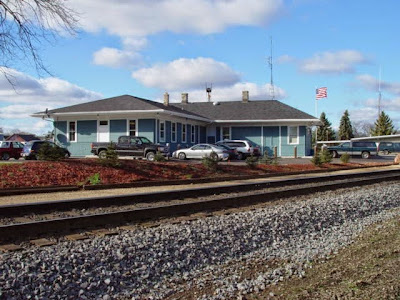
Slinger Depot on November 19, 2001

The LaCrosse & Milwaukee Railroad was completed to Schleisingerville on August 23, 1855. It was merged into the Milwaukee & St. Paul in 1867, which subsequently merged with the Chicago & Pacific Railroad in 1874 to become the Chicago, Milwaukee & St. Paul Railway (also known as The Milwaukee Road). The Wisconsin Central Railroad reached Schleisingerville in 1882, crossing the Chicago, Milwaukee & St. Paul, but rather than a diamond crossing, the two railroads actually share the same track for a few hundred feet south of the Slinger depot, before separating again and running parallel to each other for several miles. 


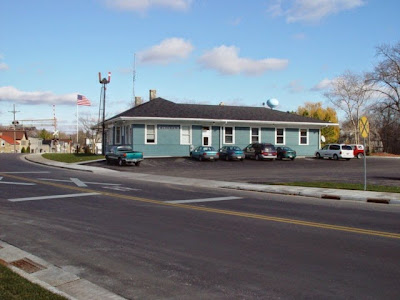
Slinger Depot on November 19, 2001

The Wisconsin Central Railroad was reorganized as the Wisconsin Central Railway in 1897 and was leased in 1909 by the Minneapolis, St. Paul & Sault Ste. Marie Railway, which itself was controlled by the Canadian Pacific Railway. This depot was built by the Chicago, Milwaukee & St. Paul around 1911 and it served both the Chicago, Milwaukee & St. Paul and the Minneapolis, St. Paul & Sault Ste. Marie. The previous depot was moved to become a residence at 121 Storck Street, where it remains today.

Slinger Depot on November 19, 2001

On September 1, 1944, the Minneapolis, St. Paul & Sault Ste. Marie Railway was reorganized as the Minneapolis, St. Paul & Sault Ste. Marie Railroad. The Wisconsin Central Railroad entered receivership in 1932, declared bankruptcy in 1944, and was reorganized as the Wisconsin Central Railroad Company in 1954. On January 1, 1961, the Minneapolis, St. Paul & Sault Ste. Marie Railroad and the Wisconsin Central Railroad Company were merged with the Duluth, South Shore & Atlantic Railroad to form the Soo Line Railroad. The Chicago, Milwaukee & St. Paul Railway was reorganized in 1928 as the Chicago, Milwaukee, St. Paul & Pacific Railroad, and after declaring bankruptcy in 1977, the line through Slinger was taken over by the new Wisconsin & Southern Railroad in 1980.

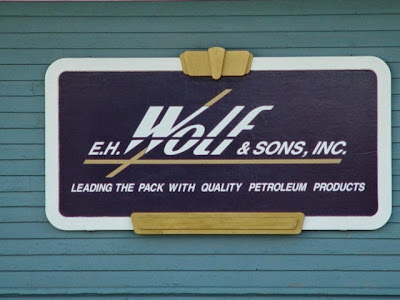
Sign on the Slinger Depot on November 19, 2001

In 1986, the depot was purchased by E.H. Wolf & Sons, Inc. and was restored for use as the company’s new headquarters as it moved from Ackerville to Slinger. It was also relocated slightly to 414 Kettle Moraine Drive South; though it is near its original location, it has been rotated about 90 degrees to face Kettle Moraine Drive South rather than the tracks. On October 11, 1987, the Soo Line spun off the former Wisconsin Central line to the new independent Wisconsin Central, Ltd. Since August 1992, the Wisconsin & Southern has had trackage rights over the Wisconsin Central from Slinger south to Waukesha. The Wisconsin Central was purchased by Canadian National Railway on October 9, 2001.

Slinger, Wisconsin

Slinger, Wisconsin, on November 19, 2001

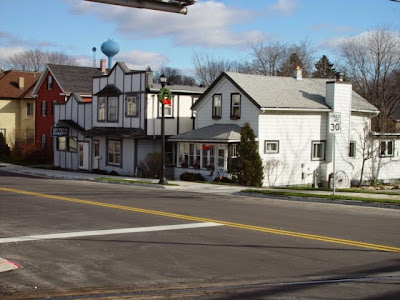
The town now known as Slinger was founded in 1845 by Baruch Schleisinger Weil, an immigrant merchant who was born in Strasbourg, France on June 29, 1802, and settled here on November 1, 1845, buying two thousand acres of government land and platting the village of Schleisingerville, which was originally part of the town of Polk when the latter was organized on January 21, 1846. Schleisinger operated a general store and later a distillery before moving from the town around 1859-1860. The village of Schleisingerville was incorporated in 1869. Over time, people began to abbreviate the long name of Schleisingerville as Slinger, and on April 5, 1921, the residents of the town voted to officially change the name to Slinger and the name was officially change on May 3, 1921.

Slinger, Wisconsin, on November 19, 2001

Arthur Road Bridge

Arthur Road Bridge on November 19, 2001

This timber stringer bridge carries Arthur Road over the Wisconsin Central Railroad at Cedar Lake in Washington County, Wisconsin, just north of the town of Slinger. The bridge was built in 1936. Its deck is 19 feet wide and it has a total length of 129.9 feet, with its longest span measuring 20.3 feet.

Arthur Road Bridge on November 19, 2001