Friday, May 2, 2014

Rainier #6: United Methodist Church

101 C Street East

United Methodist Church in Rainier, Oregon on September 5, 2005
United Methodist Church on September 5, 2005.

The oldest church in Rainier, the United Methodist Church was built in 1905 and was dedicated March 11, 1906. It has been expanded a little since then. A house behind the church is also owned by the church and used as a parsonage.

United Methodist Church in Rainier, Oregon
Historic Photo of the United Methodist Church.
(Michael Clark collection
, used with permission)

IMG_0448 United Methodist Church in Rainier, Oregon on February 24, 2011
United Methodist Church on February 24, 2011.

IMG_0614 United Methodist Church in Rainier, Oregon on February 25, 2011
United Methodist Church, February 25, 2011.

Continue to 7: State Bank of Rainier…

Rainier #5: Ellis Block

102 A Street West

Ellis Block in Rainier, Oregon on September 5, 2005
Ellis Block on September 5, 2005.

This large building was actually built in two parts. The part from the street corner to the entry to the second floor (next to the soda machine) is the oldest part. It was built as the M. Ellis building by contractor W. A. Currie and was completed February 10, 1907. M. Ellis & Company, owned by Michael and Thomas Ellis, dealt in general merchandise.

Rainier, Oregon in the 1920s
A Street in the 1920s, showing the Ellis Block on the right.
(Michael Clark collection, used with permission)

The addition to the west was built by the Lee’s Dock Company for Thomas and Eli N. Ellis from August to December 1922. The addition was originally occupied by the Ellis & Doumitt Grocery (owned by Eli Ellis and N.S. Doumitt) in the east section and the C. Nassar meat market in the west section. Doumitt sold his interest in the grocery business to Eli Ellis that same month to move to Birkenfeld. The Nassar meat market space at the west end of the Ellis Block was later occupied by a bakery. In April 1928, the Post Office leased the former bakery space, and the post office was operating there by May.

William Proctor, Margaret Lucker and William Reid in front of the Post Office in the Ellis Block in Rainier, Oregon
William Proctor, Margaret Lucker & William Reid in front of the Post Office in the Ellis Block.
(Michael Clark collection, used with permission)

Carl Robert Hallberg purchased the E.N. Ellis Grocery in November 1930, and it was renamed Hallberg Market & Grocery on November 10. Hallberg moved to his own building on the highway in November 1934. The space was later occupied by the J & H Feed Store. M. Ellis & Company occupied the original portion of the building until April 30, 1935, when the store closed and the company moved to Bonneville to operate a new store.

Ellis Block in Rainier, Oregon on September 24, 2005
Ellis Block on September 24, 2005.

In October 1937, I. B. Lindeman bought the building from Mrs. George Lewis of Portland. The building was renovated by Ed Haugeberg with a new heating system and four apartments on the second floor. The corner storefront was used by Lindeman as a furniture store. The rest of the first floor remained occupied by the J & H Feed Store and the Post Office at the far west end. The feed store soon vacated to make room for a variety store operated by Lindeman. In April 1943, the furniture store switched places with Lindeman’s dry goods store on the other side of A street, putting the dry goods store with the variety store in the Ellis Building. The stores switched back on August 11, 1945, with Lewis K. Wallin (Lindeman’s son-in-law) taking over the furniture and variety stores. On January 1, 1948, the Post Office moved next door to a wooden building that I. B. Lindeman had recently purchased from Hallberg.

IMG_1859 Ellis Block in Rainier, Oregon on July 13, 2008
Ellis Block on July 13, 2008.

Lewis Wallin died on November 5, 1950 and his widow Dorothy, Lindeman’s daughter, took over the stores. During the summer of 1955, the building was remodeled with the stores switching places, putting the variety store in the corner and the furniture store in the west side. Gene Carpenter did the carpentry and cabinetry work. In late 1955, the building and furniture store were sold to brothers Joe and Bernard Oliva. The Wallin Variety store remained, with a 10-year lease on the space.

IMG_0650 Ellis Block in Rainier, Oregon on February 25, 2011
Ellis Block on February 25, 2011.

Eventually the building along with the Variety Store and Furniture Store were all owned by Joedy and Joyce Oliva, and that is how most remember it. After the closure of the variety and furniture stores, Rainier True Value Hardware moved into the building in the summer of 2002, after rebuilding the storefronts and opening up the first floor between the two "buildings." The original hardwood floors remain though.

Below are some pictures from a 1999 car show in Rainier. In the background the old storefronts of the Ellis Block can be seen.

050-1 1970 Ford Thunderbird in front of the Ellis Block in Rainier, Oregon in 1999
1970 Ford Thunderbird in front of the Ellis Block in 1999.

052-1 1960 Pontiac Catalina in front of the Ellis Block in Rainier, Oregon in 1999
1960 Pontiac Catalina in front of the Ellis Block in 1999.

048-4 1957 Chevrolet in front of the Ellis Block in Rainier, Oregon in 1999
1957 Chevrolet in front of the Ellis Block in 1999.

051-4 1952-53 Chevrolet in front of the Ellis Block in Rainier, Oregon in 1999
1950s Chevrolet Pickup in front of the Ellis Block in 1999.

Continue to 6: United Methodist Church…

Rainier #4: Pharmacy Building

102 A Street East

Pharmacy Building in Rainier, Oregon on September 5, 2005
Pharmacy Building on September 5, 2005.

This building is one of the oldest buildings in Rainier, built around the turn of the century. It is probably best remembered as the Rainier Pharmacy with a lunch counter and soda fountain. The Rainier Pharmacy was the oldest pharmacy in Columbia County, and was originally run by Dr. Alexander P. McLaren. McLaren’s drugstore was originally located in the Dietz Building across A Street, which was destroyed by fire on July 5, 1900. This building was constructed around the same time, and I assume that after the fire Dr. McLaren reopened his drugstore in this building, which may have been built specifically for that purpose. The building originally had two storefronts (reflected in the twin peaks of its roof when viewed from the back), with the pharmacy on the east side.

Rainier, Oregon in the 1920s
A Street in the 1920s, showing the Pharmacy Building as well as the Ellis Block and the Bryant Building.
(Michael Clark collection, used with permission)

In 1916, Joseph McKay took over the pharmacy from Dr. McLaren. In 1920, McKay moved the pharmacy to the west side, occupying the more prominent corner position, to make room for the Post Office to move into the east side in December 1920. In May 1928 the Post Office moved to the Ellis Building. The east storefront eventually became a Northwest Greyhound bus station.

IMG_1858 Pharmacy Building in Rainier, Oregon on July 13, 2008
Pharmacy Building on July 13, 2008.

Glenn T. Coldwell purchased the Rainier Pharmacy from McKay on March 1, 1959. After Northwest Greyhound closed the bus station on February 1, 1961, Coldwell remodeled the building with a single storefront, removing the soda fountain and expanding the Pharmacy to fill the entire first floor by March 1964. Coldwell died in 1979. The pharmacy gave way to a liquor store, and by the mid-1990s the building had become a restaurant, as it remains today. The Cornerstone Restaurant has had several different owners over the years.

IMG_1860 Pharmacy Building in Rainier, Oregon on July 13, 2008
Pharmacy Building on July 13, 2008.

The building has been threatened by fire multiple times. The most recent fire occurred in the apartments upstairs in the late 1990s. The fire spread quickly in the old wood building, but fortunately the Rainier Fire Department was practicing just down the street and were able to respond almost immediately. Still, only one original upstairs window survived the fire: the main window of the bay-window. Some smoke damage from the fire can also still be seen at the top of the front fascia.

IMG_0463 Pharmacy Building in Rainier, Oregon on February 24, 2011
Pharmacy Building on February 24, 2011.
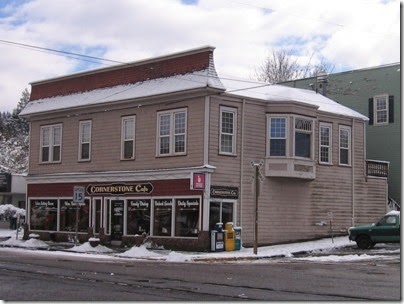
IMG_0648 Pharmacy Building in Rainier, Oregon on February 25, 2011
Pharmacy Building on February 24, 2011.

Notice the railroad tracks running down the middle of the street. The Astoria & Columbia River Railroad opened service through Rainier on May 16, 1898, with an excursion to Portland. Rainier's railroad depot, built in 1899 and expanded several times, used to be next door to this building (the depot was built first). A house behind the depot served as a residence for the station agent. The Astoria & Columbia River Railroad was acquired by the James J. Hill for the Great Northern and Northern Pacific railways on December 19, 1907, and operation continued under the Astoria & Columbia River name until it became the Astoria Division of the Spokane, Portland & Seattle Railway on February 24, 1911. During that time period, there were three passenger trains operated in each direction between Portland and Astoria in the summer months, and two additional trains in each direction between Portland and Rainier. Passenger service operated to Fort Stevens until March 1926. There was also a Saturday afternoon special to Seaside for businessmen and others to join their families at the beach for the weekend and another special to bring them back. On more than one weekend more than 10,000 passengers were handled on the trains. Weekend excursions and the Saturday afternoon beach special continued until 1940. In October 1940, passenger service was cut back from two to one daily train in each direction between Portland and Astoria.

Railroad Depot in Rainier, Oregon, circa 1920
Rainier railroad depot, circa 1920.
(Michael Clark collection, used with permission)

On June 5, 1949, Rainier’s last station agent J. E. Maddox received an order to close the depot effective June 14. The Rainier Commercial Club sent a telegram to Public Utilities Commissioner George Flagg, and the Rainier depot received a 30-day extension. The depot permanently closed on July 14, 1949, ending the sale of tickets, handling of telegrams, and Railway Express Agency service. Mr. and Mrs. Maddox subsequently moved to Portland. Less-than-carload freight could still be consigned to the Rainier depot, with payment made at the Clatskanie depot and a key to the depot kept at the Weiby’s store across the street.
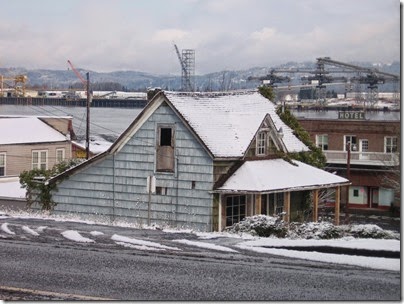
IMG_0423 Station Agent's Residence in Rainier, Oregon on February 24, 2011
Station Agent’s Residence, February 24, 2011.

The last regular passenger train between Portland and Astoria operated on January 15, 1952. On Sunday, January 13, 1952, a 16-car farewell excursion had carried 1,192 passengers.

IMG_1192 Station Agent's Residence in Rainier, Oregon on July 14, 2012
Station Agent’s Residence, July 14, 2012.

Demolition of the Rainier depot began in late November 1957 and was completed in February 1958. When the depot was demolished, the railroad installed a freight locker for less-than-carload freight to be delivered to Rainier, with the key still kept at the Weiby’s store. The former agent’s house behind the depot was reconditioned for use as the section foreman’s residence, replacing a building at Goble which would be demolished to make room for a highway relocation.

IMG_1194 Station Agent's Residence in Rainier, Oregon on July 14, 2012
Station Agent’s Residence, July 14, 2012.

Construction of the U.S. Bank began in September 1977 and it opened on December 15, 1977. In spring of 1978, the former agent’s residence at 112 East Second Street was renovated by Pauline and Daryle Alwine for use as a Mexican restaurant called La Poloma.

IMG_1196 Station Agent's Residence in Rainier, Oregon on July 14, 2012
Station Agent’s Residence, July 14, 2012.

The former U.S. Bank building is now occupied by a branch of the St. Helens Community Federal Credit Union. The former station agent’s residence still stands, but was vacant for many years. A renovation of the house started in 2012 but has progressed slowly and is still in progress in 2014.

IMG_20140208_083209_960  Station Agent's Residence in Rainier, Oregon on February 8, 2014
Station Agent’s Residence, February 8, 2014.

Passenger service briefly returned for the summers of 2003-2005 in honor of the Lewis & Clark Expedition. Here are some pictures of the Lewis & Clark Explorer running down A Street near the end of the final season in 2005.

Lewis & Clark Explorer in Rainier, Oregon on September 24, 2005
Lewis & Clark Explorer in Rainier, September 24, 2005.
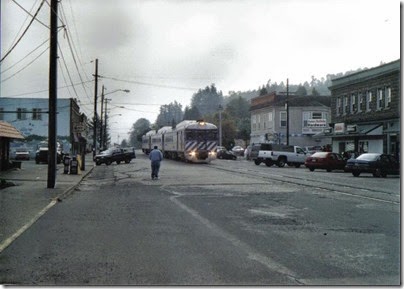
Lewis & Clark Explorer in Rainier, Oregon on September 24, 2005
Lewis & Clark Explorer in Rainier, September 24, 2005.

Lewis & Clark Explorer in Rainier, Oregon on September 24, 2005
Lewis & Clark Explorer in Rainier, September 24, 2005.

Lewis & Clark Explorer in Rainier, Oregon on September 24, 2005
Lewis & Clark Explorer in Rainier, September 24, 2005.

Continue to 5: Ellis Block…

Rainier #3: Masonic Hall

220 C Street East

Masonic Hall in Rainier, Oregon on September 5, 2005
Masonic Hall on September 5, 2005.

Rainier Masonic Lodge #24 A.F. & A.M. (A.F. & A.M. stands for Ancient Free and Accepted Masons) received its charter on July 16, 1858. George F. Moeck was a founding member. The lodge building was built in 1894. Until recently, it was also the home of the Rainier Senior Center. (Note: The website of the Oregon Free Masons lists the address of the Rainier Lodge as 22 East C Street, but this address is wrong. There are no 2 digit addresses on the lettered streets in Rainer. The lodge is in the 200 block of C Street East. I didn't notice an address on the lodge building, but considering the lodge's location, 220 has to be close.)

Continue to 4: Pharmacy Building…

Rainier #2: George Moeck House

713 B Street West

George Moeck House in Rainier, Oregon on September 5, 2005
George Moeck House on September 5, 2005

This house is known by most people as the 1888 House, and it even has the words "1888 House" on it, and an "1888 House" sign in front of it, but officially it is the Moeck House. It was built in 1888, naturally, as the home of George F. Moeck. It was not only a home for Moeck and his wife to raise their six children, but was also a boarding house for sailors. The seven-foot-high stone basement was added under the house around 1909-1911. Moeck once owned most of West Rainier, the area known as Kentucky Flats. Moeck was a founding member of the Rainier Masonic Lodge and was postmaster of the Rainier post office from 1892 to 1897. George Moeck died December 21, 1917, and his wife Margaret died July 10, 1927.

The entire Moeck estate was sold under foreclosure proceedings on January 9, 1928. The house ended up being subdivided into a four-plex in the 1930s. The dormers were added to the roof, interior walls were added, and staircases were sealed off. In 1977, Jim Rouse began restoring the house to its original 14-room floor plan, with restaurants, shops, and an art gallery occupying the various rooms. His plans included a steak restaurant in the basement, and a French restaurant on the main floor. The first store opened in September 1977, and the German-themed Rose Manor restaurant opened in October. The Moeck House was placed on the National Register of Historic Places on April 14, 1978. In the years since it has been home to a variety of restaurants and other businesses.

Continue to 3: Masonic Hall…

Rainier #1: Dibblee House

313 B Street East

Dibblee House in Rainier, Oregon on September 5, 2005
Dibblee House on September 5, 2005.

This is the oldest house in Rainier. It was built in 1851 as an overnight rest stop for travelers on the Columbia River. John Dibblee and his family moved to Rainier in 1869 and lived in this house. John Dibblee died July 12, 1910, but his wife Sarah was still living in the house in 1925. In her History of Rainier, written around 1914, Mrs. Grace Reid notes that the original builder and owner of the house would no longer recognize it, due to the alterations to the house and street improvements. Its depiction on the "Rainier - The River Town" mural shows it looking largely as it does today, but painted white. The house's 3024 square feet includes 3 apartments and commercial space, once occupied by Twin Gables Antiques. It was more recently occupied by the Broderick Galley, now located in Longview.

IMG_1886 Dibblee House in Rainier, Oregon on July 13, 2008
Dibblee House on July 23, 2008.

IMG_1887 Dibblee House in Rainier, Oregon on July 13, 2008
Dibblee House on July 23, 2008.

IMG_1888 Dibblee House in Rainier, Oregon on July 13, 2008
Dibblee House on July 23, 2008.

IMG_0412 Dibblee House in Rainier, Oregon on February 24, 2011
Dibblee House on February 24, 2011.

IMG_0414 Dibblee House in Rainier, Oregon on February 24, 2011
Dibblee House on February 24, 2011.

IMG_0418 Dibblee House in Rainier, Oregon on February 24, 2011
Dibblee House on February 24, 2011.

IMG_0579 Dibblee House in Rainier, Oregon on February 25, 2011
Dibblee House on February 25, 2011.

IMG_0586 Dibblee House in Rainier, Oregon on February 25, 2011
Dibblee House on February 25, 2011.

IMG_0589 Dibblee House in Rainier, Oregon on February 25, 2011
Dibblee House on February 25, 2011.

Continue to 2: George Moeck House…

Rainier, Oregon

I originally posted the Rainier, Oregon PLACES page on my website on November 3, 2005, and I last updated it on March 17, 2010. I have updated the page with additional photographs and additional research, primarily from the City of Rainier’s online archive of the Rainier Review newspaper, and a few articles from the Columbia River Reader. I have also included some historical photographs from Michael Clark's Written History, Historical Images & Memorabilia of Rainier, Oregon website, used with permission.

Rainier

Though I wasn't born in Rainier, Oregon, my parents moved there when I was two years old, so I will always consider it my hometown. And because of that, I just had to do a page on it. It took me a while to get around to it, and it took my moving to Salem to really focus on getting it done. I was surprised to find that a lot of Rainier's history had been documented and was readily available. Most of the information on this page that didn't come from my own recollections or on the buildings themselves comes either from archives of the Clatskanie Chief, the Columbia County Historian, or The Story of Rainier 1805-1925 by Anna Zerzyke. I have also taken information from a History of Rainier by Mrs. Grace Reid, written around 1914 and republished in the 2008 Rainier Days in the Park program.  Another good reference is Michael Clark's Written History, Historical Images & Memorabilia of Rainier, Oregon website.

Early History

The town of Rainier was founded by Charles E. Fox, who came to the area in 1850. Fox opened the first Post Office in Rainier (though there would not be an established government Post Office until many years later) in 1851. He originally called the town Eminence, but officially changed the name to Rainier on January 6, 1852. The town takes its name from Mt. Rainier in Washington. The mountain was named in 1792 by George Vancouver for Rear-Admiral Peter Rainier of the British Royal Navy. Rainier was incorporated as a town in 1885.

Charles Fox is said to have donated 24 acres in 1852 for a townsite, which he platted in 1855. Rainier's street layout originated with Fox's plat. Starting at the river were Water Street, Commercial Street and Union Street, now known as A, B and C Streets. They were intersected by Quincy Street, New Bedford Street, Virginia Street, Cowlitz Street and Washington Street, now known as East Second through East Sixth Streets.

Fox left Rainier in 1863, by which time the town had very nearly died off. But at the same time, a man named Dean Blanchard arrived. Blanchard had first visited Rainier in April 14, 1854 on his way to Portland. On November 6, 1863, he came to stay and began building business interests, including a mill, a store and an established government Post Office (before 1863, Rainier was just a place to drop mail off from the boats on the river), upon which the city would build.

Blanchard replatted the city in 1888. The layout was much the same as Fox's plat, though Blanchard's had wider streets, and added Harrison Street (now First Street), Alder Street (now D Street) and Ash Street (now E Street). Blanchard's plat would officially replace Fox's in 1907.

Related Links:

Biography of Dean Blanchard, from Michael Clark's website

On December 24, 1892, George Moeck added Cleveland, Carlisle, Columbia and California Streets (now West Third through Sixth Streets) and extended Water, Commercial and Union Streets through them. West of this point was an area originally known as Cedar Landing in 1850 that later become known as Kentucky Flats. In 1903, Kentucky Flats was platted by Blanchard. In this addition, the streets in line with Water, Commercial and Union Streets were instead called First, Second and Third Streets. The cross streets were Market, Blanchard, Watts, Plue, Harris and Nordby (now West Seventh through Twelfth Streets). At the time, Kentucky Flats wasn't really considered part of Rainier, and wouldn't be until another addition platted in 1912 west of Kentucky Flats became known as West Rainier. In 1907, Moeck platted the land between Cleveland and Carlisle (now West Third and Fourth), adding Oak, Pine and Maple Streets (now F, G and H Streets, though H Street has never actually existed).

Related Links:

Biography of George F. Moeck, from Michael Clark's website

Another addition made in 1913, and not shown on my maps, is the area known as Roxy Park, south of the east part of town. Quincy and Virginia Streets (now East Second and Fourth Streets) stretched into Roxy Park.

In 1923 or 1924, the streets in Rainier were renamed to their current naming system of lettered and numbered streets. Interestingly enough, the streets in Roxy Park kept their old names, except for East Second Street. In Roxy Park, East Fourth Street becomes Virginia Street. There is also a New Bedford Street in Roxy Park, approximately in line with East Third Street, though it is not actually connected.

Recent History

Today, Rainier is best known for something that is actually six miles from the city limits. Oregon's only nuclear power plant was the Trojan Nuclear Power Plant. The plant is actually closer to the very small town of Goble, Oregon, but Rainier is the closest town of significance and is where most of the plant's employees lived. Trojan opened in 1976, on a 634 acre site that was once the home of a dynamite factory called the Trojan Powder Works. The plant shut down in 1993, due to minor problems that Portland General Electric decided weren't economical to correct since, at 17 years, the plant was over halfway through its operational life anyway. In 1995, the steam generators and pressurizer were removed, and the reactor was removed in August 1999. The plant's spent fuel rods were originally kept in the ponds on the site, but by 2004 all had been removed from the ponds and encased in concrete casks, which will remain on the site until the U.S. Government opens the nuclear waste disposal facility at Yucca Mountain, Nevada. The facility is not scheduled to begin receiving Trojan's material until 2013, meaning the Trojan site will not be cleared of all nuclear material until 2018 to 2024. The plant's buildings, including the tall cooling tower, were expected to remain until that time, however demolition of the power plant buildings began in March of 2006. The cooling tower was demolished by implosion at 7:00 AM on the morning of May 21, 2006. Trojan's grounds have been maintained as a public park called Trojan Park by Portland General Electric since the plant opened, and continue to remain as such.

Matt Groening, creator of The Simpsons, is an Oregonian, and it is widely believed that the nuclear power plant that Homer Simpson works at in Springfield was inspired by Trojan. Also, a minor character on The Simpsons, the Schwarzenegger-esque movie star who plays the character of "McBain," is named Rainier Wolfcastle.

Rainier's other claim to fame is the 2000 motion picture Men of Honor (2000), starring Cuba Gooding, Jr. and Robert De Niro. The scenes on the Navy base in the movie were filmed near Dibblee Beach on the Columbia River just west of Rainier. The buildings of the base were just sets built for the movie and were demolished after filming.

Now that the basic history is covered, we can start the tour.

Map of Rainier, Oregon

Inset Map of Rainier, Oregon

1: Dibblee House
2: George Moeck House
3: Masonic Hall
4: Pharmacy Building
5: Ellis Block
6: United Methodist Church
7: State Bank of Rainier
8: Kliks Building
9: Nativity of the Blessed Virgin Mary Catholic Church
10: McKay Building
11: Rainier Elementary School
12: Odd Fellows Hall
13: Poetsch Building, Tucker Building & Lindeman Building
14: Bryant Building
15: Rainier Union High School
16: Rainier City Hall
17: Sammons Building
18: Old Post Office Building
19: U.S. Post Office
20: United States Gypsum Wallboard Plant
21: Veterans Memorial
22: Riverfront Park
23: Rainier Senior Center
24: Phone Booth
25: A Street Bridge
26: Fox Creek Footbridge
27: Rail Bridge 46.0
28: Nice Creek Viaduct
29: Lewis & Clark Bridge

Continue to 1: Dibblee House…