Alaska Airlines Boeing 737-400 N775AS is pictured here at a gate at the Portland International Airport in Portland, Oregon, on November 28, 2006. The airport opened in 1936, replacing the small Swan Island Municipal Airport. The airport is owned and operated by the Port of Portland.
Friday, March 6, 2026
Portland International Airport
Views near Perris and Moreno Valley, California
These views were taken from Interstate 215 between Perris and Moreno Valley, California, on November 29, 2006. This view shows Terri Peak, part of the Lake Perris State Recreation Area. At an elevation of 2,569 feet, it is the highest point in the recreation area that can be hiked to. In the foreground is a Ritchie Brothers Auctioneers yard near Perris, California.
Monday, June 17, 2024
M/V Zhen Hua 1 with Port of Portland Crane
My dad, Cliff West, photographed the heavy load carrier M/V Zhen Hua 1 on the Columbia River at Rainier, Oregon, on April 28, 2006, carrying a new gantry crane bound for the Port of Portland.
This ship was originally built by the Nippon Kokan Tsurumi Works in Yokohama, Japan, in December 1976 as a K-Line bulk carrier called the Titan. In 1988 or 1989 it was sold to Crescent Shipping Ltd. and was renamed the Rudy G. In October 1991 it was sold to Andreas Ugland Car Carrier and renamed Rudi. In October 1993 it was purchased by Greece-based Global Ocean Carriers and renamed Global Adelaide. In December 1998 it was sold to Entrust Maritime Co. Ltd. and renamed Kyrenia. In 2000 it was rebuilt into the heavy load carrier Zhen Hua 1 for Shanghai Zhenhua Shipping Company. The Zhen Hua 1 is 233.6 meters long overall, with a beam of 32.24 meters and a draft of 9 meters. It has a gross tonnage of 29,300 tons and a deadweight tonnage of 72,399 tons.
On April 2, 2006, the Zhen Hua 1 arrived at the Port of Seattle carrying five gantry cranes built by Zhenhua Port Machinery Company Limited, which was founded in 1885 as Gongmao Shipyard. Four of the 1,200-ton cranes were unloaded at the Port of Seattle’s Terminal 18, with the fifth bound for the Port of Portland’s Terminal 6. The ship waited in Seattle’s Elliott Bay until the water levels of the Columbia River were low enough for the crane to clear the Lewis & Clark Bridge between Longview, Washington, and Rainier, Oregon. Because the 412-foot width of the crane exceeded the beam of the ship by 95 feet on the port side and 193 feet on the starboard side, the United States Coast Guard established a Safety Zone of a 100 yard radius around the ship. The maximum height of the crane aboard the ship would exceed 225 feet.
On April 27, 2006, the Zhen Hua 1 crossed the Columbia River bar at Astoria, Oregon, and passed under the Astoria-Megler Bridge at low water with a minus tide of one foot. The crane was measured at 192 feet high aboard the ballasted ship, and the clearance under the bridge was measured at 207 feet. The ship proceeded up the Columbia River to anchor for the night at Longview, Washington.
The next day, the Zhen Hua 1 was ballasted to a draft of 40 feet, the depth of the Columbia River shipping channel, leaving approximately two feet of freeboard. The clearance under the Lewis & Clark Bridge was measured at 195 feet. The ship passed under the bridge at half a knot with clearance of seven feet. A crewmember standing on top of the crane reportedly reached up and touched the bridge.
The gantry crane was bound for the container terminal at the Port of Portland’s Terminal 6 to replace a smaller crane. The new post-Panamax crane had a capacity of 60 long tons and a reach of 169 feet. It was the third of its class at Terminal 6, and cost $7.5 million.
The passage of this crane was a major local news event, with a news helicopter overhead that appears to be KATU’s Chopper 2.
Sunday, November 26, 2023
Kelso Airport Fly-In in July 2005
In July 2005, Mothers of Military Support organized a 3-day Fly-In at Molt Taylor Field at the Kelso-Longview Regional Airport in Kelso, Washington, featuring two dozen vintage military aircraft from the Cascade Warbirds chapter of the EAA Warbirds of America, a division of the Experimental Aircraft Association attended, along with three dozen members of the Puget Sound Military Vehicles Collectors Club and a POW/MIA Honoring Field. My dad, Cliff West, didn’t hear about the event until it was almost over and when he got there only a few planes remained for him to take pictures of: two 1955 North American T-28B Trojans and a FM-2 Wildcat.
The T-28 served as an advanced trainer for the Air Force and the Navy as well as a first line fighter in Vietnam, Laos, and Cambodia. The cockpits were designed and arranged to be as much like fighter cockpits as practical. The T-28B came equipped with a nine-cylinder radial air-cooled Wright Cyclone R-1820 engine producing 1,425 horsepower with a Hamilton Standard 3-bladed propeller and a belly-mounted speed brake. 489 “B” models were built and used from the middle ‘50s to the middle ‘80s. North American Aviation also produced the legendary P-51 Mustang and the B-25. The U.S. Navy retired the T-28 in 1984.
With a length of 32 feet 6 inches and a wingspan of 40 feet, the T-28B has a normal gross weight of 8,600 pounds and has a cruising speed of 230 miles per hour and a maximum speed of 346 miles per hour. With a fuel capacity of 177 gallons it has a range of 1,060 miles, consuming 50 gallons per hour. It has a take off run of 800 feet, an initial rate of climb of 800 feet per minute, and a service ceiling of 37,000 feet. They were armed with machine guns and bombs or rockets carried externally under each wing panel.

United States Navy FM-2 Wildcat
Photo by Cliff West
The FM-2 Wildcat was a variant of the Grumman F4F, which was developed at the beginning of World War II and was first purchased by the British Royal Navy as the Martlet in 1940 before being purchased by the United States Navy as the Wildcat in 1941. Wildcats were also built under license by the Eastern Aircraft Division of General Motors, even after Grumman began producing the more powerful F6F Hellcat in 1943. With a length of 28 feet 9 inches and a wingspan of 38 feet, the F4F was powered by a 1,200-horsepower Pratt & Whitney R-1830-76 14-cylinder air-cooled radial piston engine with a 3-bladed constant speed propeller. It had a maximum speed of 331 miles per hour, a range of 845 miles, a service ceiling of 39,500 feet and a rate of climb of 2,300 feet per minute. They were armed with four or six .50” Browning machine guns and could also carry 2 100-pound bombs or 2 58-gallon drop tanks. The FM-2 variant was optimized for small-carrier operation, with a 1,350-horsepower Wright R-1820-56 radial engine and armed with four .50” Browning machine guns and wing racks to carry 2 250-pound bombs or six 5” rockets. Out of a total of 7,885 Wildcats built, 5,280 were FM variants built by the Eastern Aircraft Division of General Motors. By the time the war ended in 1945, they were considered obsolete and were retired.
Tuesday, August 11, 2015
Grand Gallery Exhibits at the Columbia Gorge Interpretive Center Museum
…Continued from First Floor Exhibits.
The Native Americans fished the Columbia River for thousands of years.
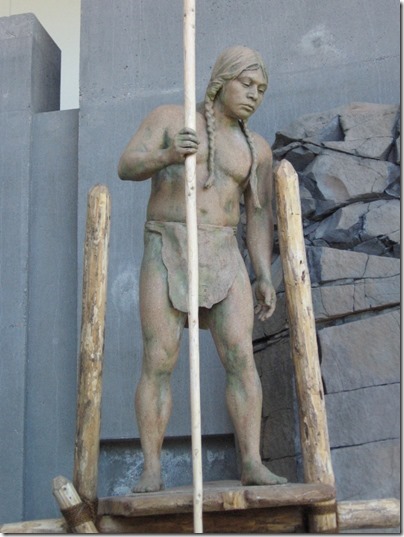
At narrows like those at the Cascades and Five Mile Rapids east of The Dalles, men suspended wooden platforms over the water and used dipnets to harvest tons of salmon, steelhead, sturgeon, smelt and eels, which the women then worked for weeks to split, smoke, sun-dry and store.
Waterfall in Memory of Henry Metzger
The museum's artificial indoor waterfall was donated by Louise Metzger Bennett in memory of her father Henry Metzger (1861-1958), who installed the first water system in Carson, Washington.
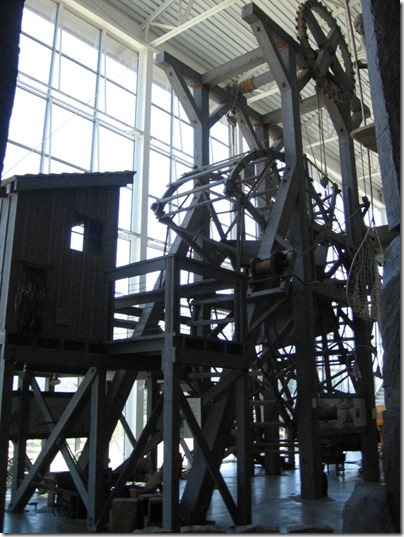
Fishwheels were first used to harvest salmon in the Columbia River Gorge in 1879. Fishwheels were built at narrow channels where the swift current would turn the wheel to dip into the water and scoop out tons of salmon, steelhead and sturgeon swimming upriver to spawn and deposit them into bins and boxes bound for canneries.
By 1899, there were 72 fishwheels on the river. Oregon banned fishwheels in 1926 and Washington did as well in 1934.
This is a replica of the McCord fishwheel, the third fishwheel on the river, which was built by William Rankin McCord, Frank Warren and William Sargent Ladd on the south shore of Bradford Island in 1882.
William Rankin McCord
(Donaldson & Cramer, 1971)
Thornton Williams and William Rankin McCord each patented fishwheels in 1881 and 1882 respectively, and ended up suing each other.
Patent #257,960, issued in May 1882, was used to design this replica fish wheel, as was a 1914 US Army Corps of Engineers drawing, photographs of the original wheel, and the advice of museum volunteer and fishwheel expert, Frederick "Fritz" K. Cramer (1916-1999) in whose memory a plaque has been placed on the fishwheel replica.
The fishwheel was a gift of the Robert C. and Nani S. Warren Foundation in memory of his forebearers who owned and operated fishwheels on the Columbia River. Structural timber was donated by Wilkins Kaiser Olsen, Inc. of Carson, Washington and engineering & construction services provided by KPFF and Promotion Products, Inc. of Portland, Oregon.
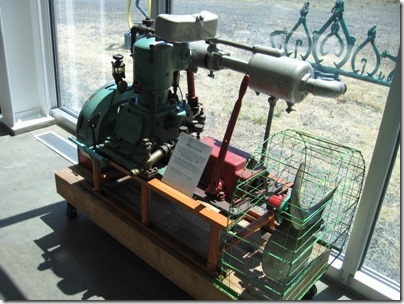
This single-cylinder, 7-horsepower marine engine with reverse gear and original water-cooled exhaust system was manufactured by the Regal Gasoline Engine Company of Coldwater, Michigan around 1900.
It powered a commercial fishing boat on the Columbia River from Astoria, Oregon to Stevenson, Washington from 1909 to 1915. It was restored & donated by Dwight M. Smith of Portland, Oregon.
1907 Corliss Engine from the Wind River Lumber Company
The Corliss steam engine became famous when one was displayed as an exhibit at the American Centennial Exposition in Philadelphia, Pennsylvania in 1876.
1907 Corliss Engine from the Wind River Lumber Company
Steam engines were widely used in logging to move logs and at lumber mills to power sawmill carriages and saws and the green chain.
1907 Corliss Engine from the Wind River Lumber Company
This Corliss engine was manufactured in 1907 by the Casey-Hedges Company of Chattanooga, Tennessee for the Wind River Lumber Company's former Storey-Keeler Lumber Mill in Cascade Locks, Oregon, where it powered the drove the saws, saw carriages and conveyors.
1907 Corliss Engine from the Wind River Lumber Company
This engine originally ran on steam from three boilers like the one it is displayed with here.
1907 Corliss Engine from the Wind River Lumber Company
In 1926 the Mid-Columbia Lumber Company moved the engine to Washington. Wilhelm J. Birkenfeld acquired it in 1941 for the Carson Lumber Company, where his workers used it to cut cants for decking World War II "Baby Flatop" ships and material for dams on the Columbia.
1907 Corliss Engine from the Wind River Lumber Company
In 1975, Birkenfeld's family donated the Corliss engine to Skamania County as a memorial to him and the industry of the Gorge.
This 1921 Mack AC is an example of the log trucks used in Skamania County from 1921 to the 1950s. The Mack AC was the first to carry the name "Bulldog," derived from the French-style hood that opens straight up, designed and patented by Mack Brothers of New York.
Under the hood is a 40-horsepower 471-cubic-inch 4-cylinder gas engine. The radiator is mounted behind the engine rather than in front. The truck is started by a hand crank, has a chain drive, rides on original hard rubber tires and has a top speed 17.2 miles per hour.
This truck is owned by Ed Callahan of Home Valley, Washington. The load is cedar logs that were blow-downs from the Gifford Pinchot National Forest in Skamania County received from the USDA Forest Service.
Here is a display of vintage saws and other logging tools
This Caterpillar Ten tractor was manufactured in 1930 at a cost of $3,000. The tractor was originally owned by Mrs. Gibbs of Underwood, Washington, but the sole operator was Paul Newell, who used it exclusively for working in an orchard in Underwood. It was donated by Mr. & Mrs. Paul Newell, Sr. and restored by The Halton Company, the Caterpillar equipment dealer in NW Oregon & SW Washington.
American-LaFrance Foamite Model FM Chemical Engine
This piece of firefighting apparatus is an American LaFrance Foamite Model FM Chemical Engine.
The Curtiss JN-4 "Jenny" biplane was the first mass-produced warplane in the United States. Approximately 17,000 were ordered between 1915 and the end of World War I. They served as trainers and surveillance planes as well as early bombers. The pilot carried a small bomb in the open cockpit, which he could drop over the side onto a target. The Jenny was also the type of plane used to deliver the first air mail in the Columbia River Gorge.
The Jenny is powered by a 90-horsepower OX-5 engine, has a 44-foot wingspan, weights 1,400 pounds, carries 22 gallons of fuel and can climb 100 feet per minute. With a top speed of 55 miles per house and a stall speed of 35 miles per hour, there is little room for error, and reportedly the early Jenny squadrons often walked home due to losing control and crashing.
Wally Olsen, owner of the Evergreen Airport in Vancouver, found this 1917 Jenny in pieces in Spokane in the early 1980s. He restored it, flew it, crashed it, and restored it again. Olsen died in July 1997 at the age of 86. He had expressed his desire to have the plane exhibited here, and it is loaned to the center by Eleanor Olsen and family of Vancouver, Washington.
This is one of seven airworthy Jennys in existence. It is decorated for the 9th Aero Squadron of the United States Surveillance Corps.
Continue to Second Floor Exhibits…
Wednesday, April 29, 2015
Milwaukie #14: Lacey’s Bomber Restaurant
13515 SE McLoughlin Boulevard
Lacey’s Bomber Restaurant on September 27, 2008
The Bomber was a Portland area landmark: a B-17G Flying Fortress that has been here since 1947, originally sheltering a 40-pump gas station.
Lacey’s Bomber Restaurant on September 27, 2008
After local pilot and gas station owner Art Lacey accepted a $5 bet that he couldn't install such a plane over his station, he spent $13,750 to purchase this war-surplus Flying Fortress (one of the last built; the war ended before it could be put into service) and flew it from Oklahoma to Oregon.
Lacey’s Bomber Restaurant on September 27, 2008
The Bomber was installed over the gas station in 1947, and a Drive In was added in 1948.
Lacey’s Bomber Restaurant on September 27, 2008
The gas station closed in 1991, and the B-17 has been under restoration since 1996.
B-17 Turret at Lacey’s Bomber Restaurant on July 27, 2008
The Bomber has its own World War II museum, which contains a gun turret and the restored nose section of the B-17.
B-17 Nose at Lacey’s Bomber Restaurant on July 27, 2008
Restoration of the cockpit section began in Aurora, Oregon, with plans to put sections on display as they were restored until all sections were complete and the plane could be fully reassembled.
Lacey’s Bomber Restaurant Sign on September 27, 2008
In August 2014, the B-17 was removed from its pedestal and moved to Salem for a complete restoration to flying condition.
Continue to 15: Ledding Library & Scott Park…


