I originally posted the PORTLAND PLACES: Portland Firefighters Park page on my old website on March 17, 2010.

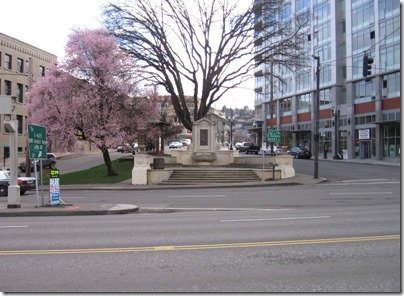
Portland Firefighters Park on February 27, 2010
Portland Firefighters Park is almost hidden in plain sight, along West Burnside just a block from Providence Park.

Portland Firefighters Memorial on February 27, 2010
The park is a memorial to the Portland firefighters who gave their lives in the line of duty.

Portland Firefighters Memorial on February 27, 2010
The Firefighters Memorial in the park is named in honor of Portland Fire Chief David Campbell, who died in the line of duty on June 26, 1911 after serving as Fire Chief for 18 years.

Portland Firefighters Memorial on February 27, 2010
Campbell and his men had responded to a fire at Union Oil in southeast Portland. As they fought the fire, Campbell observed that the building was weakening. He ordered a retreat and entered the burning building himself to make sure all his men were clear, and as he did so an explosion caused a wall to collapse on top of him, killing him instantly.

Portland Firefighters Memorial on February 27, 2010
The land for the memorial was donated to the City of Portland in 1918 by Katherine A. Daly, specifically as a place to honor Chief Campbell. However, it was not until 1927 that the memorial fountain was finally designed, by Paul Cret of Philadelphia with Ernest F. Tucker as a Portland representative, and construction began.

Portland Firefighters Memorial on February 27, 2010
The memorial is constructed of Caen stone, a light colored, easily worked limestone imported from France and used between the 11th and 19th centuries for many significant European buildings, including Canterbury Cathedral, Westminster Abbey, and Buckingham Palace.

Portland Firefighters Memorial on February 27, 2010
The monument was dedicated by Mayor George L. Baker on June 26, 1928 who at the time declared: "It is a memorial for all the Portland firemen who give their lives in the line of duty. I pledge that their names will be enshrined on plaques."

Portland Firefighters Park on February 27, 2010
Over the years that followed, the streets surrounding the triangular plot of land were widened so that by the 1960s, the memorial was tightly surrounded by city streets.

Portland Firefighters Memorial on February 27, 2010
In 1963 and 1964, the streets were altered to make room for a small park to surround the memorial, created by the Portland Junior Chamber of Commerce with assistance from the Oregon Chapter of the American Institute of Architects and local businesses and labor unions.

Portland Firefighters Memorial on February 27, 2010
Every year on June 26th, a service is held at the memorial in honor of Chief David Campbell and all Portland firefighters who died in the line of duty, and awards are given to current firefighters who have acted with extraordinary bravery. If the memorial is up to date, Portland hasn't lost a firefighter in the line of duty since 1977.

Portland Firefighters Memorial Detail on February 27, 2010
The Portland Firefighters Memorial features some detailed architectural elements.

Portland Firefighters Memorial Detail on February 27, 2010
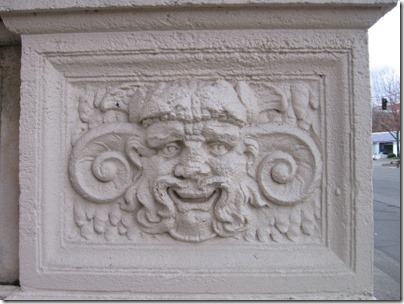
Perhaps most impressive details are the green men sculpted into the corner pedestals.

Portland Firefighters Memorial Detail on February 27, 2010
There are two basic styles of green man used here: three of each style.

Portland Firefighters Memorial Detail on February 27, 2010
There seem to be slight differences between the three of each style, but this could just be the result of over 80 years of weathering of the soft limestone.

Portland Firefighters Memorial Detail on February 27, 2010
Portland Firefighters Memorial Detail on February 27, 2010

Portland Firefighters Memorial Lantern on February 27, 2010
On top of each of the two pedestals with the green men is a large decorative bronze lantern.

Portland Firefighters Memorial Lantern on February 27, 2010

Portland Firefighters Memorial Lantern on February 27, 2010

Portland Firefighters Memorial Detail on February 27, 2010
Here are some more examples of the decorative architectural elements sculpted into the memorial's limestone.

Portland Firefighters Memorial Detail on February 27, 2010

David Campbell Bronze Relief on February 27, 2010
The main feature of the memorial is a bronze bas-relief of David Campbell above the fountain, sculpted by University of Oregon artist Avard Fairbanks in 1927.
Around the base of the fountain are the names and dates of service of the 36 members of the Portland Fire Department who gave their lives in the performance of their duty. They are listed here in the same order they are in at the memorial.
F. WAGNER 1885-1890
F. McCORMICK 1910-1919
W. WILBUR 1917-1926
E. GUSTAFSON 1915-1916
F. PLATT 1914-1937
V. SPENCER 1951-1966 | T. O'KEEFE 1884-1891
K. GUNSTER 1913-1921
C. RYAN 1924-1928
H. JOSEPHSON 1927-1928
E. BRADFORD 1913-1945
J. L. DEVANEY 1949-1977 | J. HEWSTON 1883-1892
O. LEHMAN 1910-1921
W. McCREERY 1928-1928
F. KEARNEY 1925-1934
A. BERG 1919-1948
J. REED -1881 |
| T. GRENFELL 1883-1896
J. BALDWIN 1917-1922
R. LAISNER 1912-1930
H. MORROW 1913-1934
D. SHAW 1912-1949
H. KRIMBEL 1920-1930 | D. CAMPBELL 1881-1911
O. GABRIEL 1913-1922
C. G. MARKSTROM 1930-1940
H. GARDNER 1923-1935
V. BROWN 1928-1957
J. ALLERTON 1923-1945 | W. HIGDON 1911-1912
A. WEFEL 1905-1923
E. W. BILLS 1930-1940
W. HEATH 1892-1935
J. METCALFE 1938-1960
G. WARNER 1924-1946 |

The Messenger Fire Bell on February 27, 2010
A relatively recent addition to Portland Firefighters Park is Portland's old fire bell, which was placed here in June of 2000.

The Messenger Fire Bell on February 27, 2010
Ordered after the great fire of 1873 nearly destroyed Portland's entire west side, the 4,200-pound silver & bronze bell was cast by the Meneely Bell Foundery of West Troy, New York in 1874.

The Messenger Fire Bell on February 27, 2010
It was originally installed at the top of a 70-foot tower behind Vigilance Hook & Ladder Company #1 at Fourth and Yamhill and could be heard as far away as Oregon City.

The Messenger Fire Bell on February 27, 2010
At that time, even horse-drawn fire engines were still in the future, and the volunteer firefighters ran to fires on foot, carrying their equipment and pulling the steam-powered fire engines by hand.

The Messenger Fire Bell on February 27, 2010
Installation of a telegraph system with alarm boxes began in 1875, and in 1913 the fire bell was retired.

The Messenger Fire Bell on February 27, 2010
The bell was displayed at special events for a few years before being put into storage, where it remained until being placed here.

Bell Tower Plaque on February 27, 2010
Because of its location, the current firefighters memorial is inadequate to host large crowds for events like the annual commemoration of David Campbell's heroic death. Thus, a new, larger memorial is planned for construction on the east side of the Willamette River near the Hawthorne Bridge, with a dedication originally planned for the 100th anniversary of Campbell's death on June 26, 2011, but not yet built. This existing historic memorial will remain, although the bell may be moved to the new memorial. Therefore, here is the text of the plaque on the current "bell tower" which may or may not be moved with the bell.
We want to give special thanks to the following
organizations and individuals for the construction
of this great Bell Tower.
| Portland Firefighters Association
Aron Faegre Architect
Jerry Abdie Engineer
Brick Masons Apprenticeship Program
Alaskan Copper and Brass Company
Parr Lumber Company
Sheet Metal Apprenticeship Program | Mutual Material
Portland General Electric
Portland Police Association
Safway Scaffolding
Lone Star Northwest
Portland Maintenance Bureau
Carl Lauersen Artist |
David Campbell Memorial Association
President Peter Linsky
Secretary-Treasurer Chief Robert Wall
Trustees: Betty Hedberg, Worth Caldwell, Jim Hebe and
Firefighter Paul Corah
June 2000
Related Links:
Portland Firefighters Memorial
Portland Fire & Rescue
This concludes the original content of my PORTLAND PLACES: Portland Firefighters Park page. To see additional blog entries about Portland, click on the Portland label.


