Pictured here on July 23, 1999, is the Stevenson Co-Ply plywood mill in Stevenson, Washington. Stevenson Co-Ply, Incorporated, was incorporated on August 17, 1955, and purchased the Stevenson Plywood Corporation in March of 1956. This mill was one of Skamania County's largest employers, and the main building had an area of 130,000 square feet. Stevenson Co-Ply went into receivership on January 24, 1992. The mill was purchased by High Cascade International Corporation and was used a warehouse to store wood pellets. The mill was destroyed by arson on September 21, 2007.
Thursday, November 22, 2018
Stevenson Co-Ply Mill
Pictured here on July 23, 1999, is the Stevenson Co-Ply plywood mill in Stevenson, Washington. Stevenson Co-Ply, Incorporated, was incorporated on August 17, 1955, and purchased the Stevenson Plywood Corporation in March of 1956. This mill was one of Skamania County's largest employers, and the main building had an area of 130,000 square feet. Stevenson Co-Ply went into receivership on January 24, 1992. The mill was purchased by High Cascade International Corporation and was used a warehouse to store wood pellets. The mill was destroyed by arson on September 21, 2007.
Tuesday, August 11, 2015
Second Floor Exhibits at the Columbia Gorge Interpretive Center Museum
…Continued from Grand Gallery Exhibits.
Mount St. Helens by Paul Kane, from the Royal Ontario Museum in Toronto, Canada.
T. Gilbert & Company Square Piano
This is a square piano made by T. Gilbert & Company of Boston, Massachusetts. Square pianos were first made at the turn of the 19th century.
T. Gilbert & Company Square Piano
Due the their shape, square pianos have a very narrow harp, giving them a poor quality tone. They were also difficult to repair and do not retain a tuning for very long. They were mainly used as a conversation piece for wealthy families.
Mixsell & Company/N.P.B. Curtiss Square Piano
This square piano was made by Mixsell & Company of New York. It also bears the name of N.P.B. Curtiss of New York. It was once owned by Dr. Hiriam Leavens, the first physician in the Columbia River Gorge. Leavens was born in Onondaga County, New York in 1824 and got his medical degree there, later moving to Iowa and then Illinois where he met and married Miss Pluma St. Ores in 1849. They eventually had four children. Dr. Leavens came overland to Oregon in 1852 and fought in the Indian wars of 1856. He moved his family to the gorge in 1859, settling at the old garrison at Fort Cascades at the Lower Cascades, now North Bonneville, Washington. From 1859 to his retirement in 1886, Dr. Leavens was the first and only physician from White Salmon, Washington west to Vancouver and Troutdale.
Mixsell & Company/N.P.B. Curtiss Square Piano
Dr. Leavens purchased this piano in Portland. It had arrived from the east coast via Cape Horn, and was shipped by steamer to Dr. Leavens' home at the Lower Cascades. A tuning date of 1842 is recorded on the piano, suggesting it had previous owner. Apparently, no one in the Leavens family played the piano and a pianist was hired for special occasions.
Mixsell & Company/N.P.B. Curtiss Square Piano
Dr. Leavens died May 7, 1906 three years after his wife, at the home of his daughter Mrs. Ada Ridenour in Cascade Locks, Oregon. His only son, Turner Leavens, inherited the piano, and he sold it to Mrs. Grace Sams-Walker of Skamania, Washington. She donated it to the museum in 1977. The piano cabinet and stool were restored with donations from the Mid-Columbia Family Health Center and Martin Hecht of Stevenson, Washington.
The Community Gallery was financed in part by a generous donation in memory of Frank E. and Joan Wittenberg, Home Valley, California. It contains various items belongs to individuals from the area.
View of the Hegewald Timber Company
This photo shows a view of the Hegewald Timber Company, Inc. which occupied the current site of the museum from 1952 to 1973.
This gold balance from around 1930 is an instrument used to measure small amounts of material, particularly related to mining. It was donated by Luella Rehfuss of North Bonneville, Washington in memory of her husband, William Rehfuss (1901-1987).
Charles Lindbergh Spirit of St. Louis Memorabilia
In the foreground is a Charles Lindbergh souvenir bank donated by Josephine Towers who in sixth grade with Louise Kirpatrik saw through a window of Stevenson Grade School a plane she believes was the Spirit of St. Louis fly over Stevenson and under the Bridge of the Gods. In the background is a model of the Spirit of St. Louis hand carved by Henry Peyrollaz of Carson, Washington that was a favorite toy of his sons Bertil and Johnnie.
This gallery of vintage toys includes a Marx M-10000 tinplate train.
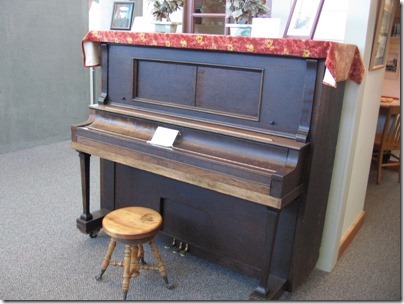
This theater piano from around 1924 was originally played in a silent movie theater. Enos Browitt won the piano in a raffle in 1938, and his daughter, Joan Ann Browitt Schupbach, inherited it.
Statue of Kazeon-bosatsu, the Japanese Goddess of Mercy
This statue of Kazeon-bosatsu, the Japanese Goddess of Mercy, from around 1600, is holding a treasure representing happiness, joy and good health. It was donated by Rev. & Mrs. Ohki of Home Valley, Washington.
Household Items belonging to Baron Eugene Ferson
The museum has a number of household items belonging to author and philosopher Baron Eugene Fersen, a Russian who settled in Washington.
Household Items belonging to Baron Eugene Ferson
Among the items belonging to Fersen pictured here are a bronze Japanese incense burner from the Meji period of 1868-1912, a copper shield by Cellini, inspired by a sketch by Michaelangelo: Soldiers Bathing in Arne, from around 1514, paintings by Russian artist Baron Pavel Romanovich Medem from around 1880, a French cabinet with inlaid woods, bronze ormolu trim & porcelain inserts from around 1890 and jewelry belonging to Fersen's mother, Baroness Olga de Medem (1842-1928).
Household Items belonging to Baron Eugene Ferson
More items belonging to Fersen include a case clock of red mahogany made by Grand Rapids with German works from around 1906 and a Swiss cabinet with a variety of inlaid woods that is approximately 200 years old and was used by Fersen to store linens.
Donald A. Brown
(Skamania County Historical Society)
Donald A. Brown (1895-1975) of North Bonneville, Washington helped found the Skamania County Historical Society in 1926 and helped reorganize it in 1959. He also did historical research on the Columbia River Gorge and wrote newspaper columns about local history.
Brown also collected Roman Catholic rosaries, or prayer beads. The beads of the rosary are used by Roman Catholics to keep track of the number of times a prayer has been recited. On each of four large beads a person recites the Lord's Prayer, fifty small beads call for reciting "Hail Mary's," prayer to the Virgin Mary and the dangling pendent beads represent the cross and call for the Apostle's Creed. Similar beads are used by other religions including Hinduism, Buddhism and Islam.
Brown's collection of nearly 4,000 rosaries and other religious artifacts is the world's largest rosary collection and led to the creation of the museum.
This pump organ from around 1875 was a gift to Don Brown from the St. Paul Catholic Church in St. Paul, Oregon.
1940 Quilt by Marguerite Peyrollaz
This hand-stitched full size quilt was started in 1934 and completed in 1940 by Marguerite Peyrollaz for her younger brother John. It features squares embroidered with designs of various types of boats including a square-rigged clipper ship in the center. It is on loan from John & Cloida Peyrollaz of Carson, Washington.
1976 United States Bicentennial Quilt
The 1976 United States Bicentennial Quilt was sponsored by the Skamania County Historical Society. Twenty-two county women created this album quilt which features the Bicentennial logos for the nation, state and county and blocks inspired by photographs, family records and books that were displayed in local store windows as they were completed.
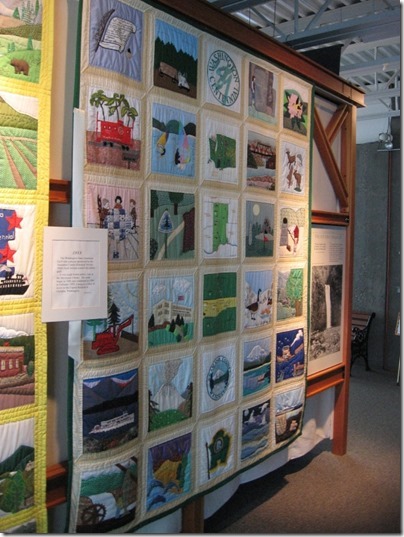
1989 Washington State Centennial Quilt
The Washington State Centennial Quilt was sponsored by the Skamania County Historical Society. Thirty local women made this album quilt in public view at the Stevenson Library from 1986 to 1988. In February 1989 it hung in the rotunda of the Washington State Capitol in Olympia, Washington.
This concludes the original content of my Columbia Gorge Interpretive Center Museum PLACES page. To see any additional blog entries about Stevenson, Washington, click on the Stevenson label.
Grand Gallery Exhibits at the Columbia Gorge Interpretive Center Museum
…Continued from First Floor Exhibits.
The Native Americans fished the Columbia River for thousands of years.
At narrows like those at the Cascades and Five Mile Rapids east of The Dalles, men suspended wooden platforms over the water and used dipnets to harvest tons of salmon, steelhead, sturgeon, smelt and eels, which the women then worked for weeks to split, smoke, sun-dry and store.
Waterfall in Memory of Henry Metzger
The museum's artificial indoor waterfall was donated by Louise Metzger Bennett in memory of her father Henry Metzger (1861-1958), who installed the first water system in Carson, Washington.
Fishwheels were first used to harvest salmon in the Columbia River Gorge in 1879. Fishwheels were built at narrow channels where the swift current would turn the wheel to dip into the water and scoop out tons of salmon, steelhead and sturgeon swimming upriver to spawn and deposit them into bins and boxes bound for canneries.
By 1899, there were 72 fishwheels on the river. Oregon banned fishwheels in 1926 and Washington did as well in 1934.
This is a replica of the McCord fishwheel, the third fishwheel on the river, which was built by William Rankin McCord, Frank Warren and William Sargent Ladd on the south shore of Bradford Island in 1882.
William Rankin McCord
(Donaldson & Cramer, 1971)
Thornton Williams and William Rankin McCord each patented fishwheels in 1881 and 1882 respectively, and ended up suing each other.
Patent #257,960, issued in May 1882, was used to design this replica fish wheel, as was a 1914 US Army Corps of Engineers drawing, photographs of the original wheel, and the advice of museum volunteer and fishwheel expert, Frederick "Fritz" K. Cramer (1916-1999) in whose memory a plaque has been placed on the fishwheel replica.
The fishwheel was a gift of the Robert C. and Nani S. Warren Foundation in memory of his forebearers who owned and operated fishwheels on the Columbia River. Structural timber was donated by Wilkins Kaiser Olsen, Inc. of Carson, Washington and engineering & construction services provided by KPFF and Promotion Products, Inc. of Portland, Oregon.
This single-cylinder, 7-horsepower marine engine with reverse gear and original water-cooled exhaust system was manufactured by the Regal Gasoline Engine Company of Coldwater, Michigan around 1900.
It powered a commercial fishing boat on the Columbia River from Astoria, Oregon to Stevenson, Washington from 1909 to 1915. It was restored & donated by Dwight M. Smith of Portland, Oregon.
1907 Corliss Engine from the Wind River Lumber Company
The Corliss steam engine became famous when one was displayed as an exhibit at the American Centennial Exposition in Philadelphia, Pennsylvania in 1876.
1907 Corliss Engine from the Wind River Lumber Company
Steam engines were widely used in logging to move logs and at lumber mills to power sawmill carriages and saws and the green chain.
1907 Corliss Engine from the Wind River Lumber Company
This Corliss engine was manufactured in 1907 by the Casey-Hedges Company of Chattanooga, Tennessee for the Wind River Lumber Company's former Storey-Keeler Lumber Mill in Cascade Locks, Oregon, where it powered the drove the saws, saw carriages and conveyors.
1907 Corliss Engine from the Wind River Lumber Company
This engine originally ran on steam from three boilers like the one it is displayed with here.
1907 Corliss Engine from the Wind River Lumber Company
In 1926 the Mid-Columbia Lumber Company moved the engine to Washington. Wilhelm J. Birkenfeld acquired it in 1941 for the Carson Lumber Company, where his workers used it to cut cants for decking World War II "Baby Flatop" ships and material for dams on the Columbia.
1907 Corliss Engine from the Wind River Lumber Company
In 1975, Birkenfeld's family donated the Corliss engine to Skamania County as a memorial to him and the industry of the Gorge.
This 1921 Mack AC is an example of the log trucks used in Skamania County from 1921 to the 1950s. The Mack AC was the first to carry the name "Bulldog," derived from the French-style hood that opens straight up, designed and patented by Mack Brothers of New York.
Under the hood is a 40-horsepower 471-cubic-inch 4-cylinder gas engine. The radiator is mounted behind the engine rather than in front. The truck is started by a hand crank, has a chain drive, rides on original hard rubber tires and has a top speed 17.2 miles per hour.
This truck is owned by Ed Callahan of Home Valley, Washington. The load is cedar logs that were blow-downs from the Gifford Pinchot National Forest in Skamania County received from the USDA Forest Service.
Here is a display of vintage saws and other logging tools
This Caterpillar Ten tractor was manufactured in 1930 at a cost of $3,000. The tractor was originally owned by Mrs. Gibbs of Underwood, Washington, but the sole operator was Paul Newell, who used it exclusively for working in an orchard in Underwood. It was donated by Mr. & Mrs. Paul Newell, Sr. and restored by The Halton Company, the Caterpillar equipment dealer in NW Oregon & SW Washington.
American-LaFrance Foamite Model FM Chemical Engine
This piece of firefighting apparatus is an American LaFrance Foamite Model FM Chemical Engine.
The Curtiss JN-4 "Jenny" biplane was the first mass-produced warplane in the United States. Approximately 17,000 were ordered between 1915 and the end of World War I. They served as trainers and surveillance planes as well as early bombers. The pilot carried a small bomb in the open cockpit, which he could drop over the side onto a target. The Jenny was also the type of plane used to deliver the first air mail in the Columbia River Gorge.
The Jenny is powered by a 90-horsepower OX-5 engine, has a 44-foot wingspan, weights 1,400 pounds, carries 22 gallons of fuel and can climb 100 feet per minute. With a top speed of 55 miles per house and a stall speed of 35 miles per hour, there is little room for error, and reportedly the early Jenny squadrons often walked home due to losing control and crashing.
Wally Olsen, owner of the Evergreen Airport in Vancouver, found this 1917 Jenny in pieces in Spokane in the early 1980s. He restored it, flew it, crashed it, and restored it again. Olsen died in July 1997 at the age of 86. He had expressed his desire to have the plane exhibited here, and it is loaned to the center by Eleanor Olsen and family of Vancouver, Washington.
This is one of seven airworthy Jennys in existence. It is decorated for the 9th Aero Squadron of the United States Surveillance Corps.
Continue to Second Floor Exhibits…