Showing posts with label Industry. Show all posts

Friday, May 22, 2020

Nestlé Chocolate Factory

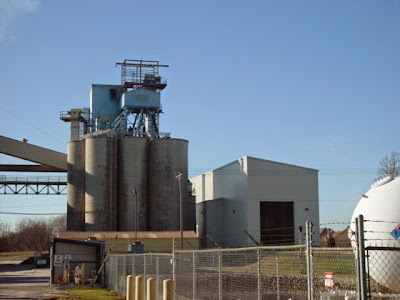
Nestlé chocolate factory in Burlington, Wisconsin, on November 21, 2001

The Nestlé chocolate factory in Burlington, Wisconsin, was built in 1966, and after it was built Burlington received the nickname “Chocolate City, USA.”

Nestlé chocolate factory in Burlington, Wisconsin, on November 21, 2001

Cooperative Plus, Inc. Grain Elevator

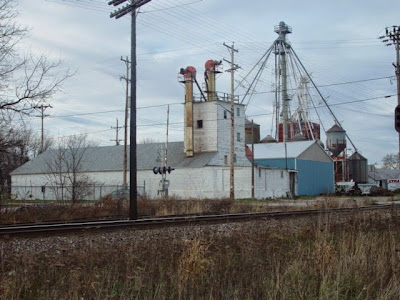
Cooperative Plus, Inc. grain elevator in Burlington, Wisconsin, on November 21, 2001

This is the Cooperative Plus, Inc. grain elevator in Burlington, Wisconsin.

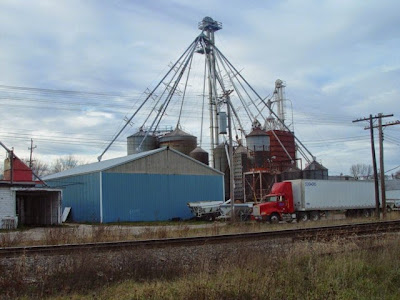
Cooperative Plus, Inc. grain elevator in Burlington, Wisconsin, on November 21, 2001

Cooperative Plus, Inc. was founded on April 20, 1937.

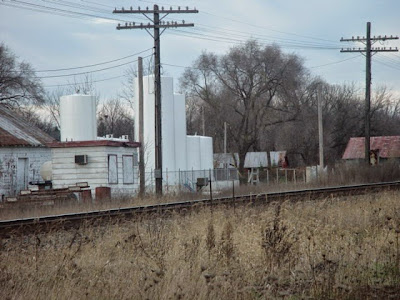
Cooperative Plus, Inc. grain elevator in Burlington, Wisconsin, on November 21, 2001

In 1944, Cooperative Plus, Inc. purchased the Farmers Feed and Fuel Company facilities in Burlington, which included a feed mill, feed warehouse, and a coal business.

Cooperative Plus, Inc. grain elevator in Burlington, Wisconsin, on November 21, 2001

At that time, the Burlington Co-op had 17 employees and an annual payroll of $35,000.

Cooperative Plus, Inc. grain elevator in Burlington, Wisconsin, on November 21, 2001

The Farmers Feed and Fuel Company had dated back to at least 1921.

Cooperative Plus, Inc. grain elevator in Burlington, Wisconsin, on November 21, 2001

Saint-Gobain Containers Glass Plant

Saint-Gobain Containers glass plant in Burlington, Wisconsin, on November 21, 2001

The Saint-Gobain Containers glass plant in Burlington, Wisconsin, was built in 1965 by the Foster-Forbes Glass Company of Marion, Indiana. This was the first glass factory in Wisconsin to produce glass bottles by machine.

Saint-Gobain Containers glass plant in Burlington, Wisconsin, on November 21, 2001

Foster-Forbes was founded in 1911 as Upland Flint Glass Company and became Foster-Forbes in 1929. In 1995, Saint-Gobain purchased both Foster-Forbes and the Ball Corporation, merging them to form Ball-Foster Glass Container Company. Ball-Foster Glass Container Company was renamed Saint-Gobain Containers in 2000.

Saint-Gobain Containers glass plant in Burlington, Wisconsin, on November 21, 2001

Murphy Brothers Feed Mill

Murphy Brothers Feed Mill in Burlington, Wisconsin, on November 21, 2001
Murphy Bros. Feed Mill in Burlington, Wisconsin, on November 21, 2001

In 1909, Chicago-area dairy farmers organized the Milk Producer's Co-Operative Marketing Company to get better prices for their milk. The organization spread through Illinois, Indiana, and Wisconsin, and in 1920 the Burlington, Wisconsin, chapter incorporated as the Badger Dairy Company, and built a dairy plant on this site.

Murphy Brothers Feed Mill in Burlington, Wisconsin, on November 21, 2001
Murphy Bros. Feed Mill in Burlington, Wisconsin, on November 21, 2001

In 1921 brothers James and Lawrence Murphy established the Murphy Brothers Company to manufacture and sell livestock feed. In 1925, they purchased the office and factory buildings of the Badger Dairy Company. The original factory was destroyed by fire in 1951 and a new Murphy Brothers Feed Mill was built, with various additions added over the years until 1972. The Joseph Schlitz Brewing Company of Milwaukee purchased Murphy Brothers in 1971, and was in turn purchased by the Stroh Brewing Company of Detroit in 1982. 

Murphy Brothers Feed Mill in Burlington, Wisconsin, on November 21, 2001
Murphy Bros. Feed Mill in Burlington, Wisconsin, on November 21, 2001

The former Murphy Brothers buildings were later purchased by Maple Leaf Farms of nearby Yorkville for use as a duck feed mill. In 1996, Purina Mills purchased the mill and restored it to full-scale feed operation following a $500,000 renovation. The former Murphy Brothers buildings were demolished in 2018 to make way for new development.

Thursday, May 21, 2020

Horn Feeds, Inc.

Horn Feeds, Inc. in Mukwonago, Wisconsin, on November 20, 2001

This grain handling facility at 728 Clarendon Avenue in Mukwonago, Wisconsin, was built around the turn-of-the-century.

Horn Feeds, Inc. in Mukwonago, Wisconsin, on November 20, 2001

The granary was originally operated by Buell & Goodman.

Horn Feeds, Inc. in Mukwonago, Wisconsin, on November 20, 2001

It was built adjacent to the Wisconsin Central Railroad tracks, providing farmers with a method to ship their products to distant markets.

Horn Feeds, Inc. in Mukwonago, Wisconsin, on November 20, 2001

Over the years, the facility was expanded to handle other material, such as with these tanks to handle a variety of fuel supplies.

Horn Feeds, Inc. in Mukwonago, Wisconsin, on November 20, 2001

Additional newer tanks are at the northeast corner of the property.

Horn Feeds, Inc. in Mukwonago, Wisconsin, on November 20, 2001

The grain handling operation has also been modernized over years, with newer buildings added alongside the historic wooden structure.

Horn Feeds, Inc. in Mukwonago, Wisconsin, on November 20, 2001

These tall metal grain silos form the central part of the modern facility.

Horn Feeds, Inc. in Mukwonago, Wisconsin, on November 20, 2001

Structures were added at various times, creating a disjointed appearance.

Horn Feeds, Inc. in Mukwonago, Wisconsin, on November 20, 2001

This shed provides covered parking for grain trucks.

Horn Feeds, Inc. in Mukwonago, Wisconsin, on November 20, 2001

This brick building is the public entrance to the business.

Horn Feeds, Inc. in Mukwonago, Wisconsin, on November 20, 2001

This facility has been Horn Feeds, Inc. since 1978.

Horn Feeds, Inc. in Mukwonago, Wisconsin, on November 20, 2001

This structure appears to be fuel-related, with a Mobil Pegasus sign and gas pumps outside.

Horn Feeds, Inc. in Mukwonago, Wisconsin, on November 20, 2001

The fuel tanks at the northeast corner of the property are a fueling station.

Horn Feeds, Inc. Volvo FE6 in Mukwonago, Wisconsin, on November 20, 2001

Based on the Volvo FL first introduced in the summer of 1985, the Volvo FE6 was introduced for North America in 1986. Usually powered by a Volvo TD63 6-cylinder turbocharged diesel engine, they were also available with a lower-priced 6.6-liter Caterpillar 3116. Also available was the FE7 model, with a larger 7-liter Volvo TD73 diesel engine for heavy-duty applications. The Volvo FE received a minor facelift for 1992, with the front turn signals moving to the corners of the bumper, and continued to be offered in North America through 1998.

Horn Feeds, Inc. in Mukwonago, Wisconsin, on November 20, 2001

These small grain bins sat at the northeast corner of the property.

Brittingham & Hixon Lumber Co. Mukwonago Lumberyard

Brittingham & Hixon Lumber Company in Mukwonago, Wisconsin, on November 20, 2001

The W.S. Heddles Lumber Company was established on this site at 616 Grand Avenue in Mukwonago, Wisconsin, in 1897. It was the third lumberyard to open in Mukwonago within 10 years. It was purchased by the Alexander Lumber Company of Chicago, Illinois in December 1924. Their first manager at this location was Peter Christisen.

Brittingham & Hixon Lumber Company in Mukwonago, Wisconsin, on November 20, 2001

John Alexander was the youngest of the Alexander family who came to Wisconsin from Scotland in the 1870s. In the 1880s he was hired by the Stewart family of Wausau, Wisconsin, to open a lumberyard in Aurora, Illinois. In 1891, John Alexander opened his own lumberyard in Aurora, the Alexander Lumber Co., with the help of partners Tom Brittingham and Joe Hixon and a $5,000 loan from the Continental Illinois Bank of Chicago.

Brittingham & Hixon Lumber Company in Mukwonago, Wisconsin, on November 20, 2001

The company continued to expand and by the 1920s Alexander operated more than 100 lumberyards. In 1929, he bought out his partners and acquired the Brittingham & Hixon lumberyards in Wisconsin, which he continued to operate using the Brittingham & Hixon name as a subsidiary.

Brittingham & Hixon Lumber Company in Mukwonago, Wisconsin, on November 20, 2001

During the Great Depression, Alexander continued to expand by purchasing additional lumberyards. His son, John Alexander, Jr., was named president of the company in 1932, and starting in 1940 the day-to-day operations were managed by vice-president Otto Unteed. John Alexander, Sr. died in 1944 and his son assumed full control of the company.

Brittingham & Hixon Lumber Company in Mukwonago, Wisconsin, on November 20, 2001

The Soo Line passenger train depot was located next to the lumberyard at 610 Grand Avenue. It was demolished after the Soo Line discontinued passenger service on the line in 1961, and the lumberyard appears to have expanded onto the former depot property.

Brittingham & Hixon Lumber Company in Mukwonago, Wisconsin, on November 20, 2001

Following the retirement of Otto Unteed in 1966, control was passed on to the third generation as Walter Alexander became company president, a position he would hold for 45 years until his retirement in 2014. This lumberyard closed between May and September of 2008.

Wednesday, May 20, 2020

Quad/Graphics

Quad/Graphics in Pewaukee, Wisconsin, on November 19, 2001

Quad/Graphics was founded July 13, 1971 by Harry V. Quadracci and his wife Elizabeth. This plant in the Duplainville neighborhood in Pewaukee, Wisconsin, is Quad/Graphics' original location. Originally a 20,171 square foot abandoned mill warehouse that Harry Quadracci purchased at auction, Quad/Graphics started here with 11 employees, a leased press and a loaned binder. Since then it has grown to a 291,097 square foot facility with over 700 employees, and includes an on-site medical clinic, fitness & rehabilitative center, and child care center for employee use.

Quad/Graphics in Sussex, Wisconsin, on November 19, 2001

The Quad/Graphics plant in Sussex, Wisconsin, opened in 1983. The 1.3 million square foot facility employs over 2,900 workers. This plant’s M-64 32-page offset web printing press set a world record in 1996, printing more than 350,000,000 impressions that year.

Quad/Graphics in Sussex, Wisconsin, on November 19, 2001

This facility features a 24-hour child care center, fitness center, sand volleyball courts, softball diamond, and fishing ponds for employee use.

Quad/Graphics in Sussex, Wisconsin, on November 19, 2001

Quad/Graphics became the largest privately-owned printing company in the world and the fifth largest printing company in the United States with 13,000 employees and 22 facilities on three continents.

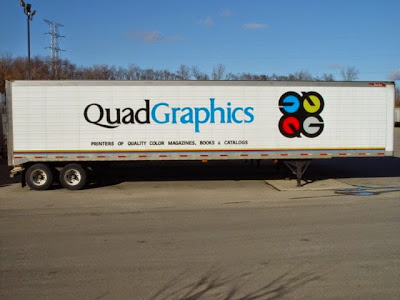
Quad/Graphics Trailer in Sussex, Wisconsin, on November 19, 2001

The Sussex plant is also the headquarters for Duplainville Transport with over 350 trucks, the company’s distribution subsidiary originally founded in 1973.

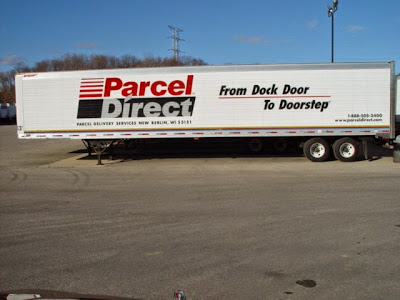
Parcel Direct Trailer in Sussex, Wisconsin, on November 19, 2001

Parcel Direct was founded by Quad/Graphics on September 16, 1998 as a package consolidator and expeditor for catalog and online retailers, picking up and sorting parcels and delivering them to post offices for final delivery. Parcel Direct’s headquarters and main facility was in New Berlin, Wisconsin. Parcel Direct was sold to Federal Express in 2004.

M. Davidson Lime Kiln

M. Davidson Lime Kiln in Sussex, Wisconsin, on November 19, 2001

As many as nine lime kilns were operating in the area of Sussex, Wisconsin, from as early as 1840. The abandoned M. Davidson lime kiln is the only one remaining in Sussex. It was built by the Wisconsin Lime & Stone Company prior to 1891, perhaps as early as 1873. The kiln is approximately 35 feet tall with exterior walls of heavily-mortared limestone. It has two rectangular burning shafts lined with refractory brick and granite with rounded corners for the uninterrupted movement of the hot, sticky pieces of limestone, which was fed from carts into the top of the kiln, accessed by an inclined wooden skid. Firing eyes originally covered by cast iron doors are on the east and west sides, and finished lime was drawn from arched opening at the base of the west side. This kiln operated continuously in all seasons until 1910, when the Chicago & North Western Railway was built on reclaimed quarry land to the north, and the kiln was abandoned.

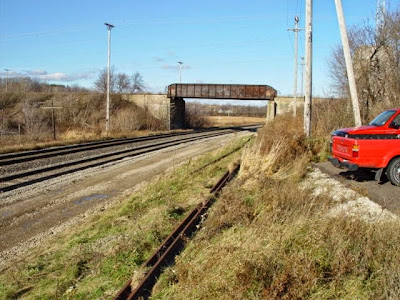
Chicago & North Western Railway Bridge over the Wisconsin Central in Sussex, Wisconsin, on November 19, 2001

This through plate girder bridge adjacent to the kiln carries the Chicago & North Western Railway line through Sussex over the Wisconsin Central. It is probably not the original bridge from 1910, though it is unclear when it was built. The Chicago & North Western was merged into the Union Pacific on April 24, 1995.

Thursday, May 14, 2020

Storck Brewery

Storck Brewery on November 19, 2001

The Storck Brewery in Slinger traces its history back to the Benedict Kornburger Brewery of 1868. Lehman Rosenheimer acquired the brewery in 1870. In 1877 Charles Storck and William Hartig acquired it and it became the Storck & Hartig Brewery. Hartig’s name was dropped from the company name in 1884. One of the products produced by the Storck Brewery was Slinger Beer.

Storck Brewery on November 19, 2001

The brewery operated until 1958, surviving prohibition by making ice cream and bootleg beer, and supplied the Milwaukee Brewers stadium during the 1953 Milwaukee brewery strike. The former brewery property is now used by Blaine’s Auto & Truck Parts.

Thursday, November 22, 2018

Stevenson Co-Ply Mill

Stevenson Co-Ply Mill on July 23, 1999

Pictured here on July 23, 1999, is the Stevenson Co-Ply plywood mill in Stevenson, Washington. Stevenson Co-Ply, Incorporated, was incorporated on August 17, 1955, and purchased the Stevenson Plywood Corporation in March of 1956. This mill was one of Skamania County's largest employers, and the main building had an area of 130,000 square feet. Stevenson Co-Ply went into receivership on January 24, 1992. The mill was purchased by High Cascade International Corporation and was used a warehouse to store wood pellets. The mill was destroyed by arson on September 21, 2007.

Monday, February 19, 2018

1992 California Trip: The Geysers

Geysers Geothermal Power Development Civil Engineering Landmark
Photo by Cliff West
On our family's California trip, my dad planned to spend a night in a motel in San Francisco, until he found out how much they cost. He then decided to head north to Santa Rosa, where we stayed in a much nicer and less expensive motel, saying we could always drive back to San Francisco. Yet, when the morning of March 17, 1992, came, we continued north instead, and came across signs for "The Geysers." Not knowing what "The Geysers" were, he decided to follow the signs and find out, hoping to perhaps discover California's version of Yellowstone's Old Faithful. Instead, after following a long and winding road, all we came across was a vista point with the plaque pictured above, declaring The Geysers Geothermal Power Development a California Historic Civil Engineering Landmark by the American Society of Civil Engineers, and we realized that whatever geysers might have been there had long since had geothermal power plants built on top of them. (We actually had seen one small spring along the road, but didn't bother to take a picture as at that point we still had hope there would be bigger ones up the road. There weren't.)
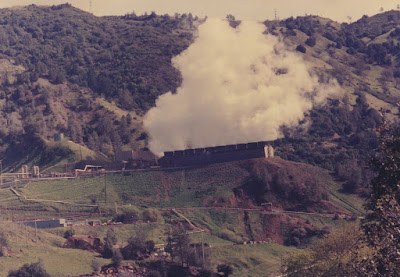
Pacific Gas & Electric Units 5 & 6
Photo by Cliff West
This is an example of what we found instead. Pacific Gas & Electric Units 5 & 6 were started up in December 1971 and have a combined generating capacity of 110 megawatts. After the 1996 deregulation of California's power generation industry, Pacific Gas & Electric sold its geothermal power plants at The Geysers to the Calpine Corporation in 1999. Today, this facility is called the McCabe Power Plant and is still in operation.

Geysers Waterfall
Photo by Cliff West
Though hardly worth the long drive, the viewpoint did offer some scenic vistas. Here is what appears to be a spring emerging from the hillside to form a small waterfall as it cascades down into Big Sulfur Creek. The Geysers is the world's largest geothermal field, but it never actually contained any geysers. It was named by a white settler named William Bell Elliot who stumbled across the area in 1847. The phenomena in this area are actually fumaroles, which emit only steam. Tourists began coming to the area in 1848, and construction of The Geysers Resort Hotel began in 1854 near the vista point. Though the hotel was destroyed by fire on February 2, 1938, the resort continued operating with cabins until 1980, when it was dismantled.

Pacific Gas & Electric Units 3 & 4 and Units 7 & 8
Photo by Cliff West
In the foreground are Pacific Gas & Electric Units 3 & 4, which were started up in 1967 and 1968, respectively. Each had a generating capacity of 28 megawatts. These units were taken offline in 1992 (as this picture was taken in March, I am not sure if they were already offline or not) and were dismantled in 1995.

On top of the hill are Pacific Gas & Electric Units 7 & 8. They were started up in November 1972 and have a combined generation capacity of 110 megawatts. Sold to Calpine Corporation in 1999, this facility is still operating today as the Ridge Line Power Plant.

Pacific Gas & Electric Units 3 & 4
Photo by Cliff West
Here is another view of Pacific Gas & Electric Units 3 & 4 from a point further down the road. In 1920, a gravel pit owner from Healdsburg, California, named John D. Grant took out a lease on The Geysers property with a plan to use the steam to generate electricity. His first well, drilled in 1921, was unsuccessful, but his second well became the first successful geothermal well drilled for electrical power generation outside the Larderello Geothermal Field in Tuscany, Italy. Grant completed the 318 foot deep well in July 1923 and subsequently built a 35-kilowatt power plant, however, startup costs and technical problem combined with cheap oil prices doomed the venture. Some of the General Electric generating equipment was eventually used to power The Geysers Resort Hotel.

Pacific Gas & Electric Units 3 & 4
Photo by Cliff West
In 1955, the Magma Power Company drilled a new modern well at The Geysers, followed by five more in the next two years. In October 1958, Pacific Gas & Electric signed a contract to purchase steam for power generation. Pacific Gas & Electric's first geothermal plant at The Geysers was started up in September 1960.
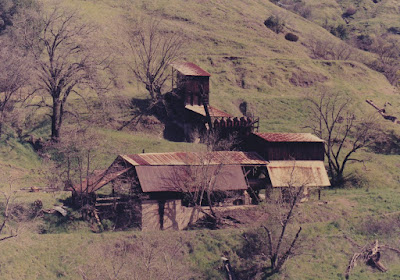
Cloverdale Mine Headquarters
Photo by Cliff West
As we continued down the road, we came across this odd abandoned structure. This is the former headquarters of the Cloverdale Mining Company, which mined cinnabar for the production of quicksilver, or liquid mercury. Cinnabar, or mercury sulfide, was discovered in this area around 1863, and was being mined here by 1875. The Cloverdale Mining Company operated until about 1960.