Showing posts with label Steam Locomotive. Show all posts

Sunday, November 5, 2023

Great Northern 2-8-2 Steam Locomotive #3059 in Railroad Park, Williston, North Dakota

Great Northern 2-8-2 Steam Locomotive #3059 in Railroad Park, Williston, North Dakota, in July 1999

In Railroad Park near the Amtrak depot in Williston, North Dakota, Great Northern O-1 Class 2-8-2 Mikado Steam Locomotive #3059 is on permanent display. When riding Amtrak's Empire Builder, it can be seen from the train, which is how these pictures were taken.

Great Northern 2-8-2 Steam Locomotive #3059 in Railroad Park, Williston, North Dakota, in September 2003

The Great Northern had a total of 145 O-1 Class 2-8-2 Mikados built by the Baldwin Locomotive Works in four groups between August 1911 and February 1919, and the last of them were retired in April 1958.

Great Northern 2-8-2 Steam Locomotive #3059 in Railroad Park, Williston, North Dakota, in May 2004
Photo by Cliff West

Built in February 1913, #3059 was one of the last 15 in operation when it was retired in December 1957, and is the only survivor. It was donated to the City of Williston and placed on display in Railroad Park on August 2, 1958.

Sunday, March 27, 2022

Great Northern P-2 4-8-2 #2507 in Wishram, Washington on September 4, 2003

Great Northern P-2 4-8-2 #2507 in Wishram, Washington on September 4, 2003

While riding the Portland section of Amtrak’s eastbound Empire Builder through Wishram, Washington, on September 4, 2003, I took this picture of former Great Northern Railway steam locomotive #2507 in a small park near the depot. This locomotive was one of 28 Class P-2 4-8-2 Mountain-type locomotives delivered to Great Northern by the Baldwin Locomotive Works. These locomotives were originally assigned to passenger service and were the initial power for the Empire Builder when it was inaugurated in June, 1929, but were replaced in Empire Builder service in 1930 by 14 new Baldwin Class S-2 4-8-4 Northern-type locomotives that pulled the Empire Builder until it was streamlined and dieselized in 1947. The Class P-2 Mountains were then assigned to freight service until their retirement in 1955. After its retirement, #2507 was put into storage in Minnesota instead of being immediately scrapped. Meanwhile, the Spokane, Portland & Seattle promised a steam locomotive to Klickitat County for display at Maryhill, only to end up having no steam locomotives left; #700 had been given to the city of Portland, #539 to the city of Vancouver, and the rest sold for scrap. To save face, the SP&S purchased #2507 from parent Great Northern, repainted it with SP&S lettering, and donated it to Klickitat County in 1962. For 30 years, #2507 sat on display in Maryhill in SP&S paint. An attempted restoration saw #2507 painted back to GN in 1992, and in 1994 it was moved from Maryhill to Pasco to be restored to operation. No restoration ever occurred, and eventually Klickitat County decided to put the locomotive back on permanent display. Track realignments had made a return to Maryhill impractical, so a new site in Wishram was chosen. The locomotive was given a complete cosmetic restoration and a structure was built to protect the locomotive from the elements. BNSF donated the locomotive's move from Pasco to Wishram.

Wednesday, February 14, 2018

Cab Forward Locomotive at the California State Railroad Museum

Southern Pacific AC-12 4-8-8-2 Cab Forward #4294
Photo by Cliff West
Southern Pacific AC-12 Class 4-8-8-2 #4294 was built by Baldwin in 1944 and was retired in March 1956. It is the only surviving example of Southern Pacific’s unique Cab Forward locomotives.

Southern Pacific purchased two conventional 2-8-8-2 articulated locomotives from Baldwin in 1909, but discovered the smoke posed a danger to crews in the tunnels and snowsheds of the mountainous routes they were needed for. The Cab Forward design was developed to solve these problems, placing the crew ahead of the locomotive’s exhaust. The first 2-8-8-2 Cab Forward locomotives were delivered in 1910 and proved to be a success for the Southern Pacific. In addition to the 2-8-8-2 wheel arrangement, Southern Pacific also ordered Cab Forwards with a 2-6-6-2 wheel arrangement which were quickly converted to the 4-6-6-2 arrangement. In 1928, Southern Pacific purchased its first Cab Forwards with a 4-8-8-2 wheel arrangement, the AC-1 class. Southern Pacific ultimately purchased a total of 256 Cab Forward locomotives. All were built by Baldwin, and no other American railroad followed Southern Pacific’s example.

Southern Pacific AC-12 4-8-8-2 Cab Forward #4294
Photo by Cliff West

Southern Pacific #4294 was the last steam locomotive purchased by the Southern Pacific. It was in service from March 19, 1944 to March 5, 1956. Southern Pacific wrote off its last Cab Forwards in September 1958. Southern Pacific #4294 was placed on display outside the Sacramento, California, station and dedicated to the city of Sacramento on October 19, 1958. In 1967 it was moved to make room an Interstate 5 ramp, and was stored at Southern Pacific’s Sacramento yards until restored in 1981 and placed in the California State Railroad Museum’s Railroad History Museum in Sacramento. 

Nevada Short Line Locomotive at the California State Railroad Museum

Nevada Short Line 2-6-0 #1
Photo by Cliff West
The Nevada Short Line was a short-lived 36-inch gauge railroad built to reach silver mines in Nevada. Established in 1913 and incorporated in 1914, the 12.5-mile railroad featured a switchback and a 6% grade. Nevada Short Line #1 was one of the line’s two locomotives. It is a 2-6-0 Mogul originally built by Baldwin in 1879 as Utah & Northern Railway Company #13. It passed through several owners before it was purchased by the Nevada Short Line in August 1913 and became their #1.The railroad was damaged by flooding in June 1918 and was abandoned on December 31, 1920. The locomotive was sold to a scrap dealer who resold it to the Nevada Central Railroad of Battle Mountain, Nevada, where it became #6. Like the former North Pacific Coast #12, Sonoma, it was acquired by Nevada Central’s general manager J. M. Hiskey and was used at the Golden Gate International Exposition on Treasure Island in San Francisco, where it last ran in October 1940. In 1941 it was donated to the Railway & Locomotive Historical Society, and was donated to the state of California in 1969. It is new displayed at the California State Railroad Museum’s Railroad History Museum in Sacramento, California.

Sonoma Locomotive at the California State Railroad Museum

North Pacific Coast 4-4-0 #12 Sonoma
Photo by Cliff West
North Pacific Coast Railroad 36-inch gauge 4-4-0 locomotive #12, the Sonoma, was built by Baldwin in 1876 and was last run in October 1940. The North Pacific Coast operated an 80-mile main line between Sausalito and Duncans Mills, but always faced financial difficulty. By the end of 1879, the Sonoma had been sold to the Nevada Central Railroad, where it became #5 and was named General J. H. Ledlie. It was still in service when the Nevada Central was abandoned in 1938, and the line’s general manager J. M. Hiskey acquired it and loaned it to the Pacific Coast Chapter of the Railway & Locomotive Historical Society. It was taken to the Southern Pacific shops in Berkeley on December 15, 1938, and made to resemble Central Pacific #60 Jupiter for the daily reenactment of the completion of the transcontinental railroad at the Golden Gate International Exposition on Treasure Island in San Francisco. After the exposition, the locomotive was put into storage in October 1940 and has not run since. It was moved to the new California State Railroad Museum in Sacramento, California, in 1977. In 1978 it was donated to the museum by the J. M. Hiskey family. It has been restored to its original appearance.

J.W. Bowker Locomotive at the California State Railroad Museum

Virginia & Truckee 2-4-0 #21 J.W. Bowker
Photo by Cliff West

Virginia & Truckee 2-4-0 locomotive #21, the J.W. Bowker, was built by Baldwin in 1875. Named for V&T master mechanic John William Bowker, it was built with a Knowles steam water pump for firefighting and was used as the switcher in Virginia City. It was renamed Mexico in 1876. It was sold in 1896 to the Sierra Nevada Wood & Lumber Company in Hobart Mills, California. It was donated to the Railway & Locomotive Historical Society in June 1937. It was used by Cecil B. DeMille in the 1939 film Union Pacific. Its last run was in June1953 in San Francisco. It has been displayed at the California State Railroad Museum in Sacramento, California, since 1976. It is the only surviving Baldwin 2-4-0 in the United States.

Empire Locomotive at the California State Railroad Museum

Virginia & Truckee 2-6-0 #13 Empire
Photo by Cliff West
Virginia & Truckee 2-6-0 locomotive #13, the Empire, was built by Baldwin in 1873. Ordered due to an upswing in freight traffic requiring a more powerful locomotive than the 4-4-0 American-type, the Empire was delivered in February 1873. By the late 1880s, the traffic surge had abated, and the Empire was held in reserve until it was overhauled and returned to regular freight service for another upswing in 1902. In 1910, it was converted from a wood-burner to an oil-burner, and was renumbered to #15, because superstitious crews thought the number 13 was unlucky. The Empire was retired and stored in 1918, and was sold to the Pacific Portland Cement Company of Gerlach, Nevada, where it became #501 and was used as a switcher until 1931, when it last operated. In 1938 it was donated to the Pacific Coast Chapter of the Locomotive and Railway Historical Society and moved to the San Francisco Bay Area for storage. It was cosmetically restored in 1966 at the Bethlehem Steel Corporation’s San Francisco shipyards. In 1976 it was moved to the new California State Railroad Museum’s Central Pacific Railroad Passenger Station in Sacramento, California, and two years later underwent a complete restoration. It was placed in the California State Railroad Museum’s Railroad History Museum in 1981.

Genoa Locomotive at the California State Railroad Museum

Virginia & Truckee 4-4-0 #12 Genoa
Photo by Cliff West
Virginia & Truckee 4-4-0 locomotive #12, the Genoa, was built by Baldwin in January 1873. The Virginia & Truckee Railroad Company was organized on March 5, 1868, and the 21-mile route between Carson City and Virginia City was completed on January 29, 1870, with an extension connecting Carson City to the Central Pacific Railroad in Reno completed in August 1872. The Genoa pulled passenger, freight and mixed trains on the V&T for nearly 30 years. On December 31, 1908, the Genoa was retired and stored in the Carson City engine house, where it remained until it was sold to the Eastern Railroads Presidents’ Conference in 1939. The Genoa was modified to resemble Central Pacific Railroad #60 Jupiter, one of the locomotives at the driving of the golden spike completing the transcontinental railroad in 1869. It was used in the Railroads on Parade pageant at the 1939-1940 World’s Fair in New York City, and operated at the 1948 Chicago Railroad Fair. It was donated to the Pacific Coast Chapter of the Railway & Locomotive Historical Society, which presented it to the state of California in 1969. For the 100th anniversary of the transcontinental railroad, Genoa It reprised its role as Jupiter for the golden spike reenactment at Promontory Summit in Utah, with Virginia & Truckee #11 Reno playing the part of Union Pacific #119. The Genoa’s last run was at the California State Railroad Museum in Sacramento, California, in May 1979. It was then restored to its 1902 appearance as seen here.

C.P. Huntington Locomotive at the California State Railroad Museum

Southern Pacific 4-2-4T #1 C.P. Huntington
Photo by Cliff West
Southern Pacific 4-2-4T locomotive #1, the C.P. Huntington, is displayed in front of a large window at the California State Railroad Museum in Sacramento, California. It was originally built by Danforth, Cooke & Company of Paterson, New Jersey, in 1863, as the Central Pacific Railroad’s third locomotive, #3, and it arrived in San Francisco on March 19, 1864. It was named for Collis P Huntington, Vice President of the Central Pacific. The locomotive is 29.5 feet long and weighs 21.75 tons. it could pull 4 times its weight. It had a top speed of 35 miles per hour and could maintain a speed of 15 mph on a grade of 26 feet per mile (0.49%). The Central Pacific would have preferred to purchase a larger locomotive, but none were available due to the importance of railroads in the Civil War. The C.P. Huntington was used in the construction of the transcontinental railroad. In 1879 it was transferred to the Southern Pacific Railroad, by then under the same control as the Central Pacific, and became SP #1. It was involved in a head-on collision in 1872 and was rebuilt in 1875 and received a new boiler in 1888. It was renumbered to #1001 in 1891. 

Photo by Cliff West
As Southern Pacific’s oldest locomotive, the C.P. Huntington was displayed at the 1892 California State Fair and the 1894 California Mid-Winter International Exposition before being retired in 1900. It was rebuilt as a weed burner in 1901 but was unsatisfactory. It was rebuilt again in 1910 and used as a shop switcher. It was nearly scrapped in 1914 but was instead restored for display and the 1915 Panama-Pacific International Exposition in San Francisco. It continued to make appearances at special events, and was last run in May 1939 at the opening of the Los Angeles Union Passenger Terminal. In September 1964, the Southern Pacific Railroad donated the locomotive to the state of California and it was placed on display at the old state fairgrounds in Sacramento. It was donated to the Pacific Coast Chapter of the Railway & Locomotive Historical Society in June 1969. In 1970 it was refurbished by Southern Pacific’s Sacramento Shops and in 1979 it was placed in the California State Railroad Museum’s reconstructed Central Pacific Railroad Passenger Station. In 1980 it was restored to its appearance at the 1915 Panama-Pacific International Exposition. It is the only surviving standard-gauge 4-2-4T in the United States.

Gov. Stanford Locomotive at the California State Railroad Museum

On our family’s California vacation, we spent March 15, 1992, exploring the California State Railroad Museum. 

The California State Railroad Museum first opened in 1976 with the reconstructed Central Pacific Railroad Passenger Station, and the Railroad History Museum opened in 1981. Sacramento is a fitting place for the state-operated museum; not only is Sacramento the state capitol, is was also the home of the state’s first railroad in 1856, and was the starting point for the Central Pacific Railroad’s eastward construction of the first transcontinental railroad in 1863.

As I recall, flash photography was not permitted inside the museum, and I don't think my dad brought a flash anyway, so the pictures he took inside the museum did not come out well.

Central Pacific 4-4-0 #1 Gov. Stanford
Photo by Cliff West

Central Pacific 4-4-0 locomotive #1, the Gov. Stanford, was the Central Pacific Railroad’s first locomotive. It is named for California Governor Leland Stanford, the first President of the Central Pacific Railroad. It was built in 1862 by R. Norris of Philadelphia. The 40-ton locomotive arrived in Sacramento on October 7, 1863, and made its first run on November 9, 1863.

Central Pacific 4-4-0 #1 Gov. Stanford
Photo by Cliff West
The locomotive was downgraded to a switcher in 1873, and was probably renumbered to #212 at the same time. It was renumbered to #1174 in 1891. It made its last run in January 1895 and was retired on July 20, 1895. It was refurbished in 1899 and presented to Stanford’s widow Jane Lathrop Stanford, who in turn donated the locomotive to Leland Stanford Junior University, where it was placed on display from March 1899 until 1963. In May 1963, it was loaned to the Pacific Coast Chapter of the Railway & Locomotive Historical Society, whose collection formed the basis for the California State Railroad Museum.

1992 California Trip, Part 2: Dunsmuir, California

After some car repairs, our next stop was the town of Dunsmuir, California. Dunsmuir was a division point on the Central Pacific and later Southern Pacific Railroad, where, in the days of steam, trains changed locomotives and crews at the base of the mountains. Though diesel locomotives reduced the town's importance to the railroad, Dunsmuir still celebrates its railroad history.

Southern Pacific M-6 2-6-0 1727
Photo by Cliff West

Southern Pacific steam locomotive #1727 is on static display at the city park in Dunsmuir.

Southern Pacific M-6 2-6-0 1727
Photo by Cliff West
Southern Pacific #1727 is an M-6 Class 2-6-0 Mogul built by the Baldwin Locomotive Works in September 1901. It was donated to the city of Dunsmuir in June 1957.

Dunsmuir Caboose
Photo by Cliff West
Near the city park is a steel caboose painted to commemorate the Southern Pacific Railroad in Dunsmuir. Despite the paint job, this caboose was never owned or operated by the Southern Pacific. It was built for the Northern Pacific Railway in 1954 as #1068. Later it was renumbered to #10068. After the Northern Pacific Railway was merged into the Burlington Northern Railroad, this caboose became Burlington Northern #11411 and operated into the 1980s.

Wednesday, August 19, 2015

World Forestry Center Discovery Museum at Washington Park in Portland, OR

…Continued from Les AuCoin Plaza.

IMG_9386 World Forestry Center Discovery Museum in Portland, Oregon on September 24, 2009
World Forestry Center Discovery Museum, September 24, 2009

The World Forestry Center was formed in 1964 as the Western Forestry Center in the aftermath of the August 17, 1964 fire that destroyed the Forestry Building in Northwest Portland that was originally built for the 1905 Lewis & Clark Centennial Exposition. The Western Forestry Center museum was designed by Oregon architect John Storrs and opened on June 5, 1971. The name changed to the World Forestry Center in 1986.

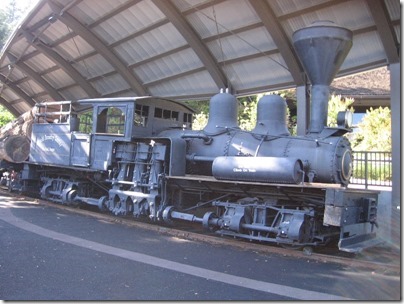
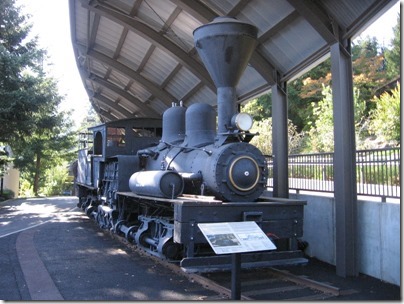
IMG_9418 Lima 2-Truck Shay Steam Locomotive 'Peggy' at the World Forestry Center in Portland, Oregon on September 24, 2009
Lima 2-Truck Shay Locomotive “Peggy” on September 24, 2009

This locomotive is a 42-ton 2-truck Shay built by the Lima Locomotive Works of Lima, Ohio on May 3, 1909.

IMG_9414 Lima 2-Truck Shay Steam Locomotive 'Peggy' at the World Forestry Center in Portland, Oregon on September 24, 2009
Lima 2-Truck Shay Locomotive “Peggy” on September 24, 2009

Shay locomotives are named after their inventor Ephraim Shay (1839-1916) who built a log tramway in Michigan in 1873, but found that horses weren't strong enough to control the logs on hills.

IMG_9408 Lima 2-Truck Shay Steam Locomotive 'Peggy' at the World Forestry Center in Portland, Oregon on September 24, 2009
Lima 2-Truck Shay Locomotive “Peggy” on September 24, 2009

His wooden rails were too weak to support a conventional locomotive, so he mounted a steam engine on a flat car and used gears to transfer the power to the wheels.
IMG_9405 Lima 2-Truck Shay Steam Locomotive 'Peggy' at the World Forestry Center in Portland, Oregon on September 24, 2009
Lima 2-Truck Shay Locomotive “Peggy” on September 24, 2009

Shay convinced the Lima Machine Works of Lima, Ohio to build locomotives based on his design, which he soon patented.

IMG_9379 Lima 2-Truck Shay Steam Locomotive 'Peggy' at the World Forestry Center in Portland, Oregon on September 24, 2009
Lima 2-Truck Shay Locomotive “Peggy” on September 24, 2009

The Lima Machine Works became the Lima Locomotive Works, building over 2,700 Shays of various sizes between 1880 and 1945 (by which time heavy-duty log trucks were replacing logging railroads) and becoming one of the major steam locomotive builders in the United States.
IMG_9403 Lima 2-Truck Shay Steam Locomotive 'Peggy' at the World Forestry Center in Portland, Oregon on September 24, 2009
Lima 2-Truck Shay Locomotive “Peggy” on September 24, 2009

Shay locomotives use vertical steam cylinders with gears to deliver equal torque directly to all the wheels on both sides of the engine at the same time.

IMG_9378 Lima 2-Truck Shay Steam Locomotive 'Peggy' at the World Forestry Center in Portland, Oregon on September 24, 2009
Lima 2-Truck Shay Locomotive “Peggy” on September 24, 2009

The axles are mounted in pairs called trucks that pivot independently to follow the curve of the track.

IMG_9401 Lima 2-Truck Shay Steam Locomotive 'Peggy' at the World Forestry Center in Portland, Oregon on September 24, 2009
Lima 2-Truck Shay Locomotive “Peggy” on September 24, 2009

This design makes them very powerful but very slow and well suited to the poorly constructed tracks with sharp curves and steep grades found on logging railroads.

IMG_9387 Lima 2-Truck Shay Steam Locomotive 'Peggy' at the World Forestry Center in Portland, Oregon on September 24, 2009
Lima 2-Truck Shay Locomotive “Peggy” on September 24, 2009

This 1909 42-ton standard-gauge Shay is a mid-sized Shay.

IMG_9388 Cab of Lima 2-Truck Shay Steam Locomotive 'Peggy' at the World Forestry Center in Portland, Oregon on September 24, 2009
Lima 2-Truck Shay Locomotive “Peggy” on September 24, 2009

It has a 42-inch diameter horizontal fire tube boiler rated for 125 pounds of pressure and three 10-inch diameter cylinders with 12-inch stroke that deliver power through a 2.05 gear ratio to the 29.5-inch wheels.

IMG_9390 Cab of Lima 2-Truck Shay Steam Locomotive 'Peggy' at the World Forestry Center in Portland, Oregon on September 24, 2009
Lima 2-Truck Shay Locomotive “Peggy” on September 24, 2009

It has an empty weight of 67,100 pounds and carried 1,560 gallons of water and 1.5 cords of wood for fuel.

IMG_9392 Cab of Lima 2-Truck Shay Steam Locomotive 'Peggy' at the World Forestry Center in Portland, Oregon on September 24, 2009
Lima 2-Truck Shay Locomotive “Peggy” on September 24, 2009

This locomotive was shipped around Cape Horn to dealer Hofius Steel & Equipment Company in Seattle, Washington and sold to the Gig Harbor Timber Company of Gig Harbor, Washington as their #1.

IMG_9393  Cab of Lima 2-Truck Shay Steam Locomotive 'Peggy' at the World Forestry Center in Portland, Oregon on September 24, 2009
Lima 2-Truck Shay Locomotive “Peggy” on September 24, 2009

In 1913 it was sold to the Stimson Lumber Company and was used first at Belfair, Washington and then at Gaston, Oregon. While at Stimson it was converted to burn oil and was given the name "Peggy."

IMG_9397 Cab of Lima 2-Truck Shay Steam Locomotive 'Peggy' at the World Forestry Center in Portland, Oregon on September 24, 2009
Lima 2-Truck Shay Locomotive “Peggy” on September 24, 2009

In 1933, Peggy was trapped in the Tillamook Forest during a forest fire and all her wood was burned off, but she was rebuilt and returned to service. By the time she was retired in 1950, Peggy had hauled an estimated one-billion feet of logs.

IMG_9395 Cab of Lima 2-Truck Shay Steam Locomotive 'Peggy' at the World Forestry Center in Portland, Oregon on September 24, 2009
Lima 2-Truck Shay Locomotive “Peggy” on September 24, 2009

The Stimson Lumber Company donated Peggy to the City of Portland in 1950 she was put on display outside the Forestry Building in Northwest Portland. She was damaged in the 1964 fire that destroyed the Forestry Building, and was moved to Oaks Amusement Park in Southeast Portland for storage.

IMG_9396 View from the Cab of Lima 2-Truck Shay Steam Locomotive 'Peggy' at the World Forestry Center in Portland, Oregon on September 24, 2009
Lima 2-Truck Shay Locomotive “Peggy” on September 24, 2009

From 1969 to 1971, the Pacific Northwest Chapter of the National Railway Historical Society rebuilt her cab and sills and in 1972 she was moved by truck against traffic up Highway 26 and placed on display behind Cheatham Hall at the new Forestry Center. She remained there in the weather for 30 years, slowly deteriorating.

IMG_9394 Cab of Lima 2-Truck Shay Steam Locomotive 'Peggy' at the World Forestry Center in Portland, Oregon on September 24, 2009
Lima 2-Truck Shay Locomotive “Peggy” on September 24, 2009

In 2003, the Theodore and Joanne Lilley Foundation donated the funds to restore Peggy and place her under a shelter in a prominent location, just as she is today.

IMG_9410 Disconnect Logging Trucks & Logs at the World Forestry Center in Portland, Oregon on September 24, 2009
Disconnect Log Cars on September 24, 2009

Behind Peggy is a pair of Disconnect Log Cars. They are each basically a railroad truck with a coupler at each end, allowing them to be coupled together when empty. When carrying logs, they are separated only by their load with no frame between them, hence the "disconnect" name.

IMG_9374 Disconnect Logging Trucks & Logs at the World Forestry Center in Portland, Oregon on September 24, 2009
Disconnect Log Cars on September 24, 2009

The logs they carry were a gift from the Stimson Lumber Company.

IMG_9373 David Douglas Monument at the World Forestry Center in Portland, Oregon on September 24, 2009
David Douglas Monument on September 24, 2009

This monument in honor of David Douglas was placed by the David Douglas Society of Western North America on December 7, 1992. David Douglas (1799-1834) was a Scottish-born botanist sent to Fort Vancouver by the Royal Horticulture Society to collect plant and seed specimens from Western North America for European gardens from 1825 to 1833. The Douglas Fir Tree is named after him.

IMG_0593 Harry A. Merlo Hall at the World Forestry Center in Portland, Oregon on November 10, 2009
Harry A. Merlo Hall on November 10, 2009

One of the other buildings on the World Forestry Center campus is Harry A. Merlo Hall, pictured here.

Continue to Portland Children’s Museum

Oregon Zoo at Washington Park in Portland, OR

…Continued from Washington Park & Zoo Railway Station.

IMG_0591 Entrance to the Oregon Zoo in Portland, Oregon on November 10, 2009
Entrance to the Oregon Zoo on November 10, 2009

The Oregon Zoo traces its origins back to Portland pharmacist Dr. Richard E. Knight, who in the 1880s acquired, among other exotic animals, a male Brown Bear named Brownie and a female Grizzly Bear named Grace, which he kept in a vacant lot at the corner of Morrison and Third, next to his drug store. In 1887, Knight donated his collection of animals to the city, and the first zoo was established in Washington Park (then called simply City Park), near where the reservoirs are now. In 1925, the zoo moved to higher ground in Washington Park, to where the Japanese Garden is now.

IMG_0592 Store at the Oregon Zoo in Portland, Oregon on November 10, 2009
Oregon Zoo Store on November 10, 2009

In 1951, the Portland City Club recommended building a new zoo and the city council placed a $3.85-million bond issue on the ballot for a new zoo on the 40-acre site of the West Hills Golf Course. The bond measure passed in 1954 and the current zoo opened in 1959 as the Portland Zoological Gardens.

IMG_0321 Concert Lawn & Stage at the Oregon Zoo in Portland, Oregon on November 10, 2009
Oregon Zoo Concert Lawn & Stage on November 10, 2009

The zoo was renamed the Washington Park Zoo in 1976, and was renamed to the current name, Oregon Zoo, in 1998.

IMG_0581 Washington Park & Zoo Railway Station at the Oregon Zoo in Portland, Oregon on November 10, 2009
Washington Park & Zoo Railway Station on November 10, 2009

The 30-inch gauge Portland Zoo Railway began operation June 9, 1958 with the first train, the Zooliner.

IMG_0582 Washington Park & Zoo Railway Station & Water Tower at the Oregon Zoo in Portland, Oregon on November 10, 2009
Washington Park & Zoo Railway Station on November 10, 2009

The Oregon steam locomotive was delivered June 19, 1959 and began operating the next day.

IMG_1037 Washington Park & Zoo Railway 4-4-0 Steam Locomotive #1 at the Oregon Zoo in Portland, Oregon on December 8, 2009
WP&Z Steam Locomotive #1 Oregon on December 8, 2009

The Zooliner and the Oregon were used at the Oregon Centennial Exposition in 1959, and a "Circus Train" was used at the zoo at that time. The "Circus Train" has since been rebuilt as the Oregon Express.

IMG_1039 Washington Park & Zoo Railway 4-4-0 Steam Locomotive #1 at the Oregon Zoo in Portland, Oregon on December 8, 2009
WP&Z Steam Locomotive #1 Oregon on December 8, 2009

In 1961 the railroad was issued its own postal cancellation stamp, which it still retains as the last operating U.S. railroad with its own cancellation to continuously offer mail service.

IMG_1041 Washington Park & Zoo Railway 4-4-0 Steam Locomotive #1 at the Oregon Zoo in Portland, Oregon on December 8, 2009
WP&Z Steam Locomotive #1 Oregon on December 8, 2009

The railroad was renamed the Washington Park & Zoo Railway in 1978.

IMG_1042 Washington Park & Zoo Railway 4-4-0 Steam Locomotive #1 at the Oregon Zoo in Portland, Oregon on December 8, 2009
WP&Z Steam Locomotive #1 Oregon on December 8, 2009

Steam locomotive #1, the Oregon, is shown here under steam decorated for ZooLights on December 8, 2009.

IMG_1043 Washington Park & Zoo Railway Passenger Car at the Oregon Zoo in Portland, Oregon on December 8, 2009
ZooLights at the Oregon Zoo on December 8, 2009

Here are a few more pictures of ZooLights, when the zoo is decorated with Christmas lights for the holiday season.

IMG_1045 Zoolights at the Oregon Zoo in Portland, Oregon on December 8, 2009
ZooLights at the Oregon Zoo on December 8, 2009

The first ZooLights was in 1988.

IMG_1047 Washington Park & Zoo Railway Train at the Oregon Zoo in Portland, Oregon on December 8, 2009
ZooLights at the Oregon Zoo on December 8, 2009

Below is a video of Zoolights taken on December 8, 2009.

ZooLights at the Oregon Zoo on December 8, 2009.


IMG_0580 Wig-Wag Signal at the Washington Park & Zoo Railway at the Oregon Zoo in Portland, Oregon on November 10, 2009
Wig-Wag Signal at the Oregon Zoo on November 10, 2009

This operational Magnetic Flagman, or "Wig-Wag" (for the movement made by the banner as it swings back and forth) Model 3 lower-quadrant crossing signal, made by the Magnetic Signal Company of Los Angeles, California between 1910 and 1949, protects a zoo service road.

IMG_0574 Wig-Wag Signal on the Washington Park & Zoo Railway at the Oregon Zoo in Portland, Oregon on November 10, 2009
Wig-Wag Signal at the Oregon Zoo on November 10, 2009

It was almost certainly originally located at a public railroad crossing somewhere else and moved to the zoo later.

IMG_0575 Wig-Wag Signal on the Washington Park & Zoo Railway at the Oregon Zoo in Portland, Oregon on November 10, 2009
Wig-Wag Signal at the Oregon Zoo on November 10, 2009

It is stenciled "CM 733.7," a milepost which would seem to place it on the Southern Pacific Railroad somewhere in Oregon, though I'm not sure where. I would guess Dallas or McMinnville.

IMG_0576 Wig-Wag Signal on the Washington Park & Zoo Railway at the Oregon Zoo in Portland, Oregon on November 10, 2009
Wig-Wag Signal at the Oregon Zoo on November 10, 2009

The banner has an odd paint scheme of a red cross, instead of a narrower black one, and no border. 

IMG_0325 Zoo Volunteer Anne with Apollo the American Kestrel Falcon at the Oregon Zoo in Portland, Oregon on November 10, 2009
Zoo Volunteer Anne with Apollo the American Kestrel Falcon

Sometimes zoo volunteers can be found around the grounds with animals from the Wild Life Live! program like Apollo the American Kestrel Falcon shown here.

IMG_0324 Apollo the American Kestrel Falcon at the Oregon Zoo in Portland, Oregon on November 10, 2009
Apollo the American Kestrel Falcon on November 10, 2009

IMG_0326 Apollo the American Kestrel Falcon at the Oregon Zoo in Portland, Oregon on November 10, 2009
Apollo the American Kestrel Falcon on November 10, 2009

IMG_0330 Apollo the American Kestrel Falcon at the Oregon Zoo in Portland, Oregon on November 10, 2009
Apollo the American Kestrel Falcon on November 10, 2009

IMG_0329 Zoo Volunteer with Sundance the Red-Tailed Hawk at the Oregon Zoo in Portland, Oregon on November 10, 2009
Zoo Volunteer with Sundance the Red-Tailed Hawk

Another animal from the Wild Life Live! program is Sundance the Red-Tailed Hawk.

IMG_0327 Sundance the Red-Tailed Hawk at the Oregon Zoo in Portland, Oregon on November 10, 2009
Sundance the Red-Tailed Hawk on November 10, 2009

IMG_0331 Sundance the Red-Tailed Hawk at the Oregon Zoo in Portland, Oregon on November 10, 2009
Sundance the Red-Tailed Hawk on November 10, 2009

IMG_0333 Sundance the Red-Tailed Hawk at the Oregon Zoo in Portland, Oregon on November 10, 2009
Sundance the Red-Tailed Hawk on November 10, 2009

Great Northwest Exhibit
Trillium Creek Family Farm
Pacific Shores Exhibit
Primates & Fragile Forests Exhibits
Inland Pigs of Asia Exhibit
Asian Elephant Exhibit
Predators of the Serengeti Exhibit
Africa Savanna & Rain Forest Exhibits
Lorikeet Landing
Insect Zoo

Continue to Great Northwest Exhibit