 |
| Milwaukee & Madison Railroad Depot in Waukesha, Wisconsin, on November 19, 2001 |
The Milwaukee & Madison Railroad Company was organized on May 15, 1880 to build a railroad between its two namesake Wisconsin cities, and this depot of local limestone and cream-colored brick was built in Waukesha, Wisconsin, in 1881. Designed by Chicago-area architect William Warren Boyington and constructed by local carpenter Samuel Dodd, the depot’s architecture has been described as Stick style, Queen Anne, and Victorian Gothic. The Milwaukee & Madison Railroad Company was consolidated into the Chicago, Milwaukee & North Western Railway Company on March 19, 1881. The first passenger train arrived from Madison on February 1, 1882. On June 7, 1883, The Chicago, Milwaukee & North Western Railway Company was consolidated into the Chicago & North Western Railway Company.
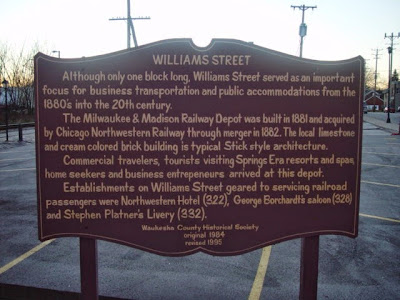 |
| Williams Street Sign at the Milwaukee & Madison Railroad Depot in Waukesha, Wisconsin, on November 19, 2001 |
The depot is located at 319 Williams Street in Waukesha. Although only one block long, Williams Street was an important focal point for business transportation and public accommodations from the 1880s and into the 20th century, as commercial travelers, tourists visiting the Springs Era resorts and spas, home seekers, and business entrepreneurs arrived in Waukesha at this depot, which served 16 trains a day at its peak. Other businesses on Williams Street that served railroad passengers included the Northwestern Hotel at 322 Williams Street, George Borchardt’s saloon at 328 Williams Street, and Stephen Platner’s Livery at 332 Williams Street.
 |
| Milwaukee & Madison Railroad Depot in Waukesha, Wisconsin, on November 19, 2001 |
This depot also served as a terminal for the Waukesha Beach Railway, an electric interurban railroad which was formed on August 27, 1894 with $75,000 in capital. This six-mile railroad was built by C. E. Loss & Company of Chicago to the shore of Pewaukee Lake, where the railroad built the Waukesha Beach Amusement Park. The 20-acre park featured a swimming beach on the lake, the Palm Gardens Ballroom, a hotel, 3 roller coasters, a fun house and other amusement rides. The Waukesha Beach Railway began operating its first summer season on June 15, 1895, with the formal opening of the railroad and the park on June 25, 1895. The six-mile trip to the park took about 15 minutes, with scheduled trains every 40 minutes. The Waukesha Beach Railway was purchased by The Milwaukee Electric Railway & Light Company in August 1897. Originally intended for operation only during the summer season, the line was connected to the rest of The Milwaukee Electric Railway & Light Company system, and year-round service began on December 11, 1899. Operations of the Waukesha Beach Amusement Park ended on July 21, 1941, with the park and beach closing entirely in 1949.
 |
| Milwaukee & Madison Railroad Depot in Waukesha, Wisconsin, on November 19, 2001 |
On October 14, 1948, President Harry S. Truman made a ten-minute speech at this depot in front of 10,000 people. The Milwaukee Electric Railway & Light Company ceased operations on July 2, 1951, and the last Chicago & North Western passenger train ran stopped in Waukesha on June 16, 1957. While freight service continued, the depot was vacated by the railroad in 1964 and remained empty until 1973, when it was purchased and converted into a railroad-themed restaurant by Edward Friend of Hubertus, Wisconsin, with a train of heavyweight passenger cars for restaurant patrons to dine in.
 |
| Milwaukee & Madison Railroad Depot in Waukesha, Wisconsin, on November 19, 2001 |
These cars, lettered for the fictitious Waukesha & Western, were previously owned by the Gulf, Mobile & Ohio Railroad. The Gulf, Mobile & Ohio Railroad was created on September 13, 1940, by the merger of the Gulf, Mobile and Northern Railroad, which was created in 1917 as a reorganization of the New Orleans, Mobile and Chicago Railroad, and the Mobile and Ohio Railroad, which was chartered in 1848. On August 10, 1972, the Gulf, Mobile and Ohio Railroad merged with the Illinois Central Railroad to form the Illinois Central Gulf Railroad. The name changed back to Illinois Central Railroad on February 29, 1988.
 |
| Coach-Observation #212 Prairieville at the Milwaukee & Madison Railroad Depot in Waukesha, Wisconsin, on November 19, 2001 |
"Waukesha & Western" Coach-Observation #212
Prairieville was built by Pullman in 1927 as Mobile & Ohio #212, and it later became Gulf, Mobile & Ohio #212. This car was not built as an open-platform observation car; it appears one of the vestibules was cut away to create the open platform after the car was purchased for the restaurant.
 |
| Coach #217 "Bethesda" at the Milwaukee & Madison Railroad Depot in Waukesha, Wisconsin, on November 19, 2001 |
"Waukesha & Western "Coach #217
Bethesda was previously Gulf, Mobile & Ohio #217, and was originally Mobile & Ohio #217. It may be from the same order as coach #212.
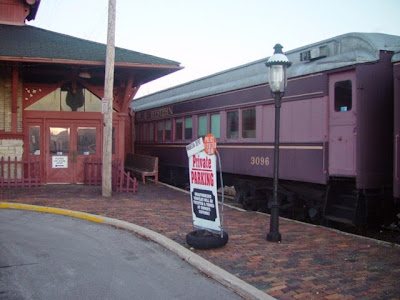 |
| Coach #3096 at the Milwaukee & Madison Railroad Depot in Waukesha, Wisconsin, on November 19, 2001 |
"Waukesha & Western" Coach #3096 was built by Pullman in 1923 as Chicago & Alton Railroad #325
Webster Groves, for the 1924
Alton Limited between Chicago and St. Louis. The
Alton Limited was originally introduced in 1899, and two new 6-car consists were built for the 1924 train at a cost of 1 million dollars. The Chicago and Alton Railroad was created on October 10, 1862, in a reorganization of the St. Louis, Alton and Chicago Railroad, and could trace its history back to the Alton and Sangamon Railroad, which was chartered February 27, 1847. In 1931 the Baltimore & Ohio Railroad purchased the Chicago and Alton Railroad and renamed it The Alton Railroad Company, before eventually ceding the bankrupt Alton Railroad to the courts in 1942. The Alton was merged into the Gulf, Mobile and Ohio Railroad on May 31, 1947, and this car became Gulf, Mobile & Ohio #3096.
 |
| Coach #326 at the Milwaukee & Madison Railroad Depot in Waukesha, Wisconsin, on November 19, 2001 |
"Waukesha & Western" Coach # 326 was previously Gulf, Mobile & Ohio #326, and was originally Mobile & Ohio #326.
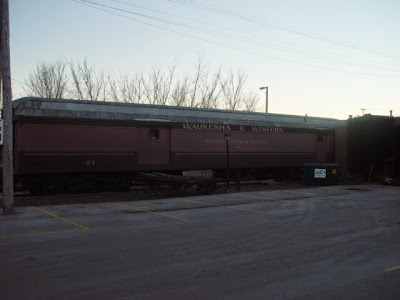 |
| Baggage Car #94 at the Milwaukee & Madison Railroad Depot in Waukesha, Wisconsin, on November 19, 2001 |
The history of "Waukesha & Western" Baggage Car #94 is not documented, but it is presumably a former Gulf, Mobile & Ohio Baggage Car that may have been originally owned by the Mobile & Ohio.
 |
| Milwaukee & Madison Railroad Depot in Waukesha, Wisconsin, on November 19, 2001 |
There was originally a steam locomotive at the head of the display train: Soo Line 4-6-0 #2645, built by Brooks Locomotive Works in 1900 as Wisconsin Central #247. Soo Line leased the Wisconsin Central in 1909. The last 4-6-0 in service on the Soo Line, it was retired in 1952 with over 1 million miles of service and was donated to the city of Waukesha on October 29, 1952, and placed on static display in Frame Park, where it would stay until it became part of the restaurant in 1972.
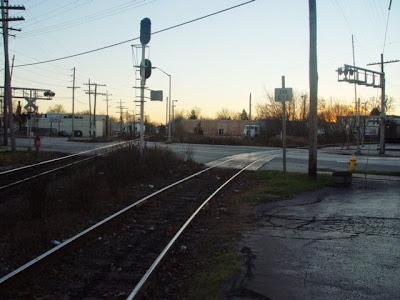 |
| Wisconsin & Southern and Wisconsin Central Rail Lines at the Milwaukee & Madison Railroad Depot in Waukesha, Wisconsin, on November 19, 2001 |
The Chicago & North Western abandoned its line from Waukesha to Cottage Grove in 1983. This left the tracks running past the depot as only a connection to the nearby former Chicago, Milwaukee, St. Paul & Pacific branch line from Milton Jct. through Waukesha, which had been purchased by the Wisconsin Department of Transportation on February 26, 1980, for $266.677. The operation of this line was leased to the Central Wisconsin Railroad Company on March 4, 1980. The Central Wisconsin Railroad filed for bankruptcy in December 1984, and in January 1985 the Chicago West Pullman Railroad’s Wisconsin & Calumet Railroad took over operations. In 1987 the Wisconsin River Rail Transit Commission assumed jurisdiction over the line. In 1988, plans were made for a new connection between the Wisconsin & Calumet’s former C&NW line and the Wisconsin Central’s former Soo Line track to allow most of the former Chicago, Milwaukee, St. Paul & Pacific track to be removed. This would require a curved track following a path that the steam locomotive was blocking. On September 20, 1988, the Waukesha City Council donated the steam locomotive to the Mid-Continent Railway Museum in North Freedom, Wisconsin, where it arrived in July 1989 and remains today. This connection marks the southern end of the Wisconsin & Southern Railroad’s trackage rights over the Wisconsin Central. The Wisconsin & Southern Railroad acquired the Wisconsin & Calumet in August 1992, and the trackage rights over the Wisconsin Central are the only connection between the Wisconsin& Southern’s original lines in the north and the former Wisconsin & Calumet lines in the south.
 |
| Caboose at the Milwaukee & Madison Railroad Depot in Waukesha, Wisconsin, on November 19, 2001 |
Also at the depot is a 28’ steel cupola caboose, built in 1941 as Illinois Central #9803. This caboose was built on an underframe from an Illinois Central gondola car, and features side doors used for collecting train orders while in motion.
 |
| Depot Barber Shop Sign at the Milwaukee & Madison Railroad Depot in Waukesha, Wisconsin, on November 19, 2001 |
This caboose was the home of the Depot Barber Shop at 321 Williams Street. The barbershop was operated by Clarence “Butch” Mareno. At the age of 83 in 2001, he was one of the oldest barbers in Wisconsin, having been cutting hair in Waukesha for 66 years.
 |
| Milwaukee & Madison Railroad Depot in Waukesha, Wisconsin, on November 19, 2001 |
There are also at least three freight cars at the depot, two along Williams Street with the caboose, and one more closer to the depot building. These cars have their sides covered with metal siding, hiding their original sides and making them difficult to identify, but they have stirrup steps near the middle where the doors would have been, suggesting they were insulated box cars or refrigerator cars, which would allow for their potential use as restaurant storage.
 |
| Freight Cars at the Milwaukee & Madison Railroad Depot in Waukesha, Wisconsin, on November 19, 2001 |
The easternmost car along Williams Street appears to have ice hatches on the roof, indicating it was a refrigerator car. The running boards on the others suggest they were boxcars. The dreadnought steel ends on the cars are not covered with siding, suggesting these cars might have wood-sheathed sides. Wood-sheathed insulated boxcars would have been unusual, though they might have started out as refrigerator cars and had their ice hatches removed.
 |
| Milwaukee & Madison Railroad Depot in Waukesha, Wisconsin, on November 19, 2001 |
The Depot was designated a Local Landmark in 1992. It was placed on the Wisconsin State Register of Historic Places on October 24, 1994, and on the National Register of Historic Places on February 24, 1995.
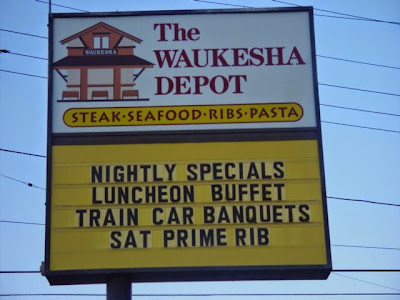 |
| The Waukesha Depot Restaurant Sign at the Milwaukee & Madison Railroad Depot in Waukesha, Wisconsin, on November 19, 2001 |
Known as the Waukesha Depot Restaurant through 2001, in 2002 it would be purchased by Tony Marquéz and converted into a Mexican restaurant called La Estacíon.


%20Signal%20&%20Former%20Union%20Pacific%20Caboose%20%2325584%20at%20the%20Canby%20Depot%20Museum%20in%20Canby,%20Oregon%20on%20May%2011,%202007.JPG "Union Pacific Caboose #25584 at the Canby Depot Museum in Canby, Oregon, on May 11, 2007")
%20Signal%20&%20Former%20Union%20Pacific%20Caboose%20%2325584%20at%20the%20Canby%20Depot%20Museum%20in%20Canby,%20Oregon%20on%20May%2011,%202007.JPG "Union Pacific Caboose #25584 at the Canby Depot Museum in Canby, Oregon, on May 11, 2007")


%20Signal%20at%20the%20Canby%20Depot%20Museum%20in%20Canby,%20Oregon%20on%20May%2011,%202007.JPG "Magnetic Flagman \"Wig-Wag\" Crossing Signal at the Canby Depot Museum in Canby, Oregon, on May 11, 2007")
%20Signal%20at%20the%20Canby%20Depot%20Museum%20in%20Canby,%20Oregon%20on%20May%2011,%202007.JPG "Magnetic Flagman \"Wig-Wag\" Crossing Signal at the Canby Depot Museum in Canby, Oregon, on May 11, 2007")
%20Signal%20at%20the%20Canby%20Depot%20Museum%20in%20Canby,%20Oregon%20on%20May%2011,%202007.JPG "Magnetic Flagman \"Wig-Wag\" Crossing Signal at the Canby Depot Museum in Canby, Oregon, on May 11, 2007")


