 |
| Photo by Cliff West |
On our family's California trip, after leaving the Towe Ford Museum in Sacramento on March 16, 1992, we headed straight for San Francisco and arrived just in time to catch the last outbound trip to Alcatraz Island.
 |
| Photo by Cliff West |
The first use of Alcatraz Island was as a US Military fort. Fort Alcatraz opened in December 1859. At the time, it was America's most powerful West Coast Defense. Throughout the 1800s, the fort was used as a military prison. In 1907, the fort was officially redesignated as a military prison. In 1933, the military prison closed. In 1934, the facility became part of the Federal prison system. Some of the more well-known prisoners held at Alcatraz were Al Capone, George "Machine Gun" Kelly and Robert Franklin Stroud, the "Birdman of Alcatraz."
 |
| Photo by Cliff West |
The Federal prison was closed Thursday, March 21, 1963. It had housed a total of 1,545 prisoners; from 222 to 302 at one time. The island's facilities remained mostly abandoned (except for a few unofficial Indian occupations in the late 1960s) until 1972 when it fell under the jurisdiction of the National Parks Service.
 |
| Photo by Cliff West |
The Golden Gate Bridge (actually, its color is International Orange, not gold) is the most famous bridge designed by noted bridge designer Joseph B. Strauss, who designed over 100 bridges, including many of Chicago's lift bridges over the Chicago River, the operating mechanism for the Burnside Bridge in Portland, Oregon and the Lewis & Clark Bridge over the Columbia River between Rainier, Oregon and Longview, Washington. Construction began January 5, 1933, and when the bridge opened to pedestrian traffic May 27, 1937, it was ahead of schedule and under budget. The bridge opened to auto traffic at noon the next day. The bridge is 9,266 feet long, and the main span (between the towers) is 4,200 feet. This was the longest suspension span in the world until the Verrazano Narrows Bridge in New York City (which is 60 feet longer) opened on November 21, 1964. Today it is the seventh-longest suspension span in the world. On average, 100,000 vehicles cross the bridge every day, and over 1 billion have crossed since it opened. The Golden Gate Bridge was named one of the Seven Wonders of the Modern World by the American Society of Civil Engineers on February 16, 1994.
 |
| Photo by Cliff West |
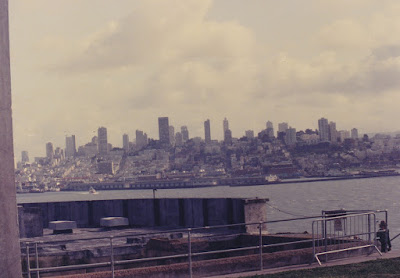
Here is a view of the San Francisco skyline from Alcatraz Island. The point of land at the northern tip of the San Francisco Peninsula was first colonized by the Spanish in 1776. At that time, the location was known as Nova Albion. It was renamed Yerba Buena by American Captain John Montgomery of the USS Portsmouth on July 9, 1846. It became San Francisco on January 30, 1847. With a population of about 776,000 people, San Francisco is the fourth largest city in the state of California. A total of about 7 million people live in the San Francisco metro area. The City of San Francisco and San Francisco County are considered a consolidated city-county. Essentially, the city and county are under a single, unified government that fills all the needs and takes all responsibilities of both city and county government.
 |
| Photo by Cliff West |
The first lighthouse in California was built here from 1852 to 1854. At 5:12 AM on the morning of April 18, 1906, an earthquake measuring 8.25 on the Richter scale shook San Francisco for 48 seconds, resulting in the deaths of over 3,000 people. The original lighthouse was damaged in the earthquake, and was replaced by this one in 1909. This lighthouse is 84 feet tall. It was automated in 1963. It contains a 200,000 candlepower beacon.
 |
| Photo by Cliff West |
The Alcatraz cellhouse was built in 1912 on the foundations of the old Fort Alcatraz from the 1860s. Constructed at a cost of $250,000, the 500-foot long concrete building was reportedly the longest concrete building in the world at the time. In 1934, it was modernized at a cost of $260,000 for use as a federal prison. The cellhouse contains 378 cells, and has an administration building at one end.
 |
| Photo by Cliff West |
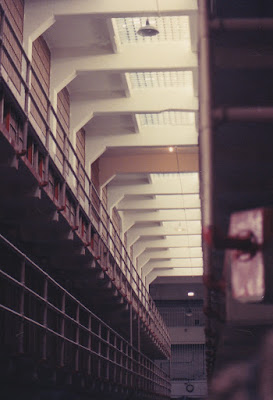
The cells are arranged in four three-tiered cellblocks, with no cell touching an exterior wall. Most prisoner were housed in B-Block or C-Block. A-Block was generally not used as it was never modernized from its military prison days. The worst prisoners found themselves in D-Block, which was used for solitary confinement and included the five isolation cells known as "The Hole." The corridors between the cellblocks were named. The main central corridor between B-Block and C-Block (pictured above) was called "Broadway," and connected to "Times Square," the corridor connecting the cellhouse to the dining hall. Other corridors were "Michigan Avenue" between A-Block and B-Block, "Park Avenue" between C-Block and the Library (adjacent to D-Block), "Sunrise Alley" on the far side of A-Block, and "Sunset Strip" on the far side of D-Block,
 |
| Photo by Cliff West |
Each of the 378 cell measured 9 feet deep by 5 feet wide by 7 feet high. The sparse cells contained only a bed, desk, washbasin and toilet. Hot water was not supplied to the washbasins until the 1960s.
 |
| Photo by Cliff West |
Inside the cells, prisoners were allowed to have books (up to three from the prison library, plus 12 textbooks, a dictionary, and a bible), magazines, personal papers, a calendar and a musical instrument, and were provided with a mirror and radio headphones.
 |
| Photo by Cliff West |
This display lists some of the more well-known Alcatraz prisoners, with the crimes they were convicted of and their years at Alcatraz.
INFAMOUS INMATES
George "Machine Gun" Kelly
Kidnapping
1934-1951
Al "Scarface" Capone
Tax Evasion
1934-1939
Robert Stroud "Birdman of Alcatraz"
Manslaughter, Murder
1942-1959
Meyer "Mickey" Cohen
Racketeering
1961-1962
Alvin "Creepy" Karpis
Kidnapping, Bank Robbery
1936-1962
Arthur "Doc" Barker
Kidnapping
1935-1939
"The inmates of Alcatraz were numerous as far as public enemies went."
-former Alcatraz convict, 1941-1953
 |
| Photo by Cliff West |
The dining hall was connected to the cellhouse by the "Times Square" corridor. The dining room seated over 250 people. Prisoners, guards and officials all dined together. Prisoners were allowed to eat all they wanted during their 20 minute mealtimes, but they had to eat all they took. All of the food was prepared by inmates and was reportedly the best in the entire US prison system.
 |
| Photo by Cliff West |
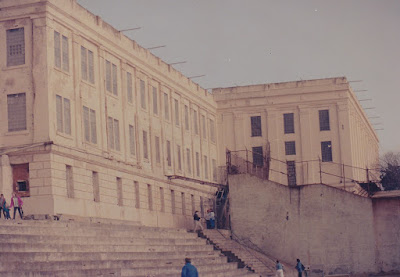
In this picture, the dining hall is on the left, and the cellhouse is on the right, attached to it. In addition to the dining hall itself, the dining hall building also contained the kitchen. On the top floor was the hospital, as well as an auditorium where movies were screened for the inmates on weekends.
 |
| Photo by Cliff West |
The recreation yard was adjacent to the dining hall. surrounded by a high concrete wall topped with a chain-link fence. Originally a dirt-covered yard when the federal prison opened in 1934, the recreation yard was paved in 1936.
 |
| Photo by Cliff West |
Inmates were allowed in the yard for up to five hours on Saturdays, Sundays and holidays, with some prisoners also rewarded with short yard breaks on weekdays. Prisoners played baseball, softball, basketball, and chess.
 |
| Photo by Cliff West |
The oddly-shaped Model Industries Building was originally built by the U.S. Military. It contained the laundry as well as workshops for inmates to work in. The guard tower on the roof was added in June 1936, but has disappeared since this picture was taken.
Also visible in the foreground of this picture is the roof of the New Industries Building. This 306-foot long two-story building was constructed in 1939 at a cost of $186,000. The ground floor contained a clothing factory, a dry cleaning plant, a furniture plant, a brush factory, and an office, while the second floor housed the laundry. Prisoners earned money working in these facilities.
 |
| Photo by Cliff West |
This view of San Francisco from Alcatraz shows the distance across the bay that prevented escaping to freedom. While a few inmates did manage to get off the island, none are known to have survived the watery expanse.
 |
| Photo by Cliff West |
Here is another view of the Golden Gate Bridge from Alcatraz Island. The island's location in San Francisco Bay offers views of both the Golden Gate Bridge and the San Francisco-Oakland Bay Bridge.
 |
| Photo by Cliff West |
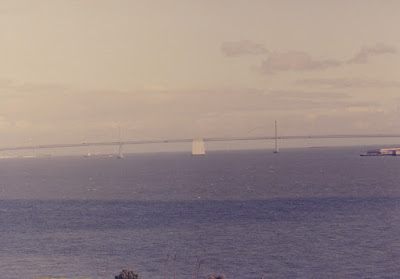
This is the San Francisco-Oakland Bay Bridge. Built from July 9, 1933 to November 12, 1936, the double-deck connection of Interstate 80 between Oakland and San Francisco is actually two separate bridges. The 9,260-foot West Span (pictured) is two suspension bridges connected end-to-end at a man-made anchor point. The towers of the West Span are 526 feet tall, and the bridge has 220 feet of vertical clearance above the bay. The 10,176-foot East Span (not pictured) is a combination of cantilever beams and trusses. The two spans meet at Yerba Buena Island, where they are connected by a 1,700-foot tunnel. The tunnel, at 76 feet wide and 56 feet high, is the largest-diameter bore in the world. On average, 280,000 vehicles make this crossing every day.
On October 17, 1989, the Loma Prieta earthquake caused a 50-foot section of the upper deck of the East Span to collapse onto the lower deck. The bridge was closed for a month for repairs. Today, a new East Span has been built.
 |
| Photo by Cliff West |
This is the guard tower at the Alcatraz Wharf. From this tower, guards could watch over every vessel that came and went. On the right is the corner of Building 64, which was originally built in 1905 on the site of an old Army barracks from the 1860s. Originally used as barracks for the military guards from 1906 to 1933, it was used as residential apartments for the federal guards and other prison personnel when Alcatraz became a federal prison. Treasure Island and Oakland are visible in the distance.
 |
| Photo by Cliff West |
Here is the Red & White Fleet's passenger ferry Royal Star at the Alcatraz Wharf boarding passengers for the trip back to San Francisco. The Royal Star remains in service on San Francisco Bay, but is now operated by the Blue & Gold Fleet.
 |
| Photo by Cliff West |
Here is a view of San Francisco from the deck of the Royal Star. The Coit Tower (center), located on the top of Telegraph Hill, is 210 feet tall and was completed in 1933. Its Art Deco design resembles the nozzle of a fire hose. Coit Tower was built from funds willed to San Francisco by firefighter admirer and supporter Elizabeth Wyche "Lillie" Hitchcock-Coit in 1929. The distinctive TransAmerica Pyramid (far right), at 600 Montgomery Street, was built from 1969 to 1972. It is 853 feet tall, and its 48 floors house a total of 530,000 square feet of office space.


