Showing posts with label Passenger Car. Show all posts

Wednesday, May 20, 2020

Milwaukee & Madison Railroad Waukesha Depot

Milwaukee & Madison Railroad Depot in Waukesha, Wisconsin, on November 19, 2001

The Milwaukee & Madison Railroad Company was organized on May 15, 1880 to build a railroad between its two namesake Wisconsin cities, and this depot of local limestone and cream-colored brick was built in Waukesha, Wisconsin, in 1881. Designed by Chicago-area architect William Warren Boyington and constructed by local carpenter Samuel Dodd, the depot’s architecture has been described as Stick style, Queen Anne, and Victorian Gothic. The Milwaukee & Madison Railroad Company was consolidated into the Chicago, Milwaukee & North Western Railway Company on March 19, 1881. The first passenger train arrived from Madison on February 1, 1882. On June 7, 1883, The Chicago, Milwaukee & North Western Railway Company was consolidated into the Chicago & North Western Railway Company.

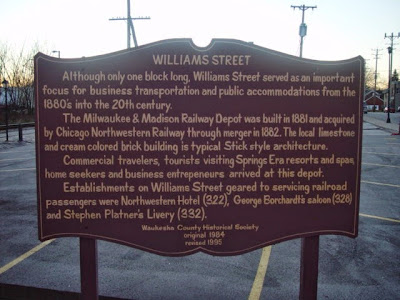
Williams Street Sign at the Milwaukee & Madison Railroad Depot in Waukesha, Wisconsin, on November 19, 2001
Williams Street Sign at the Milwaukee & Madison Railroad Depot in Waukesha, Wisconsin, on November 19, 2001

The depot is located at 319 Williams Street in Waukesha. Although only one block long, Williams Street was an important focal point for business transportation and public accommodations from the 1880s and into the 20th century, as commercial travelers, tourists visiting the Springs Era resorts and spas, home seekers, and business entrepreneurs arrived in Waukesha at this depot, which served 16 trains a day at its peak. Other businesses on Williams Street that served railroad passengers included the Northwestern Hotel at 322 Williams Street, George Borchardt’s saloon at 328 Williams Street, and Stephen Platner’s Livery at 332 Williams Street.

Milwaukee & Madison Railroad Depot in Waukesha, Wisconsin, on November 19, 2001

This depot also served as a terminal for the Waukesha Beach Railway, an electric interurban railroad which was formed on August 27, 1894 with $75,000 in capital. This six-mile railroad was built by C. E. Loss & Company of Chicago to the shore of Pewaukee Lake, where the railroad built the Waukesha Beach Amusement Park. The 20-acre park featured a swimming beach on the lake, the Palm Gardens Ballroom, a hotel, 3 roller coasters, a fun house and other amusement rides. The Waukesha Beach Railway began operating its first summer season on June 15, 1895, with the formal opening of the railroad and the park on June 25, 1895. The six-mile trip to the park took about 15 minutes, with scheduled trains every 40 minutes. The Waukesha Beach Railway was purchased by The Milwaukee Electric Railway & Light Company in August 1897. Originally intended for operation only during the summer season, the line was connected to the rest of The Milwaukee Electric Railway & Light Company system, and year-round service began on December 11, 1899. Operations of the Waukesha Beach Amusement Park ended on July 21, 1941, with the park and beach closing entirely in 1949.

Milwaukee & Madison Railroad Depot in Waukesha, Wisconsin, on November 19, 2001

On October 14, 1948, President Harry S. Truman made a ten-minute speech at this depot in front of 10,000 people. The Milwaukee Electric Railway & Light Company ceased operations on July 2, 1951, and the last Chicago & North Western passenger train ran stopped in Waukesha on June 16, 1957. While freight service continued, the depot was vacated by the railroad in 1964 and remained empty until 1973, when it was purchased and converted into a railroad-themed restaurant by Edward Friend of Hubertus, Wisconsin, with a train of heavyweight passenger cars for restaurant patrons to dine in.

Milwaukee & Madison Railroad Depot in Waukesha, Wisconsin, on November 19, 2001

These cars, lettered for the fictitious Waukesha & Western, were previously owned by the Gulf, Mobile & Ohio Railroad. The Gulf, Mobile & Ohio Railroad was created on September 13, 1940, by the merger of the Gulf, Mobile and Northern Railroad, which was created in 1917 as a reorganization of the New Orleans, Mobile and Chicago Railroad, and the Mobile and Ohio Railroad, which was chartered in 1848. On August 10, 1972, the Gulf, Mobile and Ohio Railroad merged with the Illinois Central Railroad to form the Illinois Central Gulf Railroad. The name changed back to Illinois Central Railroad on February 29, 1988.

Coach-Observation #212 "Prairieville" at the Milwaukee & Madison Railroad Depot in Waukesha, Wisconsin, on November 19, 2001
Coach-Observation #212 Prairieville at the Milwaukee & Madison Railroad Depot in Waukesha, Wisconsin, on November 19, 2001

"Waukesha & Western" Coach-Observation #212 Prairieville was built by Pullman in 1927 as Mobile & Ohio #212, and it later became Gulf, Mobile & Ohio #212. This car was not built as an open-platform observation car; it appears one of the vestibules was cut away to create the open platform after the car was purchased for the restaurant.

Coach #217 "Bethesda" at the Milwaukee & Madison Railroad Depot in Waukesha, Wisconsin, on November 19, 2001
Coach #217 "Bethesda" at the Milwaukee & Madison Railroad Depot in Waukesha, Wisconsin, on November 19, 2001

"Waukesha & Western "Coach #217 Bethesda was previously Gulf, Mobile & Ohio #217, and was originally Mobile & Ohio #217. It may be from the same order as coach #212.

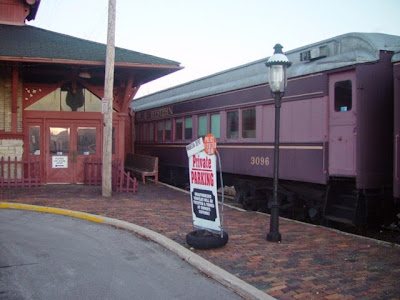
Coach #3096 at the Milwaukee & Madison Railroad Depot in Waukesha, Wisconsin, on November 19, 2001
Coach #3096 at the Milwaukee & Madison Railroad Depot in Waukesha, Wisconsin, on November 19, 2001

"Waukesha & Western" Coach #3096 was built by Pullman in 1923 as Chicago & Alton Railroad #325 Webster Groves, for the 1924 Alton Limited between Chicago and St. Louis. The Alton Limited was originally introduced in 1899, and two new 6-car consists were built for the 1924 train at a cost of 1 million dollars. The Chicago and Alton Railroad was created on October 10, 1862, in a reorganization of the St. Louis, Alton and Chicago Railroad, and could trace its history back to the Alton and Sangamon Railroad, which was chartered February 27, 1847. In 1931 the Baltimore & Ohio Railroad purchased the Chicago and Alton Railroad and renamed it The Alton Railroad Company, before eventually ceding the bankrupt Alton Railroad to the courts in 1942. The Alton was merged into the Gulf, Mobile and Ohio Railroad on May 31, 1947, and this car became Gulf, Mobile & Ohio #3096.

Coach #326 at the Milwaukee & Madison Railroad Depot in Waukesha, Wisconsin, on November 19, 2001
Coach #326 at the Milwaukee & Madison Railroad Depot in Waukesha, Wisconsin, on November 19, 2001

"Waukesha & Western" Coach # 326 was previously Gulf, Mobile & Ohio #326, and was originally Mobile & Ohio #326.

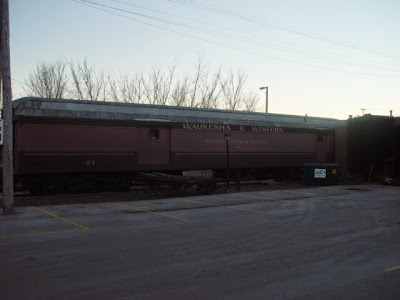
Baggage Car #94 at the Milwaukee & Madison Railroad Depot in Waukesha, Wisconsin, on November 19, 2001
Baggage Car #94 at the Milwaukee & Madison Railroad Depot in Waukesha, Wisconsin, on November 19, 2001

The history of "Waukesha & Western" Baggage Car #94 is not documented, but it is presumably a former Gulf, Mobile & Ohio Baggage Car that may have been originally owned by the Mobile & Ohio.

Milwaukee & Madison Railroad Depot in Waukesha, Wisconsin, on November 19, 2001

There was originally a steam locomotive at the head of the display train: Soo Line 4-6-0 #2645, built by Brooks Locomotive Works in 1900 as Wisconsin Central #247. Soo Line leased the Wisconsin Central in 1909. The last 4-6-0 in service on the Soo Line, it was retired in 1952 with over 1 million miles of service and was donated to the city of Waukesha on October 29, 1952, and placed on static display in Frame Park, where it would stay until it became part of the restaurant in 1972.

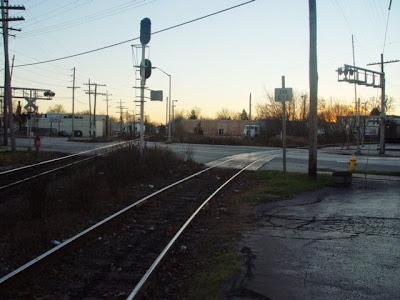
Wisconsin & Southern and Wisconsin Central Rail Lines at the Milwaukee & Madison Railroad Depot in Waukesha, Wisconsin, on November 19, 2001

The Chicago & North Western abandoned its line from Waukesha to Cottage Grove in 1983. This left the tracks running past the depot as only a connection to the nearby former Chicago, Milwaukee, St. Paul & Pacific branch line from Milton Jct. through Waukesha, which had been purchased by the Wisconsin Department of Transportation on February 26, 1980, for $266.677. The operation of this line was leased to the Central Wisconsin Railroad Company on March 4, 1980. The Central Wisconsin Railroad filed for bankruptcy in December 1984, and in January 1985 the Chicago West Pullman Railroad’s Wisconsin & Calumet Railroad took over operations. In 1987 the Wisconsin River Rail Transit Commission assumed jurisdiction over the line. In 1988, plans were made for a new connection between the Wisconsin & Calumet’s former C&NW line and the Wisconsin Central’s former Soo Line track to allow most of the former Chicago, Milwaukee, St. Paul & Pacific track to be removed. This would require a curved track following a path that the steam locomotive was blocking. On September 20, 1988, the Waukesha City Council donated the steam locomotive to the Mid-Continent Railway Museum in North Freedom, Wisconsin, where it arrived in July 1989 and remains today. This connection marks the southern end of the Wisconsin & Southern Railroad’s trackage rights over the Wisconsin Central. The Wisconsin & Southern Railroad acquired the Wisconsin & Calumet in August 1992, and the trackage rights over the Wisconsin Central are the only connection between the Wisconsin& Southern’s original lines in the north and the former Wisconsin & Calumet lines in the south.

Caboose at the Milwaukee & Madison Railroad Depot in Waukesha, Wisconsin, on November 19, 2001
Caboose at the Milwaukee & Madison Railroad Depot in Waukesha, Wisconsin, on November 19, 2001

Also at the depot is a 28’ steel cupola caboose, built in 1941 as Illinois Central #9803. This caboose was built on an underframe from an Illinois Central gondola car, and features side doors used for collecting train orders while in motion.

Depot Barber Shop Sign at the Milwaukee & Madison Railroad Depot in Waukesha, Wisconsin, on November 19, 2001
Depot Barber Shop Sign at the Milwaukee & Madison Railroad Depot in Waukesha, Wisconsin, on November 19, 2001

This caboose was the home of the Depot Barber Shop at 321 Williams Street. The barbershop was operated by Clarence “Butch” Mareno. At the age of 83 in 2001, he was one of the oldest barbers in Wisconsin, having been cutting hair in Waukesha for 66 years.

Milwaukee & Madison Railroad Depot in Waukesha, Wisconsin, on November 19, 2001

There are also at least three freight cars at the depot, two along Williams Street with the caboose, and one more closer to the depot building. These cars have their sides covered with metal siding, hiding their original sides and making them difficult to identify, but they have stirrup steps near the middle where the doors would have been, suggesting they were insulated box cars or refrigerator cars, which would allow for their potential use as restaurant storage.

Freight Cars at the Milwaukee & Madison Railroad Depot in Waukesha, Wisconsin, on November 19, 2001
Freight Cars at the Milwaukee & Madison Railroad Depot in Waukesha, Wisconsin, on November 19, 2001

The easternmost car along Williams Street appears to have ice hatches on the roof, indicating it was a refrigerator car. The running boards on the others suggest they were boxcars. The dreadnought steel ends on the cars are not covered with siding, suggesting these cars might have wood-sheathed sides. Wood-sheathed insulated boxcars would have been unusual, though they might have started out as refrigerator cars and had their ice hatches removed.


Milwaukee & Madison Railroad Depot in Waukesha, Wisconsin, on November 19, 2001

The Depot was designated a Local Landmark in 1992. It was placed on the Wisconsin State Register of Historic Places on October 24, 1994, and on the National Register of Historic Places on February 24, 1995.

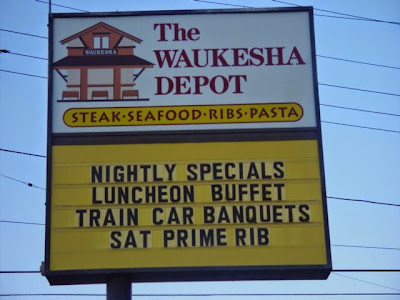
The Waukesha Depot Restaurant Sign at the Milwaukee & Madison Railroad Depot in Waukesha, Wisconsin, on November 19, 2001
The Waukesha Depot Restaurant Sign at the Milwaukee & Madison Railroad Depot in Waukesha, Wisconsin, on November 19, 2001

Known as the Waukesha Depot Restaurant through 2001, in 2002 it would be purchased by Tony Marquéz and converted into a Mexican restaurant called La Estacíon.

Wednesday, February 28, 2018

1992 California Trip: California Western Railroad

California Western GP9R #64 at Fort Bragg, California, on March 17, 1992
Photo by Cliff West

On our family's California trip, we arrived in Fort Bragg on the afternoon of March 17, 1992. Due to our unscheduled exploration of The Geysers, we were too late to ride the California Western Railroad to Willits, so we spent the night in Fort Bragg. Our motel in Fort Bragg was the best we stayed in during the entire trip. It was a fairly new motel with an indoor swimming pool. Meanwhile, my dad went down to the California Western depot and got these pictures of a California Western freight train arriving in Fort Bragg.

The California Western Railroad was originally built in 1885 by the Fort Bragg Lumber Company as the Fort Bragg Railroad. In 1904, passenger service was inaugurated. On July 1, 1905, the railroad was renamed the California Western Railroad & Navigation Company. The railroad was completed to Willits and a connection with the Northwestern Pacific Railroad on December 11, 1911. Self-propelled gas-powered railcars were added for passenger service in 1925, they were nicknamed "skunks" because of the smell of their exhaust. The "skunks" soon took over passenger service, and regular steam-powered passenger train service ended in November 1929.  On December 19, 1947, the name was shortened to California Western Railroad. In June 1987, the California Western was sold to Kyle Railways.

California Western GP9R #64 at Fort Bragg, California, on March 17, 1992
Photo by Cliff West

California Western GP9R #64 was originally built by the Electro-Motive Division of General Motors in January 1955 as Southern Pacific #5607. In 1965 it was renumbered to #3444. It was rebuilt at Southern Pacific's Sacramento General Shops to GP9R #3311 on May 11, 1970. It was retired by Southern Pacific on December 17, 1986 and sold to Metal Processing, Inc. in Vinton, Texas on January 2, 1988. It was resold later that year to Kyle Railways as #1750, and was transferred to the California Western in May 1989.

The second locomotive is California Western RS11 #62. It was originally built by Alco Products in April 1959 as Southern Pacific #5854. In 1965 it was renumbered to #2919. It was sold to Kyle Railways on January 10, 1980, and was later assigned to the California Western.

California Western M-300 at Fort Bragg, California, on March 18, 1992

The next day, we rode the California Western Railroad’s “Skunk Train” from Fort Bragg to Willits and back. While we waited for departure time, we made a souvenir flatted penny in a machine in the depot. I also got a single-use camera so I could take pictures of the ride. I took this picture of California Western motorcar M-300 waiting in front of the Fort Bragg depot for passengers to board.

Motorcar M-300 is a Motorailer built by American Car & Foundry in 1935 as Seaboard Air Line #2026. It was the third of a group of three built for the Seaboard. It became Aberdeen & Rockfish #106 in 1944 and then became Salt Lake, Garfield & Western MC-3 in 1951. It was purchased by the California Western in 1963.

California Western M-300 at Northspur, California, on March 18, 1992
Photo by Cliff West

Dad took this picture of the front end of motorcar M-300 at Northspur, the midpoint of the line, where the train makes a brief stop. Passengers have the option of remaining in Northspur, where there is a picnic area, and waiting for the train to return from Willits.

California Western M-300 at Northspur, California, on March 18, 1992

Since I took a picture of the front of motorcar M-300 in Fort Bragg, I took this picture of the rear end at Northspur.


Horseshoe Curve on the California Western Railroad on March 18, 1992
Photo by Cliff West

At one point the railroad goes around several horseshoe curves, and another part of the line appears to be a parallel track. My dad took this photo to illustrate it. This is one of the five horseshoe curves with a total length of 6.5 miles required to climb 932 feet between two points 1.5 miles apart.

California Western M-300 approaching Tunnel #2 on March 18, 1992

Here is a view from the train I took as it approached Tunnel #2, the second of the two tunnels on the line. This tunnel is 795 feet long and was completed in 1911.

California Western M-300 Engineer on March 18, 1992
Photo by Cliff West

My dad took this picture of the train’s engineer at the controls.

California Western M-300 Interior on March 18, 1992

I took this picture looking back at the interior of motorcar M-300 as we travelled, showing the light passenger load on this March weekday.

Horse along the California Western Railroad on March 18, 1992

Here is a picture I took of a horse I spotted along the line as we approached Willits.

Mendocino County Sheriff's Office Car in Willits, California, on March 18, 1992

As we entered Willits, I spotted this green & white patrol car of the Mendocino County Sheriff's Office stopped at a railroad crossing on California State Route 20 and snapped a picture, as I’d never seen a green & white police car before. At this point the highway crosses Broaddus Creek, which parallels the railroad here.

Arcata & Mad River 44-Tonner #102 at Willits, California, on March 18, 1992
Photo by Cliff West

While the train was turned around in Willits, we had a little time to explore. At Willits, the California Western connected with the Northwestern Pacific Railroad, a subsidiary of the Southern Pacific. There was a variety of railroad equipment in Willits that my dad took the opportunity to photograph. Arcata & Mad River #102 is a General Electric 44-Tonner. It was built in 1950 for the Pine Flat Dam Contractors and was acquired in 1954 by the Arcata & Mad River Railroad, a small shortline that connected to the Northwestern Pacific Railroad at Arcata, California, north of Eureka. The Arcata & Mad River shut down on May 24, 1985, and the abandoned line was sold to the Eureka Southern in 1988. This locomotive was sold to a private owner and was stored in Willits. It has since been scrapped.


Eureka Southern Caboose #51 at Willits, California, on March 18, 1992
Photo by Cliff West

Eureka Southern Caboose #51 is former Southern Pacific caboose #1101. It is a C-40-3 Class Caboose built by SP’s Los Angeles Shops in 1942. The Eureka Southern purchased the northern section of the Northwestern Pacific from the Southern Pacific in 1984, and operated from Eureka to Willits. The Eureka Southern would declare bankruptcy in April 1992, a month after our visit.

California Western DS-4-4-1000 #53 at Willits, California, on March 18, 1992
Photo by Cliff West

California Western #53 is a DS-4-4-1000 built by the Baldwin Locomotive Works in 1949 as U.S. Army Corps of Engineers W8380. It was later sold to Pan American Engineering and was acquired by the California Western in 1956. It was retired in 1985 and sold to a John Bradley of Laytonville, California, but remained stored in Willits.

Central California Traction S-1 #42 at Willits, California, on March 18, 1992
Photo by Cliff West

Central California Traction #42 is an S-1 that was built by the American Locomotive Company (later called Alco Products) in 1942 as Northern Pacific Terminal Company #34 for use in Portland, Oregon. It was sold to Central California Traction in August 1965. It was retired and sold in March 1983 to a Jim Bruggere who stored it in Willits.

California Western S-12 #57 at Willits, California, on March 18, 1992
Photo by Cliff West

California Western #57 is an S-12 originally built by Baldwin-Lima-Hamilton in September 1953 as Southern Pacific #1541. In 1965 it was renumbered to #2148. It was retired by Southern Pacific on May 24, 1973, and was sold to the California Western on August 9, 1973. The California Western sold it to John Bradley of Laytonville, California, in January 1985. 

Southern Pacific SD9R #4418 at Willits, California, on March 18, 1992
Photo by Cliff West

Southern Pacific SD9R #4418 is wearing the “Kodachrome” paint scheme of the Southern Pacific’s aborted merger with the Atchison, Topeka and Santa Fe. It was originally built by the Electro-Motive Division of General Motors in May 1955 as Southern Pacific #5432. In 1965 it was renumbered to #3910. On November 5, 1976, it was upgraded at Southern Pacific's Sacramento General Shops as SD9R #4418. It was painted in SPSF's "Kodachrome" colors in 1986, and continued to wear them despite the merger being denied by the Interstate Commerce Commission on June 30, 1987, and would continue to wear them to its retirement on September 18, 1995.

Eureka Southern GP38 #30 at Willits, California, on March 18, 1992
Photo by Cliff West

Eureka Southern #30 is a GP38 built by the Electro-Motive Division of General Motors in 1969 as Pennsylvania-Reading Seashore Lines #2007. It was built with dual control stands, and part of the front wall of the cab is extended forward a few inches to make a little more room to walk around the control stand.

Eureka Southern GP38 #30 at Willits, California, on March 18, 1992
Photo by Cliff West

This locomotive became Conrail #7667 before being sold to Eureka Southern in 1984 with three other identical GP38s. All four locomotives would be sold shortly after Eureka Southern’s bankruptcy in April 1992.

California Western M-300 Control Stand at Willits, California, on March 18, 1992

After our train was turned around, we returned to the Willits depot and reboarded for the return trip to Fort Bragg. Here are some pictures I took of motorcar M-300’s control stand while we waited for departure time.

California Western M-300 Control Stand at Willits, California, on March 18, 1992

California Western M-300 Control Stand at Willits, California, on March 18, 1992

California Western M-300 Control Stand at Willits, California, on March 18, 1992

California Western M-300 approaching Tunnel #2 on March 18, 1992

We departed Willits to return to Fort Bragg aboard the train. Here is another view I took as we approached Tunnel #2, this time from the other end.

California Western M-300 approaching Tunnel #2 on March 18, 1992

Here is a view I took from onboard the train as it approached Tunnel #1. The train is on a trestle over the Noyo River right up until it enters the tunnel. The tunnel is 1,100 feet long and was completed in 1893.

California Western Caboose #11 at Fort Bragg, California, on March 18, 1992
Photo by Cliff West

After returning to Fort Bragg, my dad took one last picture of California Western Caboose #11, on static display at the Fort Bragg depot. The plywood-bodied caboose was built in Fort Bragg in the 1960s, on the frame of a former Southern Pacific wood caboose.

Wednesday, February 11, 2015

Portland Places: Brooklyn Roundhouse

I originally posted the PORTLAND PLACES: Brooklyn Roundhouse page on my old website on May 21, 2008, and last updated it on May 16, 2010.
Portland Places

(NOTE: This website is NOT affiliated with the ORHF or its member groups; visit orhf.org for current info)
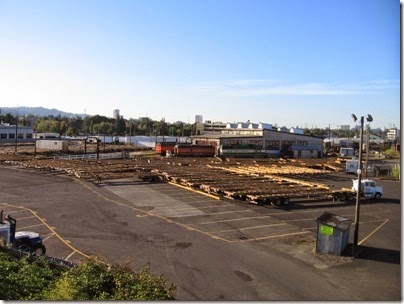
IMG_8934 Brooklyn Roundhouse in Portland, Oregon on September 6, 2007
Brooklyn Roundhouse on September 6, 2007

Union Pacific's former Southern Pacific Brooklyn Yard was one of the last places on the west coast to feature a roundhouse and turntable. A much larger brick roundhouse built in 1912 once stood in Brooklyn Yard. The 100-foot turntable replaced an 80-footer in 1925. Today's roundhouse was built next to the brick roundhouse in 1941 with four 125-foot stalls (the old roundhouse had 90-foot stalls) for the newer, longer engines. With an immediate need and many wartime material limitations, the building was built with a wood frame and covered with corrugated metal. The brick roundhouse was demolished in 1959.

IMG_8937 Brooklyn Roundhouse in Portland, Oregon on September 6, 2007
Brooklyn Roundhouse on September 6, 2007

Historical Photos:
Brooklyn Roundhouse in 1951 (ORHF)
SP Diesel at Brooklyn Roundhouse, 7/7/75 (rrpicturearchives.net)
SP Diesel at Brooklyn Roundhouse, c1980 (rrpicturearchives.net)
View of Brooklyn Roundhouse, 9/12/85 (rrpicturearchives.net)
View of Brooklyn Roundhouse, 6/21/86 (rrpicturearchives.net)

IMG_8941 Brooklyn Roundhouse in Portland, Oregon on September 6, 2007
Brooklyn Roundhouse on September 6, 2007

In 1981, the Brooklyn Roundhouse became the home of the City of Portland’s former Southern Pacific Daylight steam locomotive #4449. #4449 was joined at the roundhouse by SP&S #700 in 1986 and OR&N #197 in 1996.

IMG_8939 Brooklyn Roundhouse in Portland, Oregon on September 6, 2007
Brooklyn Roundhouse on September 6, 2007

The Brooklyn Roundhouse was demolished in September 2012, after the historic steam locomotives housed there were moved to the new Oregon Rail Heritage Center that summer.

IMG_8933 Brooklyn Roundhouse in Portland, Oregon on September 6, 2007
Brooklyn Roundhouse on September 6, 2007

The interior pictures and close-up pictures of the equipment on this page were taken during an invited visit on August 25, 2002. The pictures taken from a distance were taken from the Holgate Avenue overpass on September 6, 2007.
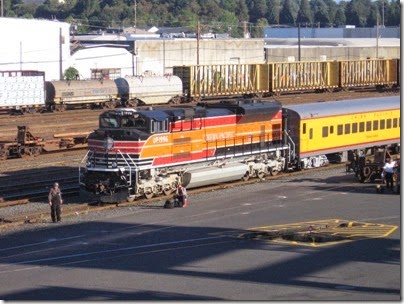
IMG_8926 Union Pacific SD70ACe #1996 at Brooklyn Yard in Portland, Oregon on September 6, 2007
UP SD70ACe #1996 at Brooklyn Yard on September 6, 2007

The Brooklyn Roundhouse was visible from the nearby Holgate overpass, but the Brooklyn Yard was, and is, still an active freight yard, patrolled by Union Pacific police; attempting to approach the roundhouse without permission could result in arrest.


IMG_8928 Union Pacific SD70ACe #1996 at Brooklyn Yard in Portland, Oregon on September 6, 2007
UP SD70ACe #1996 at Brooklyn Yard on September 6, 2007

As an active rail yard, Union Pacific trains regularly pass through. Pictured here with a special train on September 6, 2007 is Union Pacific SD70ACe #1996, the Southern Pacific Heritage Unit. It was unveiled on August 19, 2006.

IMG_8938 Brooklyn Roundhouse in Portland, Oregon on September 6, 2007
Equipment at Brooklyn Roundhouse on September 6, 2007

Some of the equipment around the roundhouse included Great Northern F7A #274, former Amtrak F40PH #231, 22-seat Parlor-Observation #2955 James J. Gilmore built by Pullman-Standard in 1941 for Southern Pacific's Daylight and the tender of the roundhouse's most famous resident: Daylight streamlined steam locomotive #4449, which has been maintained here since 1981.

IMG_8940 Brooklyn Roundhouse in Portland, Oregon on September 6, 2007
Equipment at Brooklyn Roundhouse on September 6, 2007

#4449 is a GS-4 class locomotive, built by the Lima Locomotive Works in 1941 to pull Southern Pacific's Daylight passenger trains in California. It was replaced by diesels and retired on October 2, 1957.

SP 4449 at Wishram on June 7, 1997
SP Daylight #4449 at Wishram, Washington on June 7, 1997

#4449 was donated to the City of Portland on April 24, 1958 and put on static display at Oaks Amusement Park.
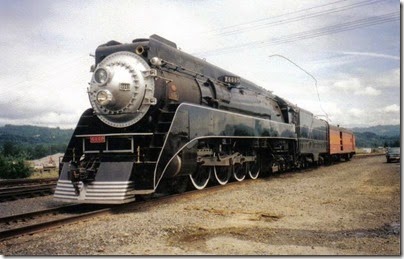
4449 at Longview Jct in June 2000
#4449 at Longview Jct., Washington on May 12, 2007

On December 14, 1974, #4449 was removed from Oaks Park restored to pull the American Freedom Train. #4449 took over the Freedom Train in Chicago on August 4, 1975 and pulled it until the tour ended in Miami on December 31, 1976.

AFT 4449 at Hillsboro in July 2002
American Freedom Train #4449 at Hillsboro, Oregon in July 2002

#4449 returned to Portland by pulling a series of "Amtrak Transcontinental Steam Excursions" in April, 1977 with the "Amtrak" name added to the tender, arriving in Portland on May 1 and going into indoor storage, having visited at least 30 states, many more than once.

IMG_6317 Southern Pacific #4449 at Peninsula Jct on May 12, 2007
SP Daylight #4449 at Peninsula Jct., Oregon on May 12, 2007

In 1981, #4449 emerged in the post-WWII version of its Daylight paint, with "SOUTHERN PACIFIC" in large lettering in the orange band. It would retain this paint scheme for nearly 20 years, longer than it had been in regular service.

IMG_6349 SP #4449-UP #844 Doubleheader at Kalama on May 12, 2007
SP Daylight #4449 at Kalama, Washington on May 12, 2007

In 2000, #4449 was painted black with white pinstripes and BNSF heralds to pull Burlington Northern Santa Fe's Employee Appreciation Special, and was later modified to recall the all-black scheme applied during World War II.

IMG_6376 Southern Pacific #4449 at Centralia on May 12, 2007
SP Daylight #4449 at Centralia, Washington on May 12, 2007

In 2002, #4449 returned to its American Freedom Train paint in remembrance of the September 11, 2001 terrorist attacks.

IMG_6391 Southern Pacific #4449 at Centralia on May 12, 2007
SP Daylight #4449 at Centralia, Washington on May 12, 2007

In 2004, #4449 was repainted into the current Daylight colors; the original, as-delivered version, with "SOUTHERN PACIFIC LINES" in small letters in the upper red band.

14 Tool Car DLMX #5811 Yes Dear at the Brooklyn Roundhouse in Portland, Oregon on August 25, 2002
DLMX #5811 at the Brooklyn Roundhouse on August 25, 2002

During my August 2002 visit, #4449 was visiting the Oregon State Fair and wasn't in the roundhouse (the photos above were taken at other events), but 4449's tool car #5811, Yes Dear, was there. Formerly Union Pacific RPO/Postal Storage Car #5811 it was one of three built by American Car & Foundry in 1949. Union Pacific transferred it to maintenance of way service as #903672 in 1973. It was sold to Doyle McCormack for use by #4449 in 1985. In 2011, this car was sold to the Canadian Pacific for use with its steam program.
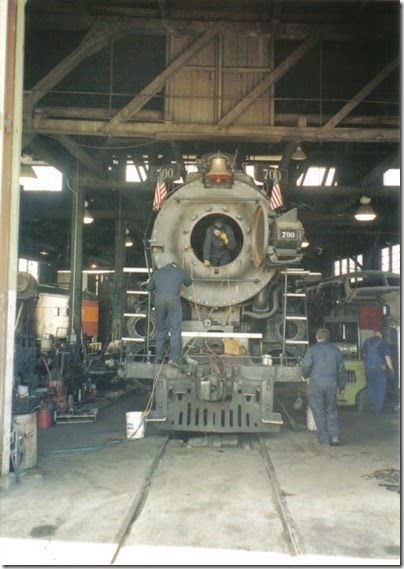
05 Spokane, Portland & Seattle A-1 Class 4-8-4 #700 at the Brooklyn Roundhouse in Portland, Oregon on August 25, 2002
SP&S #700 at the Brooklyn Roundhouse on August 25, 2002

Spokane, Portland & Seattle Baldwin E-1 Class 4-8-4 #700 is one of three 4-8-4s built for the SP&S in 1938 by the Baldwin Locomotive Works of Philadelphia, Pennsylvania.

08 Spokane, Portland & Seattle A-1 Class 4-8-4 #700 at the Brooklyn Roundhouse in Portland, Oregon on August 25, 2002
SP&S #700 at the Brooklyn Roundhouse on August 25, 2002

These locomotives were identical to A-3 class locomotives then being delivered to SP&S's parent, the Northern Pacific Railway, except that the SP&S locomotives burned oil instead of coal.

17 Spokane, Portland & Seattle A-1 Class 4-8-4 #700 at the Brooklyn Roundhouse in Portland, Oregon on August 25, 2002
SP&S #700 at the Brooklyn Roundhouse on August 25, 2002

By 1955, the SP&S had completed dieselization and was ready to retire the last of its steam locomotives.

10 Spokane, Portland & Seattle A-1 Class 4-8-4 #700 at the Brooklyn Roundhouse in Portland, Oregon on August 25, 2002
SP&S #700 at the Brooklyn Roundhouse on August 25, 2002

After pulling 1,400 passengers on a 21-car Farewell to Steam Excursion between Portland and Wishram, Washington on May 20, 1956, #700 joined the rest of SP&S's steam locomotives in a scrap line.
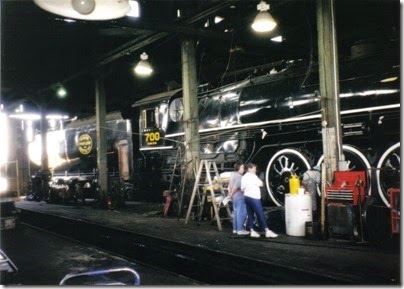
15 Spokane, Portland & Seattle A-1 Class 4-8-4 #700 at the Brooklyn Roundhouse in Portland, Oregon on August 25, 2002
SP&S #700 at the Brooklyn Roundhouse on August 25, 2002

SP&S donated #700 to the City of Portland on January 13, 1958, and it was put on static display at Oaks Amusement Park. It is the only SP&S or NP Northern and one of only two SP&S steam locomotives to survive.

16 Spokane, Portland & Seattle A-1 Class 4-8-4 #700 at the Brooklyn Roundhouse in Portland, Oregon on August 25, 2002
SP&S #700 at the Brooklyn Roundhouse on August 25, 2002

15-year-old Chris McLarney founded the Pacific Railroad Preservation Association in 1977 to restore #700, which came to Brooklyn in 1986 & returned to operation in 1990.

03 Oregon Railway & Navigation Company Baldwin P-77 Class 4-6-2 #197 at the Brooklyn Roundhouse in Portland, Oregon on August 25, 2002
OR&N #197 at the Brooklyn Roundhouse on August 25, 2002

Oregon Railway & Navigation Company P-77 Class 4-6-2 #197, later known as Union Pacific #3203, was one of a group of four built by the Baldwin Locomotive Works in May, 1905. It was rebuilt at Union Pacific's Albina Shops in Portland in 1923. It was retired in the 1950s, donated to the City of Portland and put on static display in Oaks Amusement Park in 1958.
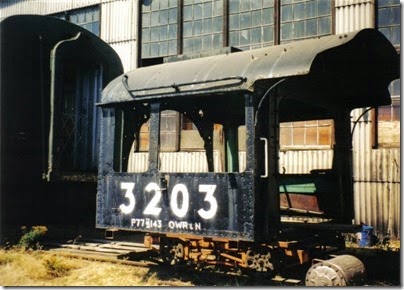
18 Cab of Oregon Railway & Navigation Company Baldwin P-77 Class 4-6-2 #197 at the Brooklyn Roundhouse in Portland, Oregon on August 25, 2002
OR&N #197 cab at the Brooklyn Roundhouse on August 25, 2002

The locomotive was removed from Oaks Park on February 10, 1996 and moved to the Brooklyn Roundhouse for restoration as OR&N 197. Only one other Union Pacific 4-6-2 still exists: #3206 on display in Spokane, Washington.

06 Tender of Oregon Railway & Navigation Company #197 & Auxiliary Tender for SP&S 700 at the Brooklyn Roundhouse in Portland, Oregon on August 25, 2002
Tenders at the Brooklyn Roundhouse on August 25, 2002

In the foreground, the tender to #197 is outside the roundhouse. The larger of the two tenders is #700's auxiliary water tender. It originally came from Great Northern 4-8-4 #2575 and was later used for firefighting around Klamath Falls. Burlington Northern donated it to the PRPA in 1985. It has a water capacity of almost 18,000 gallons.
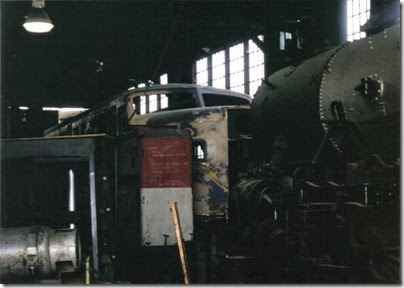
04 Delaware & Hudson Alco PA-1 #18 at the Brooklyn Roundhouse in Portland, Oregon on August 25, 2002
Ex-D&H PA-1 #18 at Brooklyn Roundhouse on August 25, 2002

After being in Mexico since 1978 and being returned to America in 2000, Doyle McCormack's former Delaware & Hudson PA-1 #18, originally built in December, 1948 as Atchison, Topeka & Santa Fe #62L, is being restored as Nickel Plate Road #190.

09 Delaware & Hudson ALco PA-1 #18 at the Brooklyn Roundhouse in Portland, Oregon on August 25, 2002
Ex-D&H PA-1 #18 at Brooklyn Roundhouse on August 25, 2002

Doyle McCormack's father was a Nickel Plate engineer, and the real Nickel Plate #190 (long since scrapped) was the first locomotive Doyle ever rode in.


NKP PA-1 #190 at Portland Union Station on May 10, 2014

Sister locomotive D&H #16 came back with #18 and was to be restored to its original appearance as Atchison, Topeka & Santa Fe #59L for the Smithsonian. It ending up being stored until 2011 and is now being restored by the Museum of the American Railroad in Frisco, Texas.

11 Great Northern F7A #274 at the Brooklyn Roundhouse in Portland, Oregon on August 25, 2002
GN F7A #274 at Brooklyn Roundhouse on August 25, 2002

Doyle McCormack's Great Northern F7A #274 was built in October 1950 as #274B. It later became Burlington Northern #610. It was sold to the Seattle & North Coast in December 1980, becoming #101.

12 Great Northern F7A #274 at the Brooklyn Roundhouse in Portland, Oregon on August 25, 2002
GN F7A #274 at Brooklyn Roundhouse on August 25, 2002

The Seattle & North Coast was liquidated in 1985 and #101 was sold to a private owner and stored a the Mount Rainier Scenic Railroad in Mineral, Washington. Doyle McCormack purchased it in 1996 or 1997 and restored it to its original colors. It has since been donated to the Oregon Coast Scenic Railroad.

02 Nickel Plate Road Alco RSD-5 #324 at the Brooklyn Roundhouse in Portland, Oregon on August 25, 2002
NKP RSD5 #324 at Brooklyn Roundhouse on August 25, 2002

This Alco RSD5 was built in November 1955 as Utah Railway #306. It was retired in May, 1982. It was sold to Industrial Salvage & Metals of Salt Lake City in November 1983 and was traded to the Promontory Chapter of the NRHS in January 1984. Doyle McCormack purchased it in October 1993 and painted it as Nickel Plate Road #324, though it actually carries the DLMX reporting mark. Nickel Plate didn't actually have any RSD5s, but they did have the similar 4-axle RS3s. The number 324 was an unused number on the Nickel Plate roster, between the road's Baldwin AS16s and Alco RSD12s.

01 Spokane, Portland & Seattle Alco FA-1 #866 at the Brooklyn Roundhouse in Portland, Oregon on August 25, 2002
SP&S FA-1 #866 at Brooklyn Roundhouse on August 25, 2002

Spokane, Portland & Seattle #866, built in December, 1950, was the last FA-1 built. It later became Burlington Northern #4120. It went to the Long Island Railroad and was rebuilt as cab car #613. It came back to Portland in 2001 to be cosmetically restored to SP&S colors.

13 Sleeping Car DLMX #9201 Clackamas River at the Brooklyn Roundhouse in Portland, Oregon on August 25, 2002
DLMX #9201 at the Brooklyn Roundhouse on August 25, 2002

#4449's crew sleeper #9201, the Clackamas River, was built in 1941 for the Southern Pacific, Union Pacific and Chicago & North Western's City of San Francisco as 10 roomette-5 bedroom sleeper Rincon Hill. It was transferred to SP in 1947 as #9201 & was retired in 1966. The Friends of SP 4449 acquired it in 1990 from a private individual in North Dakota. Though an SP car, the Daylight paint isn't correct as it was only used on day trains, not sleeping cars.

20 Tool Car PRPX #475 Kenny Prager at the Brooklyn Roundhouse in Portland, Oregon on August 25, 2002
PRPX #475 at the Brooklyn Roundhouse on August 25, 2002

SP&S #700's tool car, PRPX #475, the Kenny Prager, was built around 1912 as a sleeping car and was later converted to a rider-baggage car by the Great Northern in 1948. Kenny Prager was a former SP&S employee and a volunteer engineer for the 700. The PRPA acquired a new crew car in 2003, and subsequently sold this car in 2004.

19 Spokane, Portland & Seattle Coach #1124 at the Brooklyn Roundhouse in Portland, Oregon on August 25, 2002
SP&S Coach #1124 at Brooklyn Roundhouse on August 25, 2002

44-seat coach #1124 was built by Pullman-Standard in 1946 as Great Northern  #1124. It became Burlington Northern #4804 in 1970. In 1973 it was sold to New Jersey Transit and converted to a 108-seat commuter coach. It was retired in September 1987 and was donated to the United Railroad Historical Society of New Jersey in 1991. It was sold to the PRPA painted back in Empire Builder colors, and named John G. Melonas, after a former SP&S employee and PRPA volunteer. Though a GN car, it carries SP&S reporting marks in honor of its namesake's employer. SP&S did own similar cars for Empire Builder service. Pictured here in 2002, it is looking a little worse for wear.

IMG_8932 DLMX Heater Car #8645 Little Boy at the Brooklyn Roundhouse in Portland, Oregon on September 6, 2007
DLMX #8645 at the Brooklyn Roundhouse on September 6, 2007

Heater Car #8645, Little Boy, was built in 1928 by the St. Louis Car Company as Great Northern #1. It was sold to the Western Pacific in 1968, becoming #591.

IMG_8936 DLMX Heater Car #8645 Little Boy at the Brooklyn Roundhouse in Portland, Oregon on September 6, 2007
DLMX #8645 at the Brooklyn Roundhouse on September 6, 2007

The boiler car is used to supply steam to the boiler of #4449 the night before it is fired up, which is easier and less expensive than using the fire in the locomotive’s firebox to build up the steam pressure. The car is painted in Southern Pacific's Daylight colors to match #4449.

IMG_8931 Puget Sound & Pacific GP30 #3005 at the Brooklyn Roundhouse in Portland, Oregon on September 6, 2007
GP30 #3005 at the Brooklyn Roundhouse on September 6, 2007

This GP30 was built in October 1962 as Baltimore & Ohio #6918. It went on to become CSX #4239 and Ohio Central #4239. It was sold to Arizona & California in 1996, becoming #3005 and was transferred to sister road Puget Sound & Pacific in 1997.

IMG_8935 Puget Sound & Pacific GP30 #3005 at the Brooklyn Roundhouse in Portland, Oregon on September 6, 2007
GP30 #3005 at the Brooklyn Roundhouse on September 6, 2007

Acquired by a private individual, it came to the Brooklyn Roundhouse in 2006 for storage. It is now stored in White City, Oregon, with the collection of the Southern Oregon Railway Historical Society.

Related Links:
Oregon Rail Heritage Foundation
The Friends of SP 4449

Pacific Railroad Preservation Association
Friends of OR&N 197
Nickel Plate Road #190
Brooklyn Roundhouse at Waymarking.com
Brooklyn Roundhouse by Brian McCamish
Portland's Roundhouse Relics at Rose City & North Western

This concludes the original content of my PORTLAND PLACES: Brooklyn Roundhouse page. To see additional blog entries about Portland, click on the Portland label.