I originally posted Last Voyage of the USS Missouri under the FEATURES section of my website on November 26, 2004. I have added pictures of the historic military vehicles that were on display next to the ship.

Last Voyage of the USS Missouri
This Feature is dedicated to all Americans in uniform: past, present & future, and especially those who may find themselves in harm's way in the present, defending the liberty and freedom of all Americans.
In June 1998, the retired American battleship USS Missouri was towed across the Pacific Ocean to Pearl Harbor, Hawaii, to be put on permanent display. Just before that final departure, however, the USS Missouri visited Astoria, Oregon from May 26 to June 3, and was opened to visitors from May 28 to June 1. My dad and I were among the visitors to the ship. This page is about that last visit that, even though the ship wasn't under its own power, made Astoria the departure point for the Last Voyage of the USS Missouri.

The USS Missouri in Astoria, Oregon
The USS Missouri was launched January 29, 1944. The ship was christened by Margaret Truman, daughter of Missouri Senator (and future President) Harry Truman. The Missouri was one of four Iowa Class battleships, the largest battleships in the world. At 887 feet in length, the Iowa Class ships were about 200 feet longer than any other American battleship. To illustrate the size of these ships, I will compare them to a ship many people are familiar with: the R.M.S. Titanic. In 1912, the Titanic was the largest ship in the world, at 882 feet in length and 52000 tons of displacement. An Iowa Class battleship, such as the USS Missouri, is five feet longer and 5000 tons heavier, and has a top speed of 33 knots, versus Titanic's untested top speed of 24 knots.
The USS Missouri's main armament is nine 16-inch guns on three turrets: two forward and one aft. A sign aboard the ship describes these guns.
MAIN GUN BATTERY
16" / 50 (406 MM) CALIBER
THREE-GUN TURRET
THE MISSOURI’S MAIN ARMAMENT CONSISTED OF THREE TURRETS EACH MOUNTING 3, 16-INCH / 50 CALIBER MK7 GUNS. WITH A RANGE OF 23 MILES, THESE GUNS ARE THE MOST POWERFUL EVER MOUNTED ON A U.S. WARSHIP. EACH ARMOR PIERCING SHELL, WEIGHING 2,700 POUNDS, IS CAPABLE OF PENETRATING 32 FEET OF REINFORCED CONCRETE. EACH TURRET IS PROTECTED BY 17 INCHES OF FACE ARMOR, 9½ INCH THICK STEEL PLATES ON THE SIDES, 12 INCH THICK BACK PLATES, AND 7¼ INCH THICK ROOF PLATES. THE TOTAL ROTATING WEIGHT OF THE TURRET, LESS PROJECTILE, IS OVER 1,700 LONG TONS.
Secondary armament was made up of 10 turrets with twin 5-inch guns on each.
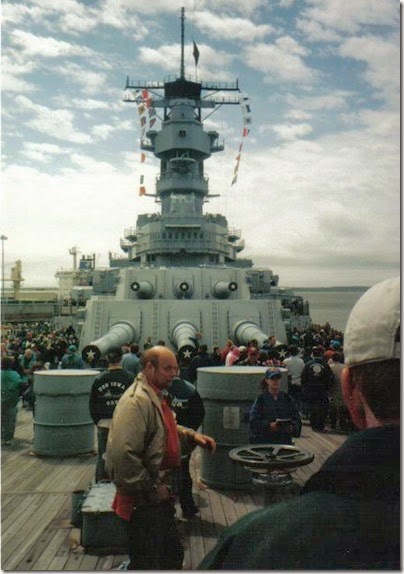
The USS Missouri's forward 16-inch gun turrets, from aboard ship.

A 16-inch shell from the Missouri at the Columbia River Maritime Museum.
On September 2, 1945, the USS Missouri in Tokyo Bay was the site of the Japanese surrender and the end of World War II. A plaque is mounted in the deck marking the exact spot on the ship where the surrender documents were signed. The plaque reads as follows:
U.S.S. MISSOURI
OVER THIS SPOT ON 2 SEPTEMBER 1945 THE INSTRUMENT OF FORMAL SURRENDER OF JAPAN TO THE ALLIED POWERS WAS SIGNED THUS BRINGING TO A CLOSE THE SECOND WORLD WAR
THE SHIP AT THAT TIME WAS AT ANCHOR IN TOKYO BAY
LATITUDE 35° 21' 17" NORTH – LONGITUDE 139° 45' 36" EAST
The fact that this historic event took place onboard put the Missouri on the National Register of Historic Places in 1971.
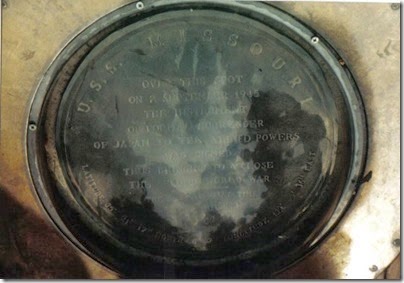
The plaque noting the location of the end of World War II.
After the war, America's large fleet of battleships was largely unnecessary, and all but the four Iowa Class ships were decommissioned by mid-1947. By 1949, three of the Iowa Class, the Iowa, New Jersey and Wisconsin, has been decommissioned and mothballed as well. However, President Truman had a fondness for the ship his daughter had christened and that was named for his home state, so the Missouri remained in service, and became the first battleship to see action in the Korean War. The Missouri was decommissioned February 26, 1955, and was mothballed at Puget Sound Naval Shipyard in Bremerton, Washington. By 1958, the others had followed.
The Missouri's sister ship, the New Jersey, was reactivated and saw action during the Vietnam War, but was again decommissioned. It wasn't until the 1980's that all four battleships returned to service. On May 10, 1986, the Missouri became the third of the Iowa Class to be reactivated, following the New Jersey and the Iowa. The Wisconsin followed in 1988. The four ships had been modernized, with four of the 5-inch gun turrets replaced with armored launchers for long-range Tomahawk cruise missiles.
In 1990, with the close of the Cold War, the Iowa and New Jersey were decommissioned for the last time, and plans were in place for the Wisconsin and Missouri to join them, but in 1990, Iraq invaded Kuwait, and by 1991 the two battleships were in the Persian Gulf to take part in Operation Desert Storm.

The map above is stenciled on the Missouri's hull to indicate the ship's service in the Persian Gulf. The sign below explains the significance of the map.
OPERATION "DESERT STORM"
THE MAP AND NUMBERS STENCILED ABOVE ARE A REMINDER OF THE MISSOURI’S RECENT CONTRIBUTION IN THIS HISTORIC ACTION.
STARS: INDICATE TARGETS FIRED UPON
NUMBER: REPRESENTS NUMBER OF ROUND FIRED
Following Operation Desert Storm, the Wisconsin was retired after a final cruise, however the Missouri, due to its historic role in the end of World War II, was kept in service long enough to participate in the 50th Anniversary of the Pearl Harbor attack on December 7, 1991, making it the world's last operating battleship. The Missouri steamed into Long Beach, California under its own power for the last time on December 20, 1991. The ship was decommissioned for the second and final time on March 31, 1992.
After the Missouri's decommissioning, the ship was once again mothballed at Bremerton, but a plan started circulating to put the ship on display at Pearl Harbor alongside the USS Arizona Memorial, a fitting place as Pearl Harbor was America's entrance to World War II, and the Missouri was the site of the end of the war. On May 23, 1998, the Missouri was towed out of Bremerton by the Crowley Marine tugboat Sea Victory bound for Hawaii, but first it was to make one stop... in Astoria, Oregon.

The ocean-going tugboat that towed the USS Missouri across the Pacific Ocean from Bremerton to Pearl Harbor, via Astoria: Sea Victory, owned by Crowley Marine Services.
The Missouri arrived in Astoria on Tuesday, May 26. Wednesday was spent preparing the ship for visitors, and visitors were allowed aboard from Thursday, May 28 to Monday, June 1. Thousands of people visited the ship during those five days. The ship had already been sealed for towing across the ocean, but visitors were able to touch the powerful 16-inch guns and see the plaque marking the end of World War II while walking around on the deck. The ship's visit was sponsored by the Columbia River Maritime Museum.

The USS Missouri on display in Astoria, Oregon. Unfortunately, the Port of Astoria has too many obstructions to get a clear view of the ship.

The USS Missouri on display in Astoria, Oregon. Unfortunately, the Port of Astoria has too many obstructions to get a clear view of the ship.

The USS Missouri on display in Astoria, Oregon. Unfortunately, the Port of Astoria has too many obstructions to get a clear view of the ship.
There were also several vintage military vehicles on display for people to view while waiting in the very long line to board the ship.

U.S. Navy 1951 Willys CJ3A (I don’t know who the kid is)
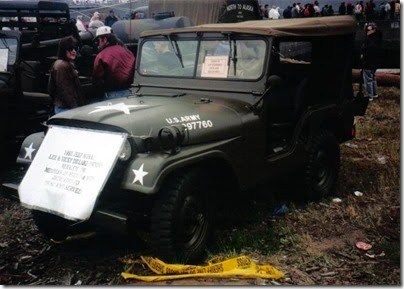
U.S. Army 1953 Willys M38A1

U.S. Army Willys M38A1 with 106mm rifle

U.S. Navy Willys MB or Ford GPW from World War II

U.S. Marine Corps International Medical Supply Truck

M88A1 Recovery Vehicle

U.S. Army Chevrolet Supply Truck

U.S. Marine Corps Willys MB or Ford GPW from World War II
On Wednesday, June 3, the USS Missouri began its final voyage, towed behind Sea Victory to Pearl Harbor, Hawaii. The ship arrived in Hawaii on June 22, 1998, and opened to the public on January 29, 1999.
USS Missouri Links:
USS Missouri
Columbia River Maritime Museum


