Showing posts with label Longview. Show all posts

Tuesday, May 6, 2014

Longview #42: Espresso Express

745 Ocean Beach Highway

Espresso Express Caboose in Longview, Washington on September 5, 2005
Espresso Express on September 5, 2005.

And of course, I like trains, so I can't resist including this old caboose turned espresso stand. According to owners Dan & Laura Estey, it was built in 1933 for the Northern Pacific Railway, and it was eventually acquired by the Weyerhaeuser Woods Railroad as their #6 and was used on log trains around Longview. Dan & Laura Estey purchased it from Weyerhaeuser in 1996 and kept "Old #6's" Weyerhaeuser number.

This concludes the original content of my Kelso-Longview PLACES page. To see any additional blog entries about Kelso or Longview, click on the Kelso or Longview labels.

Longview #41: Chinese Village

3061 Ocean Beach Highway

Chinese Village Sign in Longview, Washington on September 5, 2005
Chinese Village Sign on September 5, 2005.

I have a soft spot for cars on signs. This 1936 Ford Tudor Sedan at the Chinese Village was placed here in the 1970s when the restaurant was called Bonnie and Clyde's, which closed in the late 1980s. Chinese Village closed in September 2009. The car was practically a Longview landmark until it was removed from the sign on February 27, 2010 and subsequently donated to the local Unique Tin Car Club. The club plans to restore the car.

Related Links:
Chinese Village at the Cowlitz County Parcel Search
Classic Ford lowered from perch along Ocean Beach Highway from The Daily News
Unique Tin to restore Bonnie & Clyde's Car from The Daily News

Continue to 42: Espresso Express

Longview #40: Former Taco Bell

1006 Washington Way

Former Taco Bell in Longview, Washington on September 5, 2005
Former Taco Bell on September 5, 2005.

This Muchas Gracias restaurant is an old Taco Bell. This design is becoming rare, and this one is interesting in that the opening for the bell is still open. Yes, Taco Bell restaurants used to actually have bells. I have seen other former Taco Bells of this design with the bell opening bricked up, but this is the only one I know of with the opening still open. Incidentally, it was Taco Bell itself that removed the bell, replacing it with a lighted bell sign for a time before it closed.

Related Links:
Muchas Gracias at the Cowlitz County Parcel Search

Continue to 41: Chinese Village

Longview #39: Triangle Mall

Longview's first shopping mall, the Triangle Mall opened in 1964. It was initially a Pay 'N Save, Montgomery Ward's and Britt's Department Store (owned by J. J. Newberry's) in a cluster of separate buildings. Montgomery Ward's was built first, with construction starting in 1960 and opening in October 1961. Britt's Department Store was built in 1963, and was  renamed Newberry's in 1975. As time passed, smaller stores filled in the gaps between the large stores. Then people didn't like having to walk from store to store in the rain, so the walkways between were covered around 1972. Then people didn't like the cold, so the ends were enclosed. Other separate additions were added over the years as well, including an Ernst Hardware (which was replaced by a larger Ernst in the mid-1990s), and the Triangle Cinema in 1983.

Triangle Mall Clock in Longview, Washington in November 1995
Triangle Mall Clock in November 1995.

Around 1994, the interior of the mall was remodeled with a 4-sided pedestal clock, a small fountain, light poles, planter boxes and the like. In the late 1990's the mall's core stores began disappearing. The Ernst was the first to go in early 1997, one of the last Ernst stores. Though Ace Hardware took over the Ernst building in late 1999, opening it as their "Store 21" prototype, it didn't help the main mall much. Montgomery Ward's was the next to go. Ward's had been going through financial difficulties throughout the 1990s. First the Longview store lost its Auto Service Center in 1999, then finally in early 2001 with Ward's total shutdown, the Longview store, one of the last, closed for good, leaving the mall without its main anchor store. The Newberry's chain failed later that same year and the Longview store was one of the last when it closed in May (the last Oregon Newberry's at Portland's Lloyd Center had already closed in April), leaving only the Pay 'N Save, which had become PayLess in 1992 and then Rite Aid in 1996 as the mall's only major store. A separate Thriftway was lured to the mall in a brand new building in 1998, but the store failed and closed around the end of July, 2002.

In 2003, new owners purchased the mall, and began tearing the enclosed mall down to build a strip mall-like cluster of building called Triangle Center. First went the old Wards store, starting in October 2003, then the rest of the mall, with the demolition of the Newberry's building starting in April 2004. By 2005, only the Rite Aid building (which was to remain) and the Radio Shack (which was never meant to be a stand alone building) were all that remained of the old mall, and by the end of 2005, the Radio Shack had moved into new quarters and the last of the demolition was complete. Ace Hardware remains in the former Ernst building, and the former Thriftway became a Ross store.

Pay 'n Save Mural at the Triangle Mall in Longview, Washington in August 2005
Triangle Mall Pay ‘n Save Mural in August 2005.

Pay 'n Save Mural at the Triangle Mall in Longview, Washington on September 5, 2005
Triangle Mall Pay ‘n Save Mural on September 5, 2005.

Pay 'n Save Mural at the Triangle Mall in Longview, Washington on September 5, 2005
Triangle Mall Pay ‘n Save Mural on September 5, 2005.

The original Pay 'N Save building will remain as Rite Aid, as the stand-alone building it once was. The demolition of the rest of the mall revealed some old Pay 'N Save signage, including a hand-painted mural depicting the Trojan Nuclear Power Plant. These were still in place as of December 2005, though by the spring of 2006 a drive-up window had been installed (though clear of this signage) and the building's exterior had been renovated and this had disappeared. The only other remnant of the old Triangle Mall was the clock and some of the benches and planters that were installed in the 1990s that were placed outside the new mall. By late 2013 the clock had been removed.

IMG_8314 Triangle Mall Clock in Longview, Washington on October 19, 2010
Triangle Mall Clock on October 19, 2010.

At any rate, the Triangle Mall's story is interesting, as 40 years later it once again has become what it started out as: separate stores that require people to go out in the rain to get from one to another.

Related Links:
Triangle Cinema at CinemaTour
Triangle Mall at the Cowlitz County Parcel Search with late 1990s pictures.
Ernst selling all its stores, finally going out of business from the Seattle Times
Hardware chain falls on hard times from the Kitsap Sun
Ernst Home Center liquidation sales start today from the Seattle Times
Montgomery Ward closing stores from The Daily News
Newberry's closes its doors from The Daily News
Thriftway grocery closing in 3 weeks from The Daily News
Texas firm takes option on Triangle Mall from The Daily News
Triangle Mauled from The Daily News
Newberry's walls falling from The Daily News
Three Sides of Triangle from The Daily News

Continue to 40: Former Taco Bell

Longview #38: Harry Morgan Bridge

IMG_0507 Harry Morgan Bridge in Longview, Washington on December 17, 2005
Harry Morgan Bridge on December 17, 2005.

The first highway bridge built across the Cowlitz River here was the Pioneer Bridge in 1926. The Pioneer Bridge was washed out by the December 1933 flood, and took several years to repair. An all new span was built in 1961 to replace the Pioneer Bridge, which was then demolished with explosives. A second span was added alongside the first in 1974. These two spans are collectively known as the Harry Morgan Bridge. Today they carry State Route 432 over the Burlington Northern-Santa Fe Railway main line and across the Cowlitz River connecting Longview to Interstate 5.

IMG_0508 Harry Morgan Bridge in Longview, Washington on December 17, 2005
Harry Morgan Bridge on December 17, 2005.

This approach to Longview from the Pacific Highway opened in 1963, replacing a narrow underpass beneath the Longview, Portland & Northern Railway yards that led to California Way.

IMG_0510 Harry Morgan Bridge in Longview, Washington on December 17, 2005
Harry Morgan Bridge on December 17, 2005.

Harry Morgan was a former manager of the Hammond Lumber Company’s mill in Garibaldi, Oregon, who was hired by Weyerhaeuser as assistant to Al L. Raught, the first manager of Weyerhaeuser’s Longview mill. He supervised the construction of the mill and later succeeded Raught as manager in 1938. After retiring from Weyerhaeuser in 1954, Morgan served on Washington’s Highways Commission.

IMG_0509 Coweeman River Railroad Bridge in Longview, Washington on December 17, 2005
Coweeman River Railroad Bridge on December 17, 2005.

Adjacent to the Harry Morgan Bridge is this railroad bridge, carrying the Burlington Northern- Santa Fe Railway over the Coweeman River where it joins the Cowlitz River. The railroad bridge is also used by the Union Pacific Railroad and Amtrak.

Continue to 39: Triangle Mall

Longview #37: Lewis & Clark Bridge

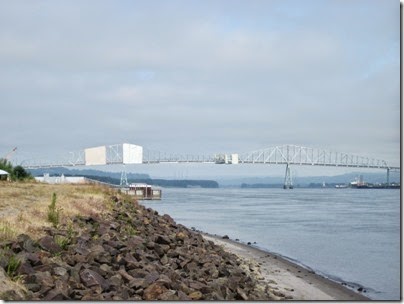
Lewis & Clark Bridge in Longview, Washington from Rainier, Oregon on September 5, 2005
Lewis & Clark Bridge on September 5, 2005.

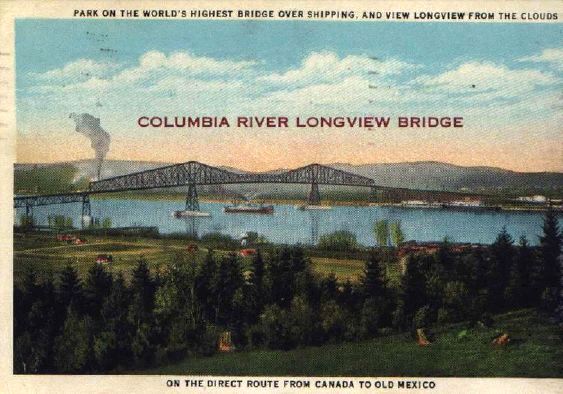
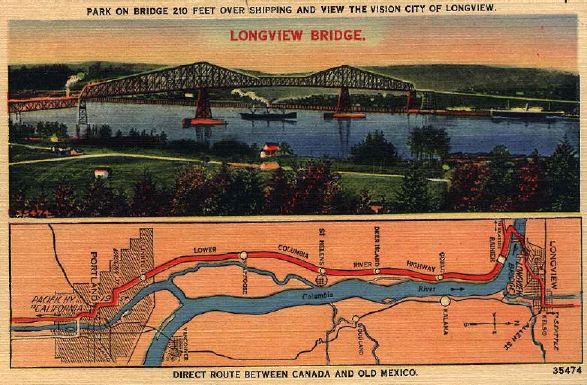
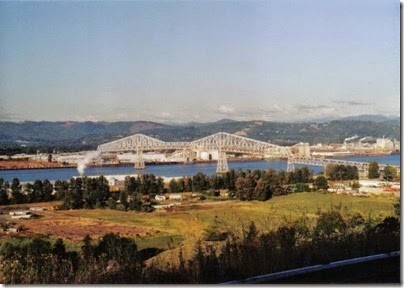
Originally called simply the Longview Bridge, this impressive structure was designed by Joseph B. Strauss. Strauss is noted for designing over 100 bridges, including many of Chicago's lift bridges over the Chicago River, as well as the operating mechanism for Portland's Burnside Bridge. He is also known for another bridge you may have heard of: San Francisco's Golden Gate Bridge. But before he built the Golden Gate, Strauss built this one.

Before the bridge, the only way to get across the Columbia River between Kelso and Rainier was by boat. On June 4, 1922, A. E. Hayes and Ed Cole inaugurated an automobile ferry between Rainier and Kelso. The ferry landing on the Washington side was on the east shore of the Cowlitz River in South Kelso. This ferry had a toll of $2 for a one-way trip. By June 23, they were operating three boats of 8, 22, and 26 car capacity, with a fourth soon to enter service. Night service began the week of July 4th.

Long-Bell Ferry in Rainier, Oregon
Long-Bell ferry Oregon at the Rainier ferry slip.
(Michael Clark collection, used with permission)

On July 16, 1922, the Long-Bell Lumber Company placed its own ferry in service between Rainier and the new city of Longview, which was still under construction. The new ferry was a 30’ by 90’ barge pulled by the tugboat Star. The Long-Bell ferry was faster and less expensive than the service operated by Hayes and Cole, and their operation shut down on July 18, 1922.

A Street in Rainier, Oregon
View of A Street in Rainier showing the entrance to ferry slip.
(Michael Clark collection, used with permission)

In 1923, Long-Bell launched an improved ferry service using two newly-built ferries, the Washington and the Oregon. They were built by St. Helens Shipbuilding and each had a capacity of 25 to 30 cars and 150 passengers. The Longview ferry slip was at the foot of Oregon Way, near where the bridge is today, and the Rainier slip was downtown at the foot of First Street. The ferries could complete a roundtrip in 40 minutes including loading and unloading time, and with both in service they could offer 20 minute service. The Washington was placed in service on June 16, 1923. The Oregon was placed in service on July 9, 1923.

Long-Bell Ferry in Rainier, Oregon
Long-Bell ferry at the Rainier ferry slip.
(Michael Clark collection, used with permission)

While two ferries were needed during the summer season, one ferry was adequate for the rest of the year. After the 1929 summer season, with the bridge to be completed before the next summer, the Oregon was sold to the Oregon Highway Department and was towed on September 22 to North Bend in Coos County, where it began operation on October 1. The Washington remained in operation until the bridge opened in 1930.

Long-Bell Ferry in Rainier, Oregon
Long-Bell ferry on the Columbia River.
(Michael Clark collection, used with permission)

A bridge across the Columbia River was first envisioned in 1919, and a serious proposal was first made in 1921. The Oregon Highway Department conducted a study beginning in the winter of 1921 and in January 1923 recommended that a five-span bridge be built across the river at Rainier. Initially, Portland was in favor of the project, but Portland soon felt threatened by Longview’s growth. In 1925, Congress passed an act authorizing the bridge, with the provision that both states agreed. Washington approved, but the Port of Portland’s concern over Longview’s growth led Oregon to oppose the bridge. In 1926 a new bill was introduced in Congress to authorize private parties to fund and build the bridge. The bill was passed by Congress in January 1927 and signed into law by President Calvin Coolidge.

The Columbia River-Longview Bridge Company was formed by William D. Comer and Wesley Vandercook. Comer was the president of W. D. Comer & Company, a building and loan association in Seattle, and Vandercook was Long-Bell’s Chief Engineer. Comer served as President of the new company, with Vandercook as Secretary and Arnold Foster of San Francisco as Treasurer. The financing was handled by Kimball & Company of New York and J.S. Watson of San Francisco. Comer and Vandercook promoted the bridge and raised money for its construction through the sale of public bonds and stock. Initially, funds came in slowly, and Comer and Vandercook had to spend their own money to hire crews to clear the land for the approaches and officially begin construction before the deadline set in the bill passed by Congress.

Joseph Srauss’s original design for the bridge had a vertical clearance of 155 feet above the river and a span of 750 feet between the center piers. Portland convinced the Department of Defense to require that the bridge be tall enough to allow all U.S. Naval vessels in existence, including the tall-masted USS Constitution with a height of 187 feet, to safely pass underneath. This required a redesign to raise the vertical clearance to 195 feet and the center span to 1,125 feet between the piers, increasing the cost of the bridge by at least $1 million. With the cost of the bridge estimated at over $5 million, Portland was hoping the bridge promoters would be unable to raise the necessary funds. There were originally plans to make the bridge a railroad bridge as well as a highway bridge, but with the higher clearance and added cost, the railroad plans were abandoned.

On October 13, 1928, the Pacific Bridge Company of Portland, Oregon, began excavating for the piers. On October 16, It was announced that Bethlehem Steel Company of Bethlehem, Pennsylvania, had signed the contract to furnish the 12,500 tons of steel for the bridge. Bethlehem was also awarded the general contract for the bridge, the G. F. Breckerly as Bethlehem’s engineer-in-charge. Bethlehem subcontracted the rest of the work to various subcontracting firms. Additional steel was fabricated by the Wallace Bridge & Structural Steel Company of Seattle, and the steel was erected by J.H. Pomeroy & Company of Seattle. The timber approaches and concrete deck were built by Lindstrum & Feigensen of Portland, Oregon. Road grading was by Henry G. Niblett, toll buildings by F.W. Clearman & Company, lighting system by Charles Langlais, and fenders by F.S. Booth & Company. The Strauss Engineering Corporation handled the design and supervision of construction, with Joseph Strauss as president and chief engineer, C.E. Paine as vice president and engineer-in-charge, and J.S. Watson as resident engineer. The first concrete was poured in October 1928, and on October 30, it was announced that all financing had been completed for the total cost of $5,800,000 and all contracts had been awarded.

The first piles were driven on the Oregon side on April 15, 1929, and on the Washington side on April 24, 1929. The first steel was placed on the Oregon side on June 5, 1929, and on the Washington side on June 27, 1929. On July 4, 1929, Joseph Strauss announced that the structure was 51% complete. By August 25, 1929, the Washington approach was practically complete and the erection of the anchor spans was progressing. The bridge was built from both ends, and on February 13, 1930, the first girder connected the two sectors in the middle of the span.

Lewis & Clark Bridge in Longview, Washington from Rainier, Oregon
View of the Longview Bridge under construction.
(Michael Clark collection, used with permission)

The bridge was dedicated and opened March 29, 1930. At the dedication, Governors A. W. Norblad of Oregon and Roland Hartley of Washington gave short speeches at the center of the bridge, and at 2 p.m., President Herbert Hoover pressed a gold telegraph key from the White House that unfurled a flag and dropped a guillotine to cut a ribbon, formally opening the bridge. Cars were lined up from Rainier as far as Goble, and by midnight, when the tolls were imposed, 11,327 cars had crossed the bridge. The tollbooth for the bridge was on the Washington side. The toll for a car and driver was originally 80 cents with 15 cents for each passenger.

Related Link:
View of the bridge shortly before completion and a copy of the bridge toll schedule, from the Cowlitz County GenWeb Project

The completed bridge was 8,289 feet long, including its timber approaches. The original design, from north to south, consisted of: 2,620 feet of wooden approach trestle, a 40-foot steel girder approach span, a 40-foot steel tower span, a 168-foot steel Warren deck truss approach span, a 760-foot steel truss anchor span, a 380-foot steel truss cantilever span, a 440-foot suspended steel Warren truss span, a 380-foot steel truss cantilever span, a 760-foot steel truss anchor span, two 337-foot steel Warren deck truss approach spans, an 84-foot steel Warren deck truss approach span, a 168-foot steel Warren deck truss approach span, a 28-foot steel girder approach span, and 1,800 feet of curved wooden approach trestle. (This actually adds up to 8,342 feet. The 1,800-foot length of the wooden approach trestle on the Oregon side may have been an approximate measure; if it were actually 1,747 feet, the numbers would add up to the 8,289 feet.) The main span of the bridge is 2,722 feet long. The center cantilever span is suspended from towers 1,200 feet apart with 196.5 feet of clearance above mean low water. The bridge’s highest point 330 feet above the river. (Today, the bridge is listed as being 340 feet tall, with 210 feet of clearance over the river. This apparent discrepancy may be explained by changes in the river level caused by the dams built further up the river in the intervening years.) The deck is 34.1 feet wide with 20 feet of vertical clearance.

Related Link:
View of the bridge shortly after completion, from the Cowlitz County GenWeb Project

The bridge was said to be the longest and tallest cantilever span in North America at the time. Its closest competitors at the time of construction were said to be the Strauss-designed Montreal Harbour Bridge (renamed the Jacques Cartier Bridge in 1934) and the Albert Gallatin Memorial Bridge over the Monongahela River at Point Marion, Pennsylvania, near Pittsburgh. Both were also completed in 1930. The Montreal Harbor Bridge has a main span of 1,937 feet, consisting of two 420-foot anchor spans, two 354-foot cantilever arms, and a 378.5-foot suspended span, and had a vertical clearance above the water of 40 feet (raised to 120 feet in 1958). The Albert Gallatin Memorial Bridge was much smaller, with a total length of 810 feet and a main span of 464 feet.

Not mentioned is the much longer Quebec Bridge in Montreal, completed in 1919. The Quebec Bridge has a total length of 3,239 feet with a cantilever span of 1,800 feet between the piers, consisting of two 580-foot cantilever arms and a 640-foot suspended central span. The Quebec Bridge has a height of 340 feet, with 150 feet of vertical clearance over the water. There are a number of possible reasons why the Quebec Bridge was discounted when the Longview Bridge was declared the longest and highest cantilever bridge in North America. First, while the Quebec Bridge has a longer cantilever span than the Longview Bridge, the Longview Bridge has additional steel approach spans on either side that, when included, increase its length to 3,922 feet (not including the timber approaches), longer than the Quebec Bridge. The Longview Bridge also has more vertical clearance above the water than the Quebec Bridge. The Longview Bridge was a highway bridge (as were Montreal Harbor Bridge and the Albert Gallatin Memorial Bridge) while the Quebec Bridge was a railroad-only bridge until 1949. Finally, the Quebec Bridge used a very different cantilever design with supporting truss structures both above the deck as a superstructure and below the deck as a substructure and a suspended span that was built off-site and lifted into place in one piece. The Longview Bridge (along with the Montreal Harbor Bridge and the Albert Gallatin Memorial Bridge) used a cantilever design with only a superstructure truss above the deck and resting on vertical towers and a suspended span that was assembled in place. As a result, the Quebec Bridge may have been considered an entirely different type of bridge than the Longview Bridge at the time, making the case for the Longview Bridge to be called the longest of its type. In any case, the Longview Bridge was still the longest cantilever bridge in the United States.

Plaques at each end of the bridge read as follows:

COLUMBIA RIVER
LONGVIEW BRIDGE
COMPLETED 1930
BUILT BY
WILLIAM D. COMER
AND
WESLEY VANDERCOOK
TOTAL LENGTH OF SPAN - INCLUDING APPROACHES - 1 1/2 MILES
LENGTH OF MAIN SPAN                                                   1200 FEET
MAXIMUM VERTICAL CLEARANCE                                      196 FEET
HEIGHT OF TOWERS ABOVE WATER                                 330 FEET

-
GENERAL CONTRACTOR
BETHLEHEM STEEL COMPANY
-
SUB - CONTRACTORS
WALLACE BRIDGE & STRUCTURAL STEEL CO.          STEEL FABRICATOR
BETHLEHEM STEEL CO.                                            STEEL FABRICATOR
J. H. POMEROY & CO.                                                     STEEL ERECTOR
PACIFIC BRIDGE CO.                                                          FOUNDATIONS
LINDSTROM & FEIGENSEN                                                  APPROACHES
-
ENGINEERS
STRAUSS ENGINEERING CORPORATION

After the bridge opened, private passenger ferries continued to operate for a number of years for those looking for a less expensive way to cross the river to work at the mills. One of these was the 42-foot Elsinore, which was operated by A. Wellington McCollam and had a capacity of 35 passengers. It was originally built around 1914 by Portland shipbuilding O.P. Graham for E.A. Allen. Around 1942 Allen sold the Elsinore to Ferris Brooks, who resold it to McCollam. The Elsinore ran until 1952 and was burned as a bonfire for Rainier Daze on July 21, 1961.

Related Link:
View of the bridge shortly after completion, from the Cowlitz County GenWeb Project

Within a year of its opening, the bridge had its first suicide jumper. And it was someone from Portland! That's right, in March 1931 a man named Wilfrid Hill drove all the way from Portland to Rainier to kill himself (though on the way he attempted to throw himself in front of a train at St. Helens, but was foiled by the train crew). The suicide was not discovered until the next morning (March 17) when the morning bus across the bridge discovered a Ford roadster abandoned on the bridge with its lights on, and a suicide note was found at Hill’s home in Portland.

In August 1933, the recently-restored USS Constitution visited Portland, Kalama, and Longview, passing under the bridge and justifying its 195-foot vertical clearance. Coincidentally, the USS Constitution’s restoration had included new masts of Douglas Fir milled at the Westport Lumber Company in nearby Westport, Oregon.

IMG_1778 Lewis & Clark Bridge in Longview, Washington from Rainier, Oregon on July 12, 2008
Lewis & Clark Bridge on July 12, 2008.

The bridge’s status as the longest cantilever bridge in the United States did not last long. In 1936, the San Francisco-Oakland Bay Bridge opened, and the cantilever bridge at the east end became the longest cantilever bridge in the United States, with a span of 1,400 feet. It would retain the record until the 1958.

IMG_1781 Lewis & Clark Bridge in Longview, Washington from Rainier, Oregon on July 12, 2008
Lewis & Clark Bridge on July 12, 2008.

With the start of World War II, a guard shack was built on the Oregon side of the bridge, and soldiers began riding across the bridge with every car to prevent sabotage. At night a blackout was enforced on the bridge.

IMG_0457 Lewis & Clark Bridge in Longview, Washington from Rainier, Oregon on February 24, 2011
Lewis & Clark Bridge on February 24, 2011.

Originally the bridge was a private venture, owned and operated by the Columbia River-Longview Bridge Company. The bridge company had struggled financially in its early years. By World War II, the bridge had become profitable, but just barely, and the timber approaches were in need of replacement. The state of Washington bought the bridge in 1947 for $2,250,000, financed through public bonds. A portion of the 1947 revenue bond sale allocated for refurbishment was used initially to replace the north 84 feet of the south timber trestle approach on the Oregon side. The remaining curved portion of the south timber approach became the state of Oregon’s maintenance responsibility. In 1950, the entire north timber trestle approach was rebuilt as 23 steel-beam spans with concrete decking measuring 1,500 feet in total length. Bethlehem Pacific Coast Steel was the fabricator and Guy F. Atkinson Company of Portland was the contractor. Total cost for the project was $810,000. In 1951, a retaining wall was added to the north approach at a cost of $130,000.
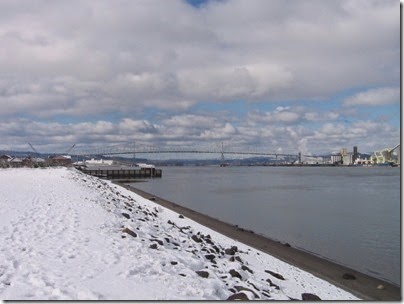
IMG_0633 Lewis & Clark Bridge in Longview, Washington from Rainier, Oregon on February 25, 2011
Lewis & Clark Bridge on February 25, 2011.

When the state of Washington bought the bridge in 1947, the toll was $1.00. Interestingly enough, the toll decreased over the following years to 75 cents, then 60 cents, and finally to 50 cents on July 1, 1957. The lower tolls increased traffic on the bridge, and allowed the bonds to be paid off at a faster rate than expected.

IMG_1250 Lewis & Clark Bridge in Longview, Washington from Rainier, Oregon on April 30, 2011
Lewis & Clark Bridge on April 30, 2011.

In 1963, an 84’ steel beam span with concrete deck replaced the 1947 north section of the south approach trestle. The state of Washington built it at a cost of $74,000. At the same time, Oregon replaced the rest of the south timber trestle approach with embankment.

IMG_1252 Lewis & Clark Bridge in Longview, Washington from Rainier, Oregon on April 30, 2011
Lewis & Clark Bridge on April 30, 2011.

On October 19, 1965, the tolls paid off the cost of the bridge 12 years ahead of schedule, and the governors of the two states, Mark Hatfield of Oregon and Dan Evans of Washington, attended a ceremonial burning of the public bonds at the toll plaza to mark the removal of the bridge tolls.

IMG_1244 Lewis & Clark Bridge in Longview, Washington from Rainier, Oregon on July 14, 2012
Lewis & Clark Bridge on July 14, 2012.

On July 6, 1980, Washington Governor Dixie Lee Ray signed Senate Bill No. 3219 into law, rededicating and renaming the Longview Bridge the Lewis & Clark Bridge. It was placed on the National Register of Historic Places on July 16, 1982. In 1985, the existing cast-in-place sidewalks were replaced with precast sidewalks.
IMG_1245 Lewis & Clark Bridge in Longview, Washington from Rainier, Oregon on July 14, 2012
Lewis & Clark Bridge on July 14, 2012.

Age and increasing traffic levels required that the bridge be redecked from January 2003 to August 2004 at a cost of $29.8 million.

IMG_1294 Lewis & Clark Bridge in Longview, Washington from Rainier, Oregon on July 14, 2012
Lewis & Clark Bridge on July 14, 2012.

When adjusted for inflation, the bridge's original construction cost equals about $60 million in 2004 dollars. So, just redecking the bridge cost half of what the entire bridge cost. And it took longer.

IMG_1298 Lewis & Clark Bridge in Longview, Washington from Rainier, Oregon on July 14, 2012
Lewis & Clark Bridge on July 14, 2012.

In 2006, a multi-phase repainting project began. The bridge had last been painted in 1984. Repainting of the Oregon approach was completed in February 2009. The piers in the river and the towers on the Washington side were painted from April 7, 2009 to December 2, 2010 at a cost of 6.7 million. Painting of the superstructure began June 30, 2010, and was completed in November 2013 at an estimated cost of $40 million. The entire painting project cost $56 million dollars. The bridge is painted a color called Washington Gray.

IMG_2602 Workers on the Lewis & Clark Bridge in Longview, Washington on October 29, 2013
Workers on the Lewis & Clark Bridge on October 29, 2013.

The Lewis & Clark Bridge carries an estimated 21,000 vehicles per day, 13% of which are trucks. As of 2013, the Lewis & Clark Bridge was the 12th longest cantilever bridge in the world and the 7th longest cantilever bridge in United States. The original eastern cantilever section of the San Francisco-Oakland Bay Bridge was replaced in 2013 by a new suspension bridge, and when the demolition of the cantilever bridge is completed, the Lewis & Clark Bridge should become the 11th longest cantilever bridge in the world and the 6th longest cantilever bridge in the United States.

IMG_2603 Workers on the Lewis & Clark Bridge in Longview, Washington on October 29, 2013
Workers on the Lewis & Clark Bridge on October 29, 2013.

Related Links:
Longview Bridge spanning the Columbia River opens March 29, 1930, from HistoryLink.org
Longview-Rainier Bridge Chronology from the Columbia County Historian

Continue to 38: Harry Morgan Bridge

Longview #36: Weyerhaeuser Timber Company

3535 Industrial Way

Weyerhaeuser Timber Company Mill in Longview, Washington on May 17, 2005
Weyerhaeuser Timber Company on May 17, 2005.

On July 4, 1926, the Weyerhaeuser Timber Company decided to build a lumber mill in Longview alongside their competitor Long-Bell's mill. The Weyerhaeuser mill opened in June 1929.

R. A. Long hoped that Weyerhaeuser would use his Longview, Portland & Northern Railway to serve the new mill, but Weyerhaeuser had their own idea. Rather than use a railroad owned by their competitor to access the major railroads in Kelso, Weyerhaeuser would build its own railroad to the other side of the Cowlitz. There was just one catch, R. A. Long didn't want railroad tracks cutting through his new planned city, so Weyerhaeuser's railroad was built just outside the city limits to the west and north of town. Weyerhaeuser's railroad crossed the Cowlitz River on a wooden trestle with steel center span completed in 1926 north of Longview and Kelso, connecting to the Northern Pacific Railway at a new yard at Rocky Point. The railroad from Rocky Point to Longview would be known as the Columbia and Cowlitz Railway. From Rocky Point, the Weyerhaeuser Woods Railroad would continue north to Ostrander and beyond into the company's timber holdings for harvesting.

Weyerhaeuser's Columbia & Cowlitz probably kept the major railroads from ever being very interested in serving Longview directly, as the Kelso side of the river would still have to be served as well. Weyerhaeuser's mill remains in operation and is one of the area's largest employers. The Columbia & Cowlitz and Weyerhaeuser Woods Railroad are still serving their owner as they have for over 80 years.

Continue to 37: Lewis & Clark Bridge

Longview #35: Longview Fibre

300 Fibre Way

Longview Fibre in Longview, Washington from Rainier, Oregon in June 1999
Longview Fibre and Geese, June 1999.

Longview Fibre's original pulp and paper mill opened in 1927, to create paper from the Douglas Fir waste from Longview's Long-Bell and Weyerhaeuser lumber mills. Today, this mill is one of the area's largest employers, and Longview Fibre has paper mills all over the country.

IMG_1251 Longview Fibre in Longview, Washington from Rainier, Oregon on July 14, 2012
Longview Fibre, July 14, 2012.

Continue to 36: Weyerhaeuser Timber Company

Longview #34: Blackstone Building

1503 20th Avenue

Blackstone Building in Longview, Washington on September 5, 2005
Blackstone Building on September 5, 2005.

I don't know anything about this building; I discovered it completely by accident. It seems out of place in a neighborhood of single-family houses. It appears to be from Longview's early years, though I don't know what is was built as. I initially thought it was an old hotel. There was once a Blackstone Clinic in Longview; perhaps there is some connection. Today it is used as a low-income apartment building by the Longview Housing Authority.

Related Links:
Blackstone Building at the Cowlitz County Parcel Search
Blackstone Apartments at the Longview Housing Authority

Continue to 35: Longview Fibre

Longview #33: Robert A. Long High School

2903 Nichols Boulevard

Robert A. Long High School in Longview, Washington on September 5, 2005
Robert A. Long High School on September 5, 2005.

Robert A. Long High School, built in 1928, was not the first school in Longview; that honor goes to nearby Kessler Elementary School on the other side of Lake Sacajawea, which opened on February 26, 1924. However, while the original Kessler Elementary was demolished in 1973 and the new version is not very photogenic, R. A. Long High School remains a beautiful building with timeless classic architecture.

IMG_0931 Robert A. Long High School in Longview, Washington on May 5, 2012
Robert A. Long High School on May 5, 2012.

This school was built by R. A. Long on a 35-acre site as yet another of his gifts to the city. R. A. Long High School was built at a cost of $1,532,803. Long spent $750,000 of his own money to build the school, and was forced to mortgage his 15-story office building in Kansas City, Missouri, to obtain the funds.

IMG_0915 Cornerstone of Robert A. Long High School in Longview, Washington on May 5, 2012
Robert A. Long High School Cornerstone on May 5, 2012.

Robert A. Long High School was designed by noted school architect William B. Ittner.

IMG_0916 Robert A. Long High School in Longview, Washington on May 5, 2012
Robert A. Long High School on May 5, 2012.

The architecture is Georgian Revival, similar to the Longview Public Library and the Monticello Hotel, with two-story Corinthian columns and a clock tower.

IMG_0917 Robert A. Long High School in Longview, Washington on May 5, 2012
Robert A. Long High School on May 5, 2012.

The school was built on less valuable property two blocks away from Lake Sacajawea. The two blocks between the school and the lake were intended to be divided into residential lots, but once the Great Depression hit, the blocks never sold, leaving the school with a view of the lake.

IMG_0919 Robert A. Long High School in Longview, Washington on May 5, 2012
Robert A. Long High School on May 5, 2012.

The school was dedicated on July 13, 1928, and opened to classes in the fall of 1929. Until then, classes were held in the dormitories of the St. Helens Inn and the Kessler Grade School.

IMG_0921 Robert A. Long High School in Longview, Washington on May 5, 2012
Robert A. Long High School on May 5, 2012.

Clarence Zimmerman was the school’s first principal. The first enrollment was 82, with a faculty of 7. For the second term the student body increased to 197 students.

IMG_0923 Robert A. Long High School in Longview, Washington on May 5, 2012
Robert A. Long High School on May 5, 2012.

The class of 1928 was the first to officially graduate from the R. A. Long, but the class of 1929 was the first to complete a full school year in the building.

IMG_0924 Robert A. Long High School in Longview, Washington on May 5, 2012
Robert A. Long High School on May 5, 2012.

By 1952, the enrollment had increased to nearly 1,400 students. In September 1953, Monticello Junior High School opened and the 9th grade moved there from R. A. Long.

IMG_0927 Robert A. Long High School in Longview, Washington on May 5, 2012
Robert A. Long High School, May 5, 2012.

In 1957, Mark Morris High School opened, dividing Longview’s high school population.

IMG_0928 Robert A. Long High School in Longview, Washington on May 5, 2012
Robert A. Long High School on May 5, 2012.

In 1970, a new math-science wing and gymnasium annex were built at R. A. Long at a cost of $2,305,320.

IMG_0864 Lobby of Robert A. Long High School in Longview, Washington on May 5, 2012
Robert A. Long High School Lobby on May 5, 2012.

This is the main lobby of Robert A. Long High School.

IMG_0861 "Eighty Years of Excellence" by Barbara Lancaster at Robert A. Long High School in Longview, Washington on May 5, 2012
“Eighty Years of Excellence” on May 5, 2012.

This painting in the lobby is called “Eighty Years of Excellence” by Barbara Lancaster and was a gift from the class of 2008.

IMG_0867 Clock in the Lobby of Robert A. Long High School in Longview, Washington on May 5, 2012
Robert A. Long High School Lobby Clock on May 5, 2012.

During the 1983-1984 school year, classes were held in classrooms and portables at Monticello Middle School while R. A. Long underwent a $12 million renovation.

Bust of Robert A. Long at age 23 by Larry Anderson at Robert A. Long High School in Longview, Washington on May 5, 2012
Bust of Robert A. Long by Larry Anderson on May 5, 2012.

The renovation was designed by Seifert & Forbes as architects and engineers with Gilnett Construction Company as the general contractor. It reopened in the fall of 1984.

Bust of Robert A. Long at age 23 by Larry Anderson at Robert A. Long High School in Longview, Washington on May 5, 2012
Bust of Robert A. Long by Larry Anderson on May 5, 2012.

A bronze sculpture of a young R. A. Long at age 23 by Larry Anderson was donated by the R. A. Long Foundation and placed in the front hall in 1985.

Bust of Robert A. Long at age 23 by Larry Anderson at Robert A. Long High School in Longview, Washington on May 5, 2012
Bust of Robert A. Long by Larry Anderson on May 5, 2012.

R. A. Long High School was placed on the National Register of Historic Places on December 5, 1985.

Robert A. Long High School Auditorium in Longview, Washington on May 5, 2012
Robert A. Long High School Auditorium on May 5, 2012.

The Robert A. Long High School auditorium features seating for 900.

Robert A. Long High School Auditorium in Longview, Washington on May 5, 2012
Robert A. Long High School Auditorium on May 5, 2012.

Robert A. Long High School Auditorium in Longview, Washington on May 5, 2012
Robert A. Long High School Auditorium on May 5, 2012.

Robert A. Long High School Library in Longview, Washington on May 5, 2012
Robert A. Long High School Library on May 5, 2012.

The Robert A. Long High School Library is in the front of the second floor, overlooking Lake Sacajawea.

Robert A. Long High School Library Ceiling in Longview, Washington on May 5, 2012
Robert A. Long High School Library Ceiling on May 5, 2012.

The library originally accommodated 200 students at small tables, with a raised librarian’s desk in the center, a barrel-vaulted ceiling, and bookshelves built into the Douglas fir wainscoting.

Robert A. Long High School Library in Longview, Washington on May 5, 2012
Robert A. Long High School Library on May 5, 2012.

The library currently features two large paintings: a portrait of R. A. Long and another painting called “The Dream” by Robert Wadsworth Grafton, which depicts Long in the doorway of his original lumberyard in Columbus, Kansas, with a vision of the city of Longview. The R.A. Long High School Alumni Association funded restoration of the portrait in 2004 and “The Dream” in 2005.

Portrait of Robert A. Long in the Robert A. Long High School Library in Longview, Washington on May 5, 2012
Portrait of Robert A. Long on May 5, 2012.

"The Dream” by Robert Wadsworth Grafton in the Robert A. Long High School Library in Longview, Washington on May 5, 2012
“The Dream” by Robert Wadsworth Grafton on May 5, 2012.

Robert A. Long High School Hallway in Longview, Washington on May 5, 2012
Robert A. Long High School Hallway on May 5, 2012.

Drinking Fountain Tilework at Robert A. Long High School in Longview, Washington on May 5, 2012
Robert A. Long High School Tilework on May 5, 2012.

Yearbooks at Robert A. Long High School in Longview, Washington on May 5, 2012
Robert A. Long High School Yearbooks on May 5, 2012.

For a number of years, Robert A. Long High School’s yearbooks had covers made of real wood as shown here.

Whacker at Robert A. Long High School in Longview, Washington on May 5, 2012
Robert A. Long High School Whacker on May 5, 2012.

Two of these were made by Ralph Dexter in the carpenter shop for football coach Buck Hammer; this one was stolen.

Robert A. Long High School Cafeteria in Longview, Washington on May 5, 2012
Robert A. Long High School Cafeteria on May 5, 2012.

The Cafeteria is at the back of the original school.

Robert A. Long High School Cafeteria in Longview, Washington on May 5, 2012
Robert A. Long High School Cafeteria on May 5, 2012.

Robert A. Long High School Cafeteria in Longview, Washington on May 5, 2012
Robert A. Long High School Cafeteria on May 5, 2012.

Robert A. Long High School Cafeteria in Longview, Washington on May 5, 2012
Robert A. Long High School Cafeteria on May 5, 2012.

The interior of the 600-seat cafeteria was designed to give the appearance of an old English manor house, with an open-timbered roof, heavy Douglas fir beams, high wood wainscoting and rough plaster. The kitchen was entirely electrically equipped when built.

Robert A. Long High School Cafeteria in Longview, Washington on May 5, 2012
Robert A. Long High School Cafeteria on May 5, 2012.

Robert A. Long High School Cafeteria in Longview, Washington on May 5, 2012
Robert A. Long High School Cafeteria on May 5, 2012.

Robert A. Long High School Cafeteria Light in Longview, Washington on May 5, 2012
Robert A. Long High School Cafeteria Light on May 5, 2012.

Lumberjack Statue in the Robert A. Long High School Cafeteria in Longview, Washington on May 5, 2012
Robert A. Long High School Lumberjack on May 5, 2012.

This lumberjack sculpture in the cafeteria was donated by the Leadership Class of 2003-2004. The plaque carried the inscription “Making R.A. Long High School Better, One Lumberjack At A Time.”

Robert A. Long High School Boiler Building in Longview, Washington on May 5, 2012
Robert A. Long High School Boiler Building on May 5, 2012.

Robert A. Long High School Gymnasium in Longview, Washington on May 5, 2012
Robert A. Long High School Gymnasium on May 5, 2012.

Robert A. Long High School Gymnasium Plaque in Longview, Washington on May 5, 2012
Robert A. Long High School Gymnasium on May 5, 2012.

Robert A. Long High School Gymnasium in Longview, Washington on May 5, 2012
Robert A. Long High School Gymnasium on May 5, 2012.

Robert A. Long High School Gymnasium in Longview, Washington on May 5, 2012
Robert A. Long High School Gymnasium on May 5, 2012.

Robert A. Long High School Gymnasium in Longview, Washington on May 5, 2012
Robert A. Long High School Gymnasium on May 5, 2012.

Robert A. Long High School Gymnasium in Longview, Washington on May 5, 2012
Robert A. Long High School Gymnasium on May 5, 2012.

A new $100,000 gymnasium with swimming pool was started in November 1938, and was built with funding from the Federal Works Agency and the Public Works Administration. The new basketball court was dedicated on December 16, 1940, and the team defeated Hoquiam in their first home appearance of the year.

Lumberjack Statue in the Robert A. Long High School Gymnasium in Longview, Washington on May 5, 2012 Lumberjill Statue in the Robert A. Long High School Gymnasium in Longview, Washington on May 5, 2012
Robert A. Long High School Gymnasium on May 5, 2012.

Statues of a lumberjack and lumberjill stand in the gymnasium.

Robert A. Long High School Weight Room in Longview, Washington on May 5, 2012
Robert A. Long High School Weight Room on May 5, 2012.

The former Swimming Pool is now a Weight Room.

Robert A. Long High School Weight Room in Longview, Washington on May 5, 2012
Robert A. Long High School Weight Room on May 5, 2012.

Robert A. Long High School Weight Room in Longview, Washington on May 5, 2012
Robert A. Long High School Weight Room on May 5, 2012.

Robert A. Long High School Racquetball Court in Longview, Washington on May 5, 2012
Robert A. Long High School Racquetball Court on May 5, 2012.

This storage room was originally a racquetball court.

Robert A. Long High School Athletic Field in Longview, Washington on May 5, 2012
Robert A. Long High School Athletic Field on May 5, 2012.

The athletic field was dedicated at a football game on September 18, 1930. The track was resurfaced in 1973 with a new nine-lane all-weather track.

Robert A. Long High School in Longview, Washington on May 5, 2012
Robert A. Long High School on May 5, 2012.

Robert A. Long High School in Longview, Washington on May 5, 2012
Robert A. Long High School on May 5, 2012.

Related Links:
R. A. Long High School at the Cowlitz County Parcel Search

Continue to 34: Blackstone Building